RPGreats now has a Discord! Come on in to talk about game music, games in general, submit reviews or just hang out!
Showing posts with label 2006. Show all posts

Wednesday, July 16, 2025

Neverwinter Nights 2 Enhanced Edition

Neverwinter Nights is a series I'm not overly familiar with; I never played the original at all, and even though I did try out 2, I never got very far in since it's running on janky, dated code that makes it unpleasant to play on modern Windows.  I was hoping the Enhanced Edition would improve upon this, but they don't seem to have put a great deal of quality of life improvements into this remaster.  It runs at higher resolutions and without weird animation bugs but it still has bizarrely long load times, weird collision detection and a somewhat clunky UI (get prompted to save before I load?  seriously?).  I also had a controller plugged in that would vibrate during the bigger hits and couldn't find any way to disable it in the options.  Not to mention several options just seem to not work; I disabled switching characters when I click on them and it still happened.

As for the game itself, it's based on Third Edition Dungeons & Dragons, which is pretty jarring for someone who isn't overly familiar with the tabletop game and previously only played the Baldur's Gate titles.  You can freely swap between classes after gaining levels (with some exceptions) and now gain upgrades in the form of Feats and stat upgrades to tweak your character more and more into a niche playstyle.  Alchemy, crafting weapons and armor, and thief skills are now also available to any class, and there are so many sub-races that I just started getting choice paralysis before very long because there's so many damn options and no way to know which ones will actually benefit you or not (at least not without playing the game to death and memorizing every one of its maps).  Like Icewind Dale most of these seem to be pretty moot since the primary focus is just on endless dungeon crawling and combat, so there's little benefit to picking anything not geared specifically toward killing things more efficiently.  Crafting armor and weapons and alchemy also seems pretty pointless when you can just buy most anything you need for a pittance; I get that it's there for completeness owing to the more open-ended, roleplaying focus of the table top game, but if it's not going to be the slightest bit practical in a video game adaption, why include it?  The story also just feels very generic overall and the voice acting is honestly pretty crappy for a 2006 game, so... yeah.  I got bored of it real quick and just found myself replaying Baldur's Gate 3 again, rather than retreading a 'classic' that's aged like an isotope of hydrogen-5.


Developer: Aspyr Media, Obsidian Entertainment
Publisher: Aspyr Entertainment
Released: 2006, 2025
Platform: PC, Switch, PlayStation 4, PlayStation 5, XBox One, XBox Series

Friday, November 15, 2024

Castlevania: Portrait of Ruin

Continuing the Castlevania franchise's very successful outing on portable platforms, Portrait of Ruin once again serves as a direct followup to an earlier game in the franchise - in this case, the Sega Genesis outing Castlevania: Bloodlines.  But does its new two-character gameplay and a heightened focus on puzzles and sidequests add to the experience, or does the Portrait get ruined by its own ambitions?


The "Metroidvania" style Castlevania games were of course quite popular on the GBA, so when Nintendo's new handheld system rolled around it wasn't long before they began to appear on that platform too.  The first, Dawn of Sorrow, was a direct sequel to Aria of Sorrow, utilizing similar gameplay with a couple new features mapped to the face buttons (being able to swap between two soul and equipment sets on the fly being the notable one) and some touchscreen gimmicks added; most annoyingly requiring you to quickly draw out a seal on the bottom screen or the bosses would regenerate a big chunk of health and continue the fight - a pretty annoying thing when the battles were already pretty difficult to begin with and fumbling with a stylus while focusing on dodging and attacking got to be pretty frustrating.

Portrait of Ruin thankfully largely exhumes the touch screen gimmicks (only utilizing them in a couple of bonus game modes) and instead builds on the idea of having multiple movesets, though this time it's in the form of two separate characters to control.  Jonathan is the more archetypal Castlevania protagonist, utilizing various melee weapons and sub-weapons like throwing daggers, axes and boomerangs (as well as temporary stat-boosting "stances"), while Charlotte is more of a mage-type character, with a weaker primary attack and generally lower physical stats, but with the ability to cast spells that can really lay on the damage (and be charged up for greater effect).  Not all of her spells are offensive, though - some can also heal, cure status effects, buff your characters' stats temporarily or even morph them into different forms.  Both characters share experience levels and the same health and magic meters, but have separate stats and equipment pages, with many items usable by one character but not the other.  Jonathan's subweapons gain SP when enemies are defeated with them, getting a power upgrade when you earn enough points.  These can be a bit grindy if you want full completion, but most players can get by just picking one or two that they like and focusing on using those.  Ironically I found the Shuriken to be one of the most useful sub-weapons despite it being among the quickest to master.

As in some earlier Castlevania titles, you can swap between Jonathan and Charlotte on the fly by pressing the X button, letting you adapt your strategies to traverse certain obstacles or deal with enemies a particular character is more suited to.  However, Portrait of Ruin expands on the concept by giving you a variety of ways to utilize both characters in tandem.  You can call out your partner briefly for one quick attack with the R button, or press A to have both characters active at once - generally to solve various puzzles by having them do things like stand in one spot to activate a switch, help push a heavy object or jump off their shoulders to reach a high ledge.  Pressing Up + A also does a team-up attack that generally drains a large chunk of your magic gauge and roots you to the spot while it's active, but can deal heavy damage when timed well.  While both characters are out only the one you're actively controlling takes damage, though if the other is hit they'll deplete some of your magic gauge instead; if the magic gauge hits 0 they'll be stunned for several seconds, locking you out of any ability to swap out or use any special or team-up moves until they recover.

Shops return once more so you can buy new equipment or potions for the boss battles, but new to this game are sidequests.  These are given to you throughout the game by the "Wind", and are rather bizarrely referred to in the menu as "studies" (and the act of working toward completing one is "studying").  Most of these are optional (you must do the first one to progress as it unlocks a key move), but they are are worth doing because they earn you powerful equipment, items or new skills.

Something else relatively new to the series is that there are multiple areas to explore now; not just one huge map.  Portraits serve as portals to sub-areas, giving the game a wider variety of locales than just "another big labyrinthine castle".  There's nine of them in total, ranging from a twisted circus to an Egyptian pyramid to a medieval village with numerous houses and shops.  Something slightly confusing is that rather than giving each map its own completion percentage, it simply accumulates them all together on the menu; so by the time I was most of the way through my first Portrait the completion counter was over 100% and kept going up as I continued in the game.  It tops out at 1000 once you've explored all ten maps, though you'll have to return to some areas to get items that aren't accessible the first time through, so backtracking is a definite requirement if you want full completion.

Portrait of Ruin is a game I didn't really pay much mind when it released, but giving it another shot on the Dominus collection made me realize I was missing out on something great.  It's a solidly designed game, and unlike Dawn of Sorrow, the new gimmick actually complements the gameplay quite well - swapping between two characters and tactically teaming up to take down foes and get past obstacles is surprisingly fun and intuitive.  The series of course maintains its usual high standards for visuals and music too, with the dark yet fun atmosphere of Castlevania fully represented even in the strange new locales you visit.  Even the voicework is surprisingly good, and of high quality for the DS.  Koji Igarashi strikes gold once again.


Developer: Konami
Publisher: Konami
Released: 2006
Platforms: Nintendo DS.  Also rereleased as part of the Castlevania Dominus Collection for PS4, XBox Series, PC and Switch.
Recommended Version:  The Dominus Collection port is an emulation of the DS game, with right-stick (or touchpad) emulation for the touch screen features.

Saturday, January 6, 2024

Baten Kaitos Origins

Released as "Baten Kaitos II" in Japan (and indeed this title still appears in the opening FMV), though it was given an alternate title in North America since it's a prequel to the original game.  They seem to have taken some criticisms of the original game to heart and made strides to greatly improve the game's pacing.  Case in point, the card-based combat is now significantly overhauled.  Rather than having a large stockpile of weapons with differing elemental properties, you're now given generic "attack" cards with numbers that go from 1-7.  Attack cards can now only be used in ascending order, and you can use any number of them in a single turn as long as you follow this rule. One also gets weapon and armor cards, which always have a number of "0"; rather than needing to be used at the moment of an attack, these cards remain in effect or a fixed number of uses before deactivating, with armor naturally reducing damage and weapons dealing extra.  However, you can only have one equipment card, weapon or armor, active at a time - using another overwrites the old one and any remaining charges are lost.  Some cards (like healing items) aren't numbered at all and can only be used on their own in a given turn, while special moves are now powered by "MP", a gauge charged as you play cards; using a special subtracts from your total number of filled MP bars.  There are now only three party members and they all draw from the same deck, which cuts down on micromanagement.  Battles move at a much faster pace, with turns activating on a linear time scale and taking longer to recharge after certain actions, not unlike the ATB system from Final Fantasy IV.  You can discard unwanted cards to stop them cluttering up your hand and don't have to lose turns to "shuffle the deck" anymore, which is quite nice.  "Class levels" are now tied to Technical Points earned from battle rather than items doled out at the whim of the plot, and experience levels are applied after battle so you don't have to run back to the church nearly as often.  The annoying element of having to snap photos of enemies is discarded in favor of simple money drops.  Quest Magnus also have a bit more purpose than simply solving puzzles - if you keep certain types in your inventory slots they'll actually boost (or lower) your battle stats and elemental resistances a bit, and can be used to craft new cards in some shops. Fittingly for a prequel many familiar locales from the first game return, though you also see several new ones, and the story, while not as interesting as the first, is a solid one that builds on the fourth wall breaking gimmick of the first game (with the player once again taking the role of a "Guardian Spirit" whom the protagonists directly speak to).  All in all a much better paced and more refined gameplay experience, and the writing, while still solid, is told through a slow-burn story that takes a good while before everything falls into place.  The world building definitely loses something without Masato Kato at the helm, which makes me wish we could get a reworked version of the first game that uses Origins' gameplay design.  It's a shame the game came out so late in the system's life that almost nobody played it, but hey, at least you can get it at an affordable price on the Baten Kaitos HD Remaster compilation now.


Developer: Monolith Soft, Tri-Crescendo
Publisher: Bandai Namco
Released: 2006, 2023
Platforms: Gamecube, Switch

The version on the Baten Kaitos HD Remaster compilation has some QoL improvements like options for disabling encounters and speeding up the gameplay, though like the original Baten Kaitos, it also loses its English dub and has only Japanese audio with English subtitles.  A bit more of a substantial loss this time as the dubbing was actually well-done in this game.

Saturday, March 25, 2023

Final Fantasy III (3D Remake)

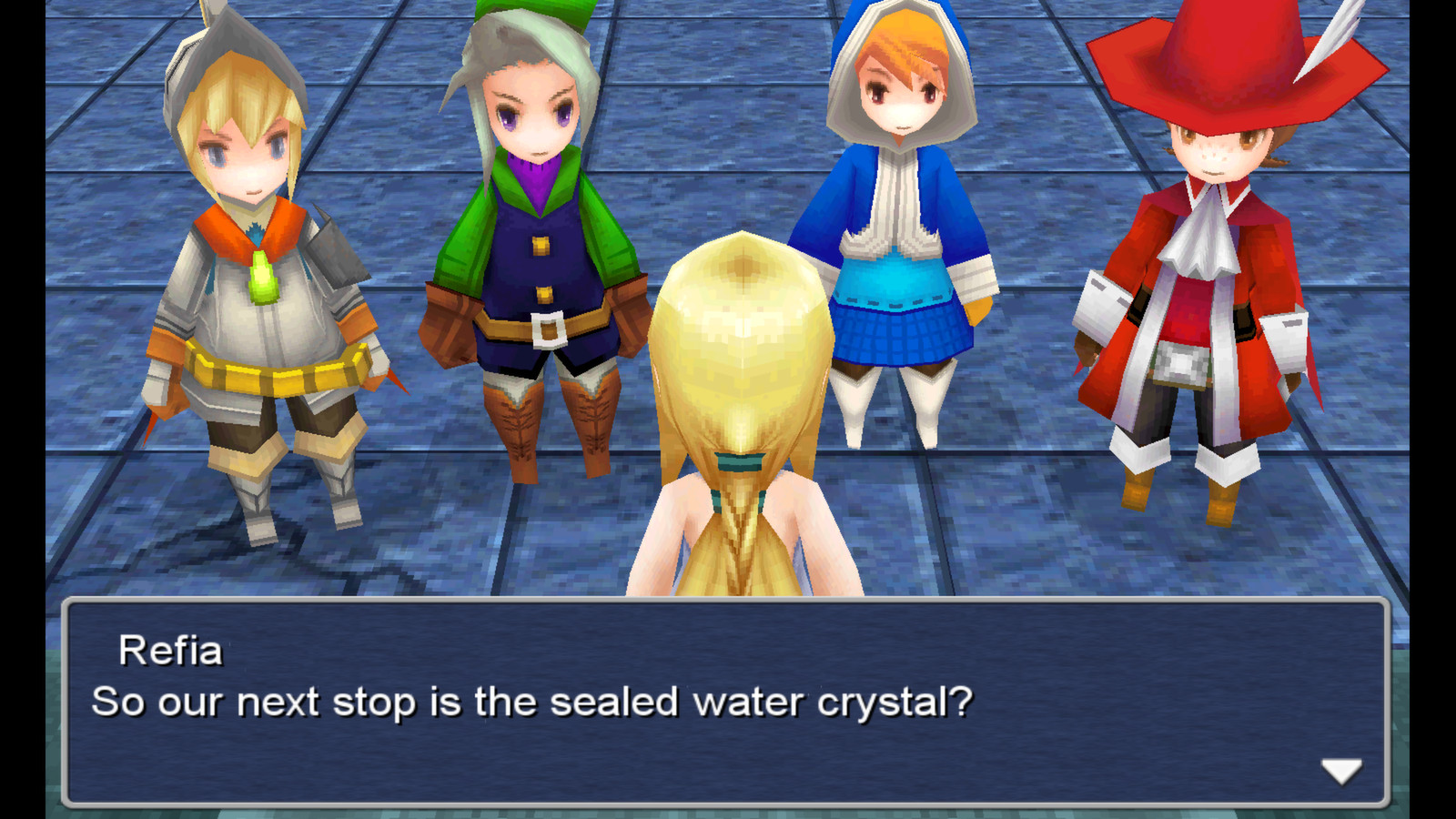
Final Fantasy III's 3D remake was notable for being the first time the game was released on something other than the Famicom - throughout the slew of remakes and enhanced ports the series got on the Playstation and the GBA and even the Wonderswan, Final Fantasy III was conspicuously absent.  Of course, having played the original Famicom release emulated I picked it up as soon as I could, but what I found was a pretty stark departure from that version.  The opening sequence of events is changed slightly, the protagonists are given prefab names and designs (by Akihiko Yoshida, who also designed characters in the Ivalice games) and the gameplay was pretty heavily reworked.  Everything feels considerably slower and battles are scaled down quite a bit, generally having no more than 4 enemies (whereas the Famicom version had double that at times).  The job system is also reworked to be more "balanced", with lackluster results - rather than the specialized jobs of original FF3, most are now more-or-less hybrid classes, adding more spell slots and abilities rather than having you focus on their individual strengths.  Worse is that there's more grinding involved now; class levels were a thing in the original FF3 and did affect stats, but to such a small degree that it was hardly worth the effort of grinding them out.  Here, it's basically mandatory, and you get to do it all again each time you find a crystal and unlock more jobs to use.  Even dopier is the fact that they've significantly nerfed the two endgame classes - Ninja and Sage - giving them low stats to offset their ability to use any equipment or spell respectively.  Onion Knights (the default class in the original) become a hidden class that comes late in the game, and like their original counterparts they are pathetically weak until you get their class to level 92, at which point their stat gains skyrocket; and gain spellcasting abilities too, which they completely lacked in the original.  There is at least an attempt to spice up some of the more lacking elements of the original game by adding in an optional boss and tweaking the final battle to be more involved, but they're only marginal improvements on a rather dragging and overall slow experience.  Final Fantasy III's 3D remake doesn't add a lot of substance and actively subtracts from the original in many other ways.  It may have provided a passable experience to some fans who were eager to check out the long-neglected third entry in the franchise back in the mid 2000s, but with the subsequent release of the Pixel Remaster (which is far more faithful to the original game), there's no reason to come back to this one.


Developer: Matrix Software, Square Enix
Publisher: Square Enix
Platform: Nintendo DS, iOS, Android, PC
Released: 2006, 2012, 2013, 2014

Friday, April 1, 2022

Disgaea 2: Cursed Memories

 The first Disgaea was a slow-starter in the west, but it did well enough over time to get a reprint and eventually a sequel in the Playstation 2's later days.  Naturally, the game underwent a significant visual overhaul, as well as adding in new classes, features like the Dark World and the Land of Carnage (adding even more content for die-hard grinders and fans of puzzle maps), unique abilities for each character and class, and a strange new "Felony" system that would grant characters more experience for committing various "crimes" like attaining a certain level or killing a set number of enemies.  At its core, though, not a great deal is different from the original game - grinding and overcoming the monstrously difficult postgame content is still the main draw of the experience.  It provides a lot of that for stat-grinders, but those looking for a more gripping storyline experience or gameplay less based on sheer numbers may want to check elsewhere.


Developer: Nippon Ichi Software
Publisher: Nippon Ichi Software, Koei
Released: 2006
Platforms: Playstation 2, Playstation Portable, Windows, Mac OS, Linux

Dark Messiah of Might & Magic

 Arkane Studios is a name I associate with ambitious but not entirely successful concepts, and Dark Messiah of Might and Magic is one that actually came out surprisingly well.  Contrary to every prior Might and Magic game, it puts much less emphasis on character building, exploration and role playing and focuses much more on action, utilizing the Source engine's physics capabilities as a central element.  This makes combat a lot more interesting than most action-RPGs, as it's much more than simply hitting them with sword, arrow or magic until they fall down - you can knock down shelves to crush enemies, pick up and throw barrels, set up ice and oil slicks to send them flipping, kick them into spikes or fires (which are conspicuously placed in almost every combat zone), get them in the path of a swinging chandelier to kill them, and even smash up floors and walls as you fight, sending enemies (and possibly yourself) plummeting.  In fact, your character isn't particularly durable, so facing enemies head-on is usually a bad plan - you're much often better served knocking them down and then finishing them while they're helpless, or throwing objects from afar or setting traps instead.  This all sounds awesome on paper, but without some tweaking, you won't get the most out of it.  Your character's constant head-bobbing is extremely distracting and the touchy mouse sensitivity makes aiming attacks surprisingly difficult, and it crashes quite frequently on modern systems without some modification.  Things that look like they would be immediately fatal (knocking an enemy off a ledge and watching them drop over twenty feet) often aren't, while a well-placed hit with a barrel or small crate often are.  Even the cutscenes (both prerendered and in-engine) seem to poke fun at the focus on physics, with characters having wildly exaggerated motions and knocking things over constantly.  It doesn't entirely succeed at what it tries to do (any part that requires precise platforming or climbing up ropes is generally a nightmare to deal with), but the short runtime and surprisingly entertaining twist on generally-dull fantasy RPG combat makes it worth a look.  So if you want something that has the look of Oblivion but action more in line with a Tom and Jerry cartoon, give DMMM a try.


Developer: Arkane Studios
Publisher: Ubisoft
Released: 2006
Platforms: PC, XBox 360

Contact

Grasshopper is a bit of a low-key cult company, known for making bizarre, heavily stylized and often extremely violent games like Killer7, No More Heroes and Killer Is Dead.  Contact was their attempt at an RPG, though more kid-friendly than their norm owing to the younger target audience of the Nintendo DS.  Grasshopper's quirkiness still shines through though, evident right away with the dichotomy of art styles on the two screens - the two main characters (Terry and the Professor) live in two very different worlds, with Terry occupying a more photorealistic environment while the Professor and his ship look more akin to a 16-bit game (and quite a bit like Earthbound).  The gameplay is also notable for working in elements of games that would become popular in subsequent years; the player has direct control over Terry's movement, equipment and skills, but he auto-attacks on his own slightly akin to the Xenoblade games.  There's a cooking system in the game that allows you to not only recover health, but temporarily bolster your stats (a la games like Elder Scrolls and Breath of the Wild), and while you do get the full benefit right away, you can't just scarf down a ton of food and put yourself back to full whenever you're in trouble - you actually have to take varying degrees of time to digest it, which can leave you in a tight spot during a tough boss battle.  Unusally for a Japanese RPG, one can also attack almost any NPC in the game, potentially accruing negative Karma and causing townspeople to attack you a la some old CRPGs (though there is no real benefit to doing so as far as I can tell).  There are also no preset 'experience levels', instead falling back on a system similar to Final Fantasy II or the Elder Scrolls games - your stats gradually improving as you do things that tie to them.  Taking damage boosts your HP, attacking boosts strength and weapon proficiency, running around boosts your agility, being hit by elemental attacks raises your resistance to them, cooking boosts that skill, and so forth.  Once weapon skills reach certain plateaus, you learn new techniques to use, governed by points that gradually recharge as you defeat enemies in battle.  One can also equip outfits and "decals" to bolster certain stats, which adds a bit of depth (especially as you can't reuse the latter once you remove them).  While not an amazingly deep game and you do frequently end up having to stop for a while and grind so you don't get crushed in the next area, the game's quirky sense of humor, unconventional design and the general off-beat mood throughout have earned it a dedicated fanbase.  If you can find a copy, give Contact a try.


Developer: Grasshopper Manufacture
Publisher: Atlus
Released: 2006
Platforms: Nintendo DS

Monday, June 21, 2021

Metal Saga

The first entry (and as of 2021, one of only two) in the Metal Max series to reach western shores, Metal Saga is an open-world, turn-based post apocalyptic RPG with a focus on customizable vehicles; sort of like Mad Max by way of SaGa.  But does Metal Saga's unique take on the wasteland make for a compelling adventure, or is this one Saga you should simply skip over?

Metal Max isn't a particularly well-known name in the west, but in Japan it's another story; it currently has fifteen entries, starting in 1991 on the Famicom and getting a fairly steady stream of sequels, ports, remakes and a subseries or two across numerous platforms, with two more currently in development as of this writing.  It's even outlived the company that created it (Crea-Tech) and continues to get new entries under Cattle Call - a company mostly comprised of former Data East employees (who also co-developed some of the early games).  Atlus, still a relatively niche publisher in 2006, took a chance and brought the series to the west for the first time with its fifth canon entry, Metal Saga.

Metal Saga is not a typical JRPG in most respects, that said.  The game seemingly draws a lot of inspiration from western RPGs, putting heavy focus on its setting rather than a running narrative within it.  The game gives you a massive open world to explore and interact with, uncovering bits of lore and interacting with various characters, but there isn't really an overarching storyline to the proceedings.  Metal Saga doesn't even really have a predefined goal - there are a number of dialog choices or events that can end the game right then and there (including one in the very first dialog sequence), and it's ultimately up to the player to set their own goals and carry them out rather than do what they're told.  Incidentally, nearly all quests you find are fairly standalone, whether it's following a bounty mark to a complex of abandoned buildings or thwarting a train robbery, they're rarely mentioned outside of that context and usually not acknowledged again after you complete them.  The setting is also a fairly unique one for this type of game - rather than taking place after a nuclear apocalypse, Metal Saga takes place on a world where mutants and machines have run amok; hence, while there are a lot of decaying buildings and stretches of desert, there are a lot of relatively pristine green landscapes and a surprising amount of still-functional (and well-maintained) machinery, both man-operated and independent.  There are also very few fantastical elements in Metal Saga - characters' special attacks are mostly in the form of one-use items or, in the case of the protagonist's signature satellite beam move, cost money to activate.

The game has been compared to Fallout in regards to its nonlinear design and a constant off-beat sense of humor, but one thing that definitely sets it apart from that franchise (and most RPGs for that matter) is its focus on vehicles.  You get your first one relatively early on - a humble dune buggy with a low-caliber machine gun - but as the game moves on you can find or purchase more.  Mostly in the form of progressively larger tanks, but with a few oddities like a double-decker bus or a firetruck (which are no less equippable with heavy artillery).  There is quite a bit of depth to the vehicles, too - balancing out the weight of the chassis, the power of the engine, accessories, weapons and ablative armor, as well as computer systems for larger, more complex vehicles that would otherwise require several characters to operate.  All of these parts also take damage individually in battle, which can require you to adapt your strategies carefully until you get back to town and can get them repaired.  You can get a lot of mileage out of any one of your vehicles with upgrades (yes, even the lowly dune buggy), which is where a large percentage of the money you make in the game will ultimately go, especially if you're looking to complete the larger bounty missions.  One can also rent vehicles temporarily for big battles, though they get charged a fee if they come back damaged (which they often will). And of course, a lot of dungeons (particularly buildings) can't accommodate vehicles, so you'll want to have your characters well-equipped for when they have to leave them behind and venture in on foot.

The open-worldness does have some natural drawbacks, though.  It is relatively easy to wander into an area where enemies are far above your current level, which can bring your run to a swift end and erase a good chunk of your progress.  While clever players can also use this to their advantage, going to a high-leveled area early with a pocketful of cash and getting ahold of some powerful vehicles or gear well beyond what they should currently have, most of us (first-timers especially) should probably save before they venture out too far from a familiar area, and be prepared to wait a while to follow up on some quest leads if they're too difficult to handle at the present time.

Metal Saga isn't all just quests, though.  There are a number of things included just for fun or to earn a bit of cash without having to fight monsters.  Collecting medals (a Dragon Quest staple) appears here, letting you earn some extra cash and prizes by trading or selling them.  Purchasing items from vending machines can occasionally give you bonus items if you get lucky, and a number of minigames are playable, like a Space Invaders style arcade game or a beer chugging contest, or more traditional ones like playing blackjack or slots.  A few other innovative features shine through, too - your character's portable computer can allow you to download minigames to it and play them at any time, or even download songs from jukeboxes and play them back later - handy during longer dungeons where the looping background tunes tend to get annoying.

If Metal Saga has a major weakness, it's probably its presentation.  While nothing overly bad, the game is somewhat drab visually compared to other well known RPGs on the platform, with a lot of samey looking brown/gray cities, buildings and caves and not much in the way of flashy combat animations.  A lot of the music is pretty repetitive too, particularly the droning combat songs, though it does get some nice atmospheric tracks on the overworld and cities, and the series' iconic theme returns to accompany bigger battles.  It's a bit like Square's SaGa series in that regard, focusing on content and setting over flair.

In short, Metal Saga is a game that, while it has some JRPG trappings, is much more akin to a western computer RPG in design, giving the player near-total freedom to explore, customize their party and vehicles and choose their own goals to complete as they make their way around the world.  Its overall setting feels like a mashup of Trigun, Terminator and Mad Max, though the heavy moods of its inspirations are greatly offset by its quirky sense of humor.  It's a niche game for sure, but those who are happy exploring a large, dense setting and love to tweak and experiment to the exception of everything else will find a lot to like in Metal Saga.

Developer: Success, Crea-Tech
Publisher: Success, Atlus
Platform: Playstation 2
Released: 2005, 2006
Recommended Version:  N/A

Monday, March 8, 2021

Xenosaga Episode III: Also Sprach Zarathustra

The third entry in the Xenosaga series marks an abrupt end for the franchise, and the last game Monolith created before they joined the Nintendo camp and started producing a very different style of game altogether.  But did the developers manage to come together and create a satisfactory conclusion to the trilogy, or was Xenosaga Episode III just a far cry from where the series started?

Xenosaga's first episode was a well-regarded one among most RPG fans, while its sequel was considerably less so; while it still did well critically, its reworked combat system and a number of bizarre and unnecessary changes caused the series to lose quite a bit of face with fans.  Monolith took several of these criticisms to heart, though, reworking the combat system once again for the third game, reintroducing most of the voice cast from 1 (though Joshua Seth is kept on as chaos and Michael Gough as Jin) and, as the box proudly boasts, shops have returned, so having to grind for items is now significantly less of an issue than it was in 2.  Code for the game has also been optimized quite a bit, resulting in generally shorter loading times for cutscenes and battles.

The art style for the game has been reworked too, striking a balance between the anime style of 1 and the realistic style of 2, which I felt was a welcome change.  Less welcome is the fact that the visual style is much darker overall - I recall very few instances of the sun shining or even many brighter colors anywhere in favor of an overall muted tone.  It matches the heavier mood of the game, admittedly, but it doesn't have the same appeal as its predecessors for the same reason.

Xenosaga III's combat system is the most 'traditional' of the three games, doing away with most of the elements from the first two in favor of one that resembles a traditional turn-based RPG.  Combos are largely done away with in favor of generic attack/magic/item commands, with a heavier focus on buffs and debuffs, using and countering status effects, and exploiting enemies' elemental weaknesses.  One can also spend a turn to swap reserve characters in and out mid-battle a la Final Fantasy X, which can help during longer battles.  Attack animations are also generally shorter, which helps improve the pacing.  A few twists are added to prevent combat from becoming too monotonous, though.  Boost returns once again, letting a character break the normal turn order to get a turn immediately.  Boost charges also fuel certain special attacks; finishing an enemy with one of these will result in a "Finish Strike", causing that character to earn extra experience and skill points.  These special moves will also power up with repeated use, with the exception of chaos's Imperial Judgment (which must be used on Gnosis-type enemies to power up) and Jr.'s Red Dragon (which must be used on either Gnosis or biological enemies).  Each character in a battle, friend and foe alike, also has a Break Gauge that depletes as they take damage; once it's fully depleted, they will be stunned and take extra damage for two turns.  Because of this, managing your party's Break to avoid being left vulnerable and trying to Break your enemies' guard both factor heavily into combat, particularly during boss battles.

A particularly strange element here is the Gnosis, who, as in the rest of the series, cause characters to "whiten" - repeated applications of this in combat will cause them to disintegrate and make them unavailable for the rest of the battle.  Items can reverse the process before it reaches the fatal point, though more often than not, you'll end the battle before then anyway.  It's also a bit jarring to see a character literally disintegrate in battle but be totally fine when you exit back to the menu after the fact.

E.S. combat remains relatively similar to the previous game; each turn you're given a pool of points to spend, which you can allocate however you wish among your mecha's current weapons.  One can also cast Ether to attack, Charge to recover HP, and use items, which can heal the entire party or even revive fallen allies (unlike the previous game).  Anima charges are built up as damage is inflicted, which fuel your most powerful attacks, and you'll occasionally get a "co-op" when attacking, causing one or more of your allies to jump in for a followup strike and a bit of extra damage.  As in the previous game, these fights are pretty spectacular to see, but not particularly deep on a strategic level.

Xenosaga III, like its predecessors, also doesn't skimp on the side content.  There are a number of optional quests to undertake, bosses to fight, weapons and accessories to find, and yes, even some fan service in the form of swimsuit outfits for every character if you want to see them fighting with almost nothing on; they're not quite as useful as in the old games as they no longer give bonus experience points, but they don't have the same drawback of giving you no defense either, so that's a plus.  My personal favorite, though, is the resident minigame HaKox.  A strange arcade title that plays like a cross of Gyromite and Lemmings, having you maneuver various characters from the game safely to a marked goal while pushing them out of the way of hazards with movable blocks mapped to the four face buttons.  You earn bonus points for grouping them together and sending them through all at once too, which is necessary to get the highest scores and prizes on many of the later levels.  Admittedly it is a little bizarre to see all the major characters from the story being pushed around a big grid by colored blocks, but the game is surprisingly addictive and fun - so much so that if it were released as a standalone game, I'd probably still buy it.

All things considered, I'd say that Xenosaga III does an admirable job of being a polished and complete-feeling game in spite of the series' abrupt conclusion.  However, it's not flawless; they were clearly trying to fit everything into the final chapter all at once, which results in quite a lot of confusing scenes coming all at once that take some time to unpack after.  The final area of the game is also probably the most blatant example of this - almost every major character and subplot from the series conveniently gathers here all at once, giving every character a chance to resolve their subplots before the credits roll.  It's all well done considering the circumstances, but it still feels a bit convenient and, well, rushed.  Even with that, though, I think Xenosaga proves to be a solid conclusion to the trilogy, and despite it being extremely unlikely, I'd love to see the series get definitively concluded in some form down the road.


Developer: Monolith Soft
Publisher: Namco Bandai Games
Platform: Playstation 2
Released: 2006
Recommended Version:  N/A

Tuesday, March 17, 2020

Wild Arms 4

Wild Arms 4 represented a major shift away from almost every norm of the franchise, and as a result is widely regarded as the black sheep of the series.  But is there still a good game to be found if you put the franchise's legacy aside and judge it on its own merits, or should it just be remembered as the beginning of the series' decline?


A franchise changing up its familiar format is always a risky move to take - the risk of alienating one's existing fans, paired with no guarantee the change will bring about new ones, has been a killing blow to more than a few beloved series.  But staying constant carries similar risks, with more than a few franchises being abandoned in favor of the new hot property on the market once the next big thing rolls in, so taking risks becomes a part of the territory even if it may ultimately doom a series.

Wild Arms 4 was Media.Vision's attempt to update Wild Arms for a new generation, and they really went all-in with the change, creating something that plays very unlike any prior game in the series.  In fact, it actually feels a bit like a puzzle-platformer rather than a straight RPG, at least outside of combat.  Movement is in three dimensions in some areas and two in others (helpfully pointed out to you with text reading "side view" in the corner of the screen).  You control only one character outside of battle (Jude), and he has some rather Mario 64-esque movement mechanics, utilizing a double-jump, slide and a stomp to get past obstacles.  Thankfully, despite the dynamic camera and perspective, the game does make navigation rather simple - a red arrow indicates the area you've just exited from, while blue arrows indicate areas you've already been and yellow ones point out areas you haven't visited yet, so it's easy too find your way around the dungeons.

Tools, formerly a mechanic that defined and distinguished the party, are no longer such. They are also not a permanent part of your repertoire - you find and use them in the same dungeon (and often in the same room), making that element feel more akin to something like Adventures of Lolo than Zelda.  There are at least quite a bit of variety to them - swords can break some objects, sword hilts can be thrown to activate switches, shields can block damage from fire and laser traps, and so forth, so while it doesn't work on the same principle as the previous Wild Arms games, it does at least keep the puzzle-oriented design to its dungeons.

Combat is another stark departure from the Wild Arms norm.  The game still utilizes a turn-based format, but battles are now based in large part around the "Hex Grid".  Players and enemies alike all move between seven spaces on the field, and attacks, items and spells target the hexes themselves - not the specific characters within them.  Moreover, multiple characters can be within a hex at the same time, though enemies and player characters cannot share a hex.  This effectively means that attacking a hex with two or more characters within it will do damage to all of them (barring a miss), and that most items and status effects are cast on the hex itself - not the characters.  Essentially, if one casts a Poison spell on a hex, the characters within it will take damage at the start of each turn, but they can also move out of that hex to get away from the effect.  Inversely, if a player uses a healing item, it will heal everyone in the hex, so grouping up the party momentarily would be beneficial in that case.  Controlling the field quickly becomes key to victory, especially as the game goes on and enemies become more aggressive, pushing your party into a single hex so they can attack them all at the same time. Hexes can also somewhat randomly be assigned as "ley points", granting bonus damage if the player uses a skill or spell that matches their element.  Inversely, casting from or into a ley point of the opposite element will reduce the effect.  Strangely, the game is also very forthcoming with enemy stats - you can view any enemy's stats at any time during a fight, even bosses.

Wild Arms 4 still utilizes random encounters, and unlike 2 or 3, there isn't a readily-available way to avoid them.  However, once a particular dungeon's boss is defeated, the player is often afforded the ability to disable them completely for that dungeon, letting them explore and find any treasures they may have missed on the way in.  Not quite as convenient to the player, but practical in its own way.

The game also retains the franchise's high standards for presentation, with some quality graphics and sound design in almost every area of the game.  It's definitely a departure in style and tone from the "old west" aesthetic of the earlier games, going for more of a futuristic science fiction bent, but nothing about it is inherently bad; just different.  Town music in particular has a very ambient, laid-back tone to it; I found myself thinking of games like Simcity as I listened.  The game's story scenes are significantly upgraded, giving the game a much more anime-like presentation - lots of cutscenes with choreographed animation, dynamic camerawork and professional voice-acting (which was still a relatively new thing for games of the time).  Even the introductory cinematic (seen when you load a save) has its lyrics dubbed into English, which was fairly unusual for a video game of the era.

Fitting with that, though, the game's story does fall into a lot of particularly cheesy anime tropes.  The characters are all rather stock and archetypal, and the dialog has a pervasive tone of "adults are all too cynical to save the world, the kids are the real heroes" that gets a bit grating.  The designs are more than a bit silly at times too, with multiple belts and chains and oversized accessories.  Still, I found myself getting wrapped up in the story, and it does at least retain a sense of humor about itself at times, so its more annoying elements are only a minor issue.

Wild Arms 4 is definitely the odd duck of the series, and it isn't hard to see why - it changed up its aesthetic and almost every familiar element of its gameplay in some rather strange ways, largely exhuming a "classic RPG" feel in favor of something more akin to an action game with an anime aesthetic.  However, I found it to be a competent and entertaining title in its own right; maybe not as fresh and captivating as its primary competitors of the time (Final Fantasy XII and Persona 3), but one that's certainly worth a look if you're a fan of the franchise.  It's not without its faults for sure - an uneven difficulty level and some irritating writing tropes hamper it a bit - but it's an interesting and mostly successful reinvention of the franchise.


Developer: Media.Vision
Publisher: SCEI, XSeed Games, 505 Game Street
Platform: Playstation 2
Released: 2006
Recommended Version: N/A

Tuesday, March 12, 2019

Suikoden V

After a few entries that attempted to rework the gameplay and storytelling format with decidedly mixed results, Suikoden V was a return to form for the franchise, going back to a linear narrative and a more traditional style of gameplay overall.  But does Suikoden V bring back fans that were driven away by the series' new turn, or does it just go too far in this direction and feel like a retread?


Suikoden's leap to the Playstation 2 was a mixed bag; for newcomers to the series, the third game provided a relatively fresh RPG experience with its multiple-path narrative and engrossing storyline, though long-time series fans were somewhat let down by its flagging pace and changed-up gameplay mechanics.  Suikoden IV, created after long-time series director Yoshitaka Murayama left Konami, proved to be an overall mediocre entry with a generic story and little connection to the rest of the series (being a prequel set 150 years prior to the first game).  Suikoden Tactics, while a competent spinoff, proved to be short and, again, a mixup in gameplay that more traditional RPG fans didn't care much for.

So, as franchises often do when they begin to drop in sales, Suikoden V attempted to take things back to basics with a design philosphy more in line with the first two games - traditional turn-based RPG combat, a crisper pace and a more focused storyline.  It does admirably well on the final point, showing a queendom divided between two rival factions and strife among its populace as their queen slowly slips into madness.

But while the game does go back to the style of the originals in many ways, some elements of the later games are retained as well.  The player now has the choice of several formations in basic battles, allowing them to arrange their party in various ways to gain stat bonuses and put fewer characters in harms way.  For example, the Cross formation puts only one character on point, making them the target for most enemy attacks, but grants everyone in the party a bonus to their attack.  Double Arm puts two characters on point, gives all characters in the party a small defensive boost, and enables the use of the Guardian ability, which boosts the party's defense further for a single turn.  The player starts with just one basic formation that grants no bonuses, but more are found throughout the game, both in chests and as rewards for meeting certain requirements during war battles or particular quests.

The "Convoy" position of early games (here called "Entourage"), formerly just a place to put story-relevant characters until they could serve their plot purpose, now plays a more significant role in Suikoden V.  One can have not just their basic party of six in combat, but up to four more can be part of the Entourage, with the player able to swap them with active characters mid-battle to give their party more longevity in boss battles, or versatility in dangerous areas.  This also affords ways for non-combat characters to prove useful, as several will grant bonus effects when placed in the Entourage.  Egbert, for example, will cause the party to gain more gold from combat, while Marina will allow them to restore a small amount of HP each turn.  Not all necessarily pertain directly to battle, either; for example, Shinro's ability replaces the "Drop" command in the item menu with "Trade In", allowing the player to earn money for items they drop as if they'd sold them at shops.  In various ways, all of these things make life easier for the player, allowing to earn cash and battle enemies more efficiently.

Skills are another returning element from the newer games, this time from Suikoden III.  As in that game, one can spend points earned through battle to bolster specific stats or, in the case of certain characters, unique abilities like Long Throw (giving ranged attacks a chance to hit an entire row, rather than a single target).  One also has a pool of "Party Points" that are stored separately and can be spent on any character, even those that haven't had an opportunity to see much battle yet, which can help to get weaker characters caught up (particularly later in the game).  Throughout the game, one can also find "Epic Skills" that effectively serve as all-in-one skills, bolstering multiple stats at once instead of one at a time

As in prior Suikodens, the game has three different combat systems for one-on-one duels, small-scale battles and large-scale battles.  While duels and small-scale battles remain relatively similar to the first two Suikodens (save for a few aforementioned differences), duels do have a couple of small changes.  First is that there is a time limit per turn; if no action is input within 3 seconds, the player will take a random action, which can prove hazardous to them.  The other prominent change is that if both players choose to Attack or Special attack, their attacks will clash; the player can then mash the button at this point to overpower the opponent and damage them without being harmed themselves.  Regardless, the overall strategy remains much the same - try to predict what the opponent will do based on their words, then counter it accordingly.

War battles are relatively similar to Suikoden II's, with a defined rock-paper-scissors weakness/strength hierarchy for units, though battles now work something like the Active Time Battle system in Final Fantasy, being in real-time save for when the player brings up the menu to take an action (at which point time pauses to let them make their decision).  Sea battles from IV return as well, though in a simplified format - similar to ground battles, there is a defined rock-paper-scissors heirarchy, with a few special units mixed in and individual characters' special abilities lending them unique tactics (such as healing some of their injured soldiers or damaging foes over an area of effect).

Suikoden V is a well-made game on the whole, but a few elements may be off-putting to some.  Probably the most prominent of these is the game's overall pacing, with a relatively slow start to the storyline proper (taking ~10 hours before you have a proper war battle and even longer before you get your castle), frequent load times and a rather irritating encounter rate.  Second, while the game overall has quite good production values (with nearly every character having a unique voice actor and well-animated cutscenes), the game does have a fairly drab color palette overall, with a lot of rather bland gray and brown towns and dungeons.  Even the more colorful cities, plains and forests have a relatively washed out palette, making the world feel bleaker than was probably intended.  Towns and dungeons can also at times be excessively large and confusing to navigate, which led me to some frustration as I played.

In spite of a few shortcomings, though, Suikoden V proves to be another worthwhile entry in the series, returning its design to form for fans of the original PS1 games while working in elements of the later titles to give it broader appeal.  Its engrossing story, a large yet distinct and fun cast of characters and a surprising amount of variety lend it much appeal, as does having multiple endings and plenty of hidden secrets for diligent RPG players to enjoy.  It really is a pity that this was the last proper Suikoden game and, aside from a mediocre spinoff game on the DS, the franchise hasn't really been heard from since.


Developer: Konami, Hudson Soft
Publisher: Konami
Platform: Playstation 2
Released: 2006
Recommended version: N/A

Monday, February 25, 2019

Kingdom Hearts II

Released three years after the first game in the late era of the Playstation 2, Kingdom Hearts II was a long-awaited sequel to a cult favorite.  But did it prove to be a worthy continuation of the franchise, or was this just a misstep?


The original Kingdom Hearts is viewed by some as the last gasp of quality from the old Square before the buyout and restructuring as Square Enix; it effectively combined a Final Fantasy format with the fluid animation and creativity of Disney, and despite some clumsy movement and downright cheap boss battles, it was a fun and enjoyable game.  Naturally, it was also a big hit with two huge names behind it, so the sequels were inevitable; first a Game Boy Advance card-based spinoff (Chain of Memories) and then, a few years later, Kingdom Hearts II.

A few prominent changes crop up right out of the gate.  First is that the game now puts much more emphasis on combat than anything else, with large groups of enemies and boss battles being a near-constant element of the game.  Conversely, the level design has become much more streamlined and utilitarian - rarely more than a linear corridor to carry the player to their next destination, with very few puzzles or paths that won't be opened on the first visit (save for a small handful of worlds).  The Trinity element of the original (allowing the player to access new areas and treasures as the game progresses and they unlock more Trinity colors) is completely gone too.

Adding to this, nearly every scripted in battle in the game is now given some sort of gimmick - from defeating all enemies in a given time limit to defending an NPC to being able to commandeer certain enemy weapons for huge attacks that can quickly wipe out waves of smaller foes.  In addition, almost every foe now has a counterattack associated with them, which can be activated with a well-timed press of the Triangle button.  For some, this is simply an evasive maneuver (such as dodging behind the basic Nobody enemies), while for others it launches into something more akin to a full-blown Limit Break animation that lasts several seconds, doing heavy damage or stunning the enemy.  In addition, the player now gets new upgrades each time they win a fight, which can be anything from minor stat boosts to new skills to even spells; there is seemingly little rhyme or reason to when these occur, as even encounters with basic enemies can sometimes give upgrades that let the player radically change up their strategies.

Sadly, while this does at first give the impression that Kingdom Hearts II steps away from the somewhat clumsy combat of the original and branches into something more like a character action game, this is not really the case.  Sora's movement is still rather slow, with his attacks being sluggish, heavy swings and jumping being floaty and awkwardly delayed.  Moreover, any hit from an enemy puts the player into stun, and almost anything that makes contact in midair sends the player flying a significant distance back before they have any chance to recover.  This can be downright frustrating in many battles, especially as nearly all of the big bosses (and even a number of normal enemies) have lengthy, elaborate and fast-moving combination attacks that often make them invulnerable for the duration and can be quite difficult to avoid with your limited movement.

Not to say that you're completely constrained by the first game's mechanics, as there are several new elements in place to let the player even the odds.  First, the summons from the original game return, albeit now slightly more akin to Final Fantasy XII's summon system, replacing one or two of one's party members for a new one temporarily.  Each teammate now has a unique Limit Break too, consuming all of Sora's HP to perform a large attack that will usually destroy minor enemies outright and deal heavy damage to bosses.  Finally, early on in the game, Sora is granted the Drive ability, which runs off a unique gauge and lets him transform to one of several new forms that boost his stats, change his skill loadout and generally make him a much more dangerous force for a short period.  To name two of these forms: Valor form lets Sora temporarily dual-wield keyblades and grants him much swifter movement and attacks, while Wisdom gives him a ranged attack and free-gliding movement.  Several more are unlocked as the game progresses, as well as a secret form that greatly boosts his stats and agility but temporarily renders him unable to heal.  However, these are generally best saved for tough boss fights, as the Drive meter does take quite a while to replenish (by collecting orbs dropped from enemies) so it can't be abused too much.  Limit Breaks are similarly restrained; though the player can restore MP on their own with Ethers and it now regenerates on its own after a short while when completely emptied, relying on them too much can put the player at a disadvantage at a bad time.

Beyond the uneven and frustrating combat, though, the game still holds a lot of appeal for both Square Enix and Disney fans.  More familiar Final Fantasy faces show up, including characters like Tifa from VII and the protagonists of X-2 (as fairies) and even a cameo from Setzer of Final Fantasy 6 fame.  New Disney worlds show up too, with some more recent properties like Pirates of the Caribbean showing up as well as some relatively obscure ones like Tron.  A personal favorite is Timeless River, based on old Disney cartoons from the 1930s; Sora, Goofy and Donald's designs change to match and the audio even becomes somewhat muffled to mimic old sound equipment, fully immersing the player in the world's atmosphere.  Seeing all of these different characters in one big universe, interacting with each other, is definitely a treat if you're a fan of both franchises.

As in the first game, Kingdom Hearts II is replete with minigames too; these not only provide a nice diversion from the near-constant combat, but completing them often earns the player worthwhile rewards to power up their party for future challenges (and on lower difficulties, completing them all is required to get the best ending).  Gummi ship missions return too, though the overhaul they've been given is nothing short of jaw-dropping.  The original game's were rather slow paced and didn't provide much challenge (save for the optional missions in the HD remakes), but 2's Gummi Ship missions are good enough to be a game in their own right, providing a style of fast-paced, fluidly-animated action more than a bit reminiscent of Star Fox 64.  Each stage is replete with hidden enemies and secrets that unlock upgrades, and after they're completed once, missions are enabled that let the player try to collect as many orbs as possible or simply defeat enemies and avoid damage to pursue high scores, with rank plateaus granting new ship parts and other extras.  It's honestly extremely fun and was by far my favorite part of the whole experience; if they released the Gummi Ship element of 2 as its own standalone game, I'd probably buy it.  Hell, as a big fan of Star Fox 64, it's a little disheartening that one of the most worthy successors I've seen to that style of gameplay doesn't even bear the title.

Kingdom Hearts II of an odd case, downgrading its RPG elements in favor of a more action-driven feel, but without actually making too much of an effort to tweak the core gameplay to fit to that style; instead, they simply pasted a huge library of new abilities on top of the clumsy mechanics of the original to try and compensate, and while it does work to a degree, your rather limited movement and the overall high reliance on limit breaks and spammy counter-attacks (all triggered by pressing/mashing the Triangle key at the right moments) can get to be extremely frustrating, particularly in the later boss battles where a missed cue or imprecise movement can result in heavy damage or even immediate death.  Basically, it's an overengineered mess that aims for sheer volume rather than taking a few core mechanics, polishing them to a fine sheen and letting those provide the foundation for a strong experience.  But in spite of some rather ill-planned implementation of mechanics and having animation spam on a level comparable to Final Fantasy VIII, Kingdom Hearts II is loaded a lot of service for fans of both franchises it combines and plenty of content for die-hard RPG fans.  It's far from perfect, but if you're a fan of the series, you're going to play it at some point.


Developer: Square Enix
Publisher: Square Enix
Platform: Playstation 2, Playstation 3, Playstation 4
Released: 2006, 2014, 2017
Recommended version: The HD ports of the game (Released on the II.5 Final Mix compilations) feature remixed audio, smoother 60 FPS animation, and a substantial amount of new content in the form of minigames, optional bosses and extra story scenes.

Tuesday, September 25, 2018

Grandia III

Released five years after Grandia II on the Playstation 2, Grandia III moved the series to a more realistic visual style for the first time and heavily revamped its combat system.  But does it prove to be a worthwhile adventure, or was this one lost in the generation shift for good reason?


Grandia was a series ahead of its time in a lot of ways, doing away with long-standing design tropes like random encounters and making time and turn order alteration a central focus of its game mechanics, ensuring that stopping an enemy's attack before it even started was just as viable a tactic as weakening its effects with buffer spells.  It was even among the earliest examples of the genre to have voice acting of decent quality, and its unique reversal of era norms - 3D environments with 2D sprites - lent its dungeons a dynamic feel that many others of the era lacked.  Unlike other RPGs of its time, it was also not apt to overusing noninteractive FMVs to push its story, instead letting the player brave many of the hazards themselves and only using them to highlight key moments in the story where the engine simply wasn't up to the task.  Essentially, it was a JRPG that felt a bit like an action movie in many respects, which helped to add to its adventurous atmosphere and charm.

Grandia III continues in that line, taking advantage of the Playstation 2's capabilities to make Grandia III a memorable experience in more ways than one.  The visual style of the series has been given a major overhaul with a more realistic style to its environments and characters.  Cutscenes have been similarly upgraded, with the minimal animation of earlier Grandias giving way to something more on par with a CGI movie- characters interact with one another realistically and even the lip syncing is surprisingly well done.  The voice talent is once again top-notch, with well-known talent like Johnny Yong Bosch, Michelle Ruff and Stephanie Sheh contributing voicework to the game.  Basically, Grandia III is a much more cinematic game than its predecessors, which was no small leap considering its lower-budget origins.

The gameplay is retooled in more ways than one to be faster-paced as well, with the coins system from Grandia II being scrapped in favor of having skills level up when used.  The more often they are used, the higher the chance they have to gain an upgrade - either a faster casting time, extra damage or a quicker recovery after use.  Mana eggs similarly no longer need to be leveled to unlock all the spells within them, but are a much more common element in the game, seeing drops from enemies as well as being purchasable in shops.  Many of the game's best Mana Eggs can only be acquired through a new fusion system, essentially combining two weaker mana eggs together into a more powerful one that has a new set of spells to use.  Tracking down the components for a particular egg can be a journey in itself, though, which lends the game quite a bit of longevity for those searching for 100% completion.

Further adding to that is Grandia III's prominent minigame, Arrange Dice.  Essentially, the game requires the player to roll dice five times, with the number they roll matching a set of five cards on the table; rolling three or more in a row results in a payout.  The odds of a payout are inordinately high with the default card set; Game Arts was seemingly aware of this, as they made many of the best prizes available cost absolutely huge amounts of tokens to buy.  The top prize - a powerful Mana Egg - costs 999,999 medals; with a maximum bet of 1000, that takes quite a long time to get, even if you are consistently getting high payouts.

The game does show some evidence of being rushed, with the storyline largely being pushed into the background by the midpoint of the game and relatively few plot and dialog scenes after the first third or so.  This is further compounded by uneven difficulty, with several instances of enemies taking a major upward leap in power that all but requires the player to stop for a while and grind to get caught up.  However, I didn't mind that very much in Grandia III's case, and this largely comes down to the fact that it features probably the single most fun, addictive and challenging combat system I've seen in any RPG to date.  As with many other elements of the game, Grandia III's distinctive combat - encouraging the player to delay or cancel enemy turns with well-placed attacks - has gotten a drastic overhaul, being better tuned to the overall fast pace of the game and just providing for a very crisp, challenging and enthralling experience in every battle.  Another new mechanic is introduced as well - cancelling an enemy's attack at the last moment will launch them into the air, at which point another character can attack them, juggling them further into the sky with a special animation and racking up a significant amount of damage as they do so.  Some skills will only further add to the damage dealt, such as Yuki's Flash doubling the amount of hits he lands during the attack, and Ulf's midair attack will send the enemy crashing back to the ground at the end for enormous damage.  Basically, one well-placed air juggle can turn the tide of battle, taking a dangerous enemy out of the fight with one extremely damaging combo, or just racking up a ton of damage while being relatively efficient with MP and SP costs.  Not to mention that it's just plain fun to watch and the game even keeps track of your height record, subtly encouraging you to launch enemies higher and higher as your characters' stats and abilities grow.

Grandia III is a bit of a mixed bag with its high production values, but also heavy evidence of being rushed; the plot largely disappears after the first half of the game, and several instances of large difficulty leaps only leave the player wondering if there were supposed to be other dungeons or events in the interim that got dropped for time constraints.  But even in spite of these problems, the game is such an addictive one that its shortcomings were quickly forgotten, with a masterfully-crafted and addictive combat system and a surprising amount of depth in its mechanics that prevents it from ever becoming dull.  A bit sad to think that this may well be Game Arts' last original contribution to the genre, as other than a third Lunar 1 remake and a forgettable licensed Ragnarok Online tie-in, they haven't made another RPG since.


Developer: Game Arts
Publisher: Square Enix
Platform: Playstation 2, Playstation 3
Released: 2006, 2016
Recommended Version: The Playstation 3 version is a direct port of the Playstation 2 game.

Wednesday, August 15, 2018

Mother 3

After many years of teaser trailers, heavily poured-over magazine previews, platform changes and at least one cancellation and revival, Mother 3 finally debuted on the Game Boy Advance in 2006, over a decade after it was first announced.  But was the conclusion to the Mother trilogy worth the long wait, or was it just a long buildup to letdown?


Earthbound, though not a popular game in its heyday, did amass a considerable cult following over the years, which was in no small part due to the popularity of its sequel among the fan translation community.  But for those who got into the series in the nineties, the wait for the game was an ordeal in itself.  First announced as a Nintendo 64 title and slated for release in 1998, it was later moved to the Nintendo 64 Disk Drive, moved back when that addon proved to be an enormous commercial flop, then finally cancelled entirely in 2001 when the Gamecube was released and the developers still had not overcome significant technical hurdles in development.  However, the project was revived a few years later on the Game Boy Advance (though this platform shift naturally required programming work to essentially be restarted from scratch) and eventually finally released in 2006, with a fan translation following two years later in 2008.

That long and patchy development cycle certainly is evident in the final product as well.  Many elements teased in early previews, such as a minecart sequence, most of the character designs and an "ice cream cone shaped tank", and the overall setting (seemingly mostly in a desert-like setting in early versions) are nowhere to be found in the final game or relegated to much smaller roles.  Even the game itself has many leftover elements from its numerous rewrites and retoolings, with numerous changed dialogue scripts and unused gameplay elements remaining buried in the code (including, most famously, a completely different and much more nightmarish final battle sequence).  Strangely it still feels a bit rushed in places despite the protracted development time, with the ending in particular being noted for having its events described almost entirely in text with no onscreen graphics at all.

Perhaps because of this, the game itself is also much more linear than earlier entries in the series.  Indeed, with few exceptions, every chapter of the game takes place in an entirely new area from the previous ones, with almost no opportunities to retrace one's steps or just revisit previous areas and see new dialog therein.  This does work in some ways, affording the player very few opportunities to become lost, but it can lend itself to frustration at times - missed items cannot be gone back for, and if one hits a particularly tough boss they can't overcome due to inadequate equipment, they may be stuck with little recourse but to level grind for a substantial amount of time.  The game is much more difficult than its precursors, too - some bosses are utterly ruthless and will take quite a lot in the way of resources, strategy and, at times, just plain luck to bring down.

However, quite a few familiar elements do return from both earlier games and early previews.  One prominent element of Mother 3's early development returns in a new combat mechanic, allowing the player to earn extra damage on normal attacks by timing button presses to the rhythm of the enemy's "heartbeat" (which is revealed to the player when the enemy is put to sleep via a Psi effect).  Up to fifteen extra hits can be tallied through this; while each hit after the first does diminishing damage, it can make a very substantial difference in the long run once the player gets good at timing it.  Another slight changeup comes in the rolling HP meter from Earthbound - while largely retained from that game (and still an essential part of surviving some fights), the player now has the ability to greatly slow the counter down by utilizing the Defend command; not only does this give that command some practical use, but it makes the rolling HP mechanic a useful tactical option even at lower levels.  The ability to instantly defeat much weaker enemies returns as well, though in a somewhat different form - the player can now dash via the B button as they attempt to avoid enemy sprites that will trigger an encounter, but if they make contact with a weak enemy while doing this, they'll bowl right through them and immediately get credit for a win.

The overall aesthetic of the game remains similar to its predecessors, with colorful, quirky environments and characters and an overall style reminiscent of western comic strips.  Combat still features relatively minimal animation, with the mesmerizing combat backgrounds and PSI effects returning from Earthbound and only static sprites for the enemies themselves; however, some scaling effects come into play when the player defeats an enemy, causing their sprite to fly off into the distance and vanish, which is a nice touch.  Things outside of battle show a surprisingly large amount of new detail as well - nearly every NPC in the game has a complement of full sprites for their various actions, and even the party members themselves now have animated sprites for dialog scenes and interact with the environment in clever new ways like swinging on a "rope snake" or riding across the landscape on a table.

Of course, no mention of Mother 3 can go without mentioning its tone.  While the game does retain the quirky humor and many of the modern elements of its predecessors, Mother 3 also takes things in a much darker direction.  Elements of abuse, cruelty and grief are prevalent throughout the story as the characters meet with tragedy and become surrounded by the evil invading the game's world.  This is perhaps no more evident than in the enemies the player faces - many of them are bizarre fusions of animals and machines or other animals, seemingly made by the villains just for some sadistic fun rather than any practical purpose.  As earlier entries in the series did, Mother 3 pulls no punches when it comes to emotional impact, pleasant and unsettling alike.

Despite some rough edges and a few balance and pacing issues,  Mother 3 becomes another memorable entry in the franchise and a grand sendoff for its story arc that was almost two decades in the making.  Even with much evidence of its long and bumpy road to completion staying prominent in the final game, it proves to be another worthwhile adventure that takes the player on an emotional journey and gets them invested on the sheer strength of its atmosphere, writing and the sincere charm within.  Sadly it's also a game Nintendo has been reluctant to localize in any form, but those savvy to importing or emulation can find a game very much worthy of concluding the tale of one of gaming's greatest hidden treasures.


Developer: Brownie Brown, HAL Laboratory
Publisher: Nintendo
Platform: Game Boy Advance, Wii U Virtual Console
Released: 2006, 2015
Recommended Version: The Wii U Virtual Console release is a direct emulation of the GBA game, and, like its predecessor, was only released in Japan.

Thursday, December 28, 2017

Final Fantasy XII

The twelfth numbered entry in the Final Fantasy franchise puts Yasumi Matsuno at the helm, delivering another game set in the fantasy world of Ivalice (formerly seen in the likes of Final Fantasy Tactics and Vagrant Story).  But do his complex characters, unique gameplay elements and elaborate storyline make this a Final Fantasy to remember, or is too much lost from the classics to make this an adventure worth having?
 

Final Fantasy XII represents a significant departure in style from the earlier Final Fantasy games, feeling more than a bit like an Elder Scrolls title in some ways.  While much emphasis is still put on the game's dungeons and the treasures within them, just as much benefit can be found by exploring the more mundane locales in the game - back-alley shops can occasionally yield rare and useful items, and taking on side-quests like monster hunts or fetch quests can give surprisingly good rewards as well.  A puzzle element frequently comes into play on hunts, with the player having to seek out specific locations and take specific actions to find his mark, which they often won't know unless they converse with various NPCs.  Rather than featuring turn-based combat or even having the Active Time Battle system of many of the more entries in the series, Final Fantasy XII instead took place almost entirely in real-time, with the player freely wandering about the map and seamlessly transitioning into combat whenever enemies drew near.

Compounding this, while the player still has the ability to control individual party members' actions via menus (with the option to either have the gameplay continue or to pause while making choices), combat also has a much more automated element to it.  This comes in the form of the Gambit system, which essentially allows the player to specify a list of conditions and actions to take when they are met for each of their characters.  For example, if an ally's HP drops below 50%, they can then have a character automatically cast Cure to restore their health.  Similarly, one can have characters automatically recast buffers (such as Haste or Shell) when their effects expire, automatically take aim at enemies with specific elemental weaknesses, or concentrate attacks on enemies with the lowest HP in order to get them off the battlefield.  While some have criticized this element of the game for taking much of the active player involvement out of the experience, I think it actually works quite well, allowing the player to breeze through mundane fights while simultaneously forcing them to keep an eye on their progress and change up their strategies when new threats arise; one probably doesn't want to be casting Fire spells on Bomb enemies, for example, and will want to concentrate their attacks on them one at a time to prevent the party from being taken out in a series of explosions.  Thus, the player's role is now less about picking each individual action and instead acting as more of a strategist, having to know when to use their pre-programmed gambits, change them up for a new situation, or take manual control of the party.

Another controversial change to the game comes in the form of the License Board.  Somewhat similar in premise to Final Fantasy X's Sphere Grid, the player earns License Points for taking part in battles, which can then be spent to unlock spaces on the Board in order to unlock new abilities.  These govern almost every aspect of a character - what equipment they can use, what skills and spells they can utilize, and even give bonuses like extra attack damage, faster turns or extra HP.  Unfortunately, some familiar Final Fantasy archetypes like the Blue Mage or the Dragoon make no appearance in the game, though a few of their trademark skills appear on the sphere grid such as 1000 Needles and Telekinesis (allowing melee weapons to reach flying enemies).

An unfortunate limitation of this system is that it lends little to individuality among the cast - all six characters utilize the same sphere grid, and while there is some merit to mixing up weapon types (melee weapons having the ability to combo multiple hits together while ranged attacks hit flying foes), the party's abilities tend to look very similar after a while on the whole.  There is little benefit in some skills by the time they become available (such as the aforementioned 1000 Needles, which tends to come well after one's normal attacks are doing well above that amount), and some of the stranger weapon types like Measures (weak weapons that inflict positive status effects) and Hand-Bombs (elemental mage-style weapons) are little more than novelties of questionable value.  Indeed, I mostly just found myself giving all of my characters White and Green magics so that I could keep my party healed whilst having them use physical attacks for much of the game, only using the occasional Quickening to deal with tougher enemies.

Quickenings serve as the game's "Limit Breaks", and thankfully are not nearly as abusable as in some previous entries of the series.  Rather than operating off of a gauge or just randomly being awarded to the player, they now operate off of Magic Points, taking a third of the bar for each level of the attack (up to 3).  Each of the three active characters can also chain multiple Quickenings together for extra damage and even be randomly awarded "Mist Charges" to lengthen a chain for even more damage, though there is a substantial random element to this - sometimes you'll get a combo of 10+ Quickenings and a Finisher that can deplete a huge chunk of a bosses' HP, sometimes you'll only get three or four and do significantly less damage.  In either case, the player is left at a disadvantage afterward (with one or more characters at 0 MP), ensuring that Quickenings are best used either as a last resort or as a costly bailout measure, forcing them to use valuable Ethers or Elixirs to not leave themselves vulnerable after the fact.  They also become substantially less useful as the game's difficulty ramps up for this reason, as even a large chain of Quickenings can do relatively little to a more powerful boss by the end of the game.

Summons work on a similar principle, taking the player's MP gauge in thirds to call them to the field.  Whilst they are active, the other two characters (ie not the Summoner) are temporarily replaced by the summoned creature, who fights in their place until either being dismissed or losing all of their HP.  However, while their level matches the summoner's, their abilities and "equipment" does not scale up with them, making them significantly more limited in application and usefulness than a normal character.  However, they are immune to most status effects, which makes them useful against some particularly annoying foes (like Malboros).

In short, Final Fantasy XII's gameplay, like most games in the series, is uneven and awkwardly balanced, with some skills proving incredibly useful and others situational or even outright useless.  Similarly, many fights are easy but some are incredibly difficult, requiring the player to utilize unconventional tactics, sometimes bordering on "cheating", to win.  The License Board assists in this as well, with the overwhelming majority of enemies giving the player 1 LP per kill, which in a way encourages the player to revisit lower-leveled areas and stomp weaker enemies in order to build it up and unlock new skills in order to power through a particularly tough boss, which feels just a bit unfair.

But while this is the norm for the series, the storytelling element is at least not.  Yasumi Matsuno's talents shine through once again in Final Fantasy XII, delivering a  dense and complex narrative set in an equally vast game world.  Each locale the player visits feels dynamic and alive - NPCs chatter about current events and wander the town on their own business, conversing with them reveals much in the way of lore and backstory leading up to the game's events, and each and every enemy the player encounters has a lexicon entry detailing their history and traits.  Main characters, antagonists and tertiary ones alike show much in the way of development, questioning their loyalties and what led them to their current plights.  There is even surprising eye for detail in the voiceover, with characters from different regions bearing varying accents.  As per Matsuno's standards, the game feels less like a fairy tale story and much more like a grandiose fantasy epic, telling the story of events past and the complex relationships between all of its major characters, and it's that factor that kept me motivated to play to the end even as the gameplay got less and less balanced.  From a personal standpoint, it was also interesting to see how it flipped the series' norms becoming the "anti Final Fantasy" in many ways.  For example, Cid is a villain rather than a supporting protagonist, the summons one unlocks were the major villains in the Final Fantasy Tactics franchise, and the traditional series summons now lend their names to the Empire's airships, making it feel like the tables have been turned on the player in a strange way.  There are many more elements like this, as well as countless little nods to earlier games in the series, that make it an interesting sight for those accustomed to many of the earlier games' tropes.

In the end, Final Fantasy XII, while it hits many of the series' usual cues, does just as much to change them up as well.  Its gameplay and storytelling remains a bit rough around the edges, but now focuses more on progress and strategy rather than the sheer tedium of mashing and spamming elemental weaknesses.  Its storyline, while hitting a few of the usual tropes, plays heavily to Matsuno's strengths, telling a complex political tale rather than a simple good-versus-evil fantasy story (until the last few hours, anyway).  Its world now feels very dynamic and alive, challenging the player to not only explore deep dungeons in search of treasure, but to hunt around towns, back-alley shops and the rumor mill in search of rewards.  By drawing elements from both the classic Final Fantasies and the more exploration-based gameplay of western-styled games and MMORPGs, Final Fantasy XII provides an experience that, if you give it a chance, will keep you captivated for a long time.


Developer: Square Enix
Publisher: Square Enix
Platform: Playstation 2, Playstation 4, PC
Released:  2006, 2007, 2017
Recommended version: The Zodiac Age version of the game (released for Playstation 4, Switch and PC) overhauls many elements of the game, making some items easier or harder to find and making a few side-quests less luck-based (most notably the rather asinine Zodiac Spear quest).  More significantly, the party no longer operates off of a single License Board; instead, each character is allowed to pick two of twelve boards, which they then use for the remainder of the game.  These allow them to better fit into the archetypal Final Fantasy job classes (Red Mage, Machinist, Knight, Monk, etc) and lend more diversity and strategy to the game as a whole.  Quickenings now operate off a more traditional "Limit Bar" that slowly recharges over time, and the game can now be sped up with the L1 button, making level-grinding and mundane monster battles much less tedious to sit through.  All in all, a much more polished and satisfying experience than the original release of FFXII.