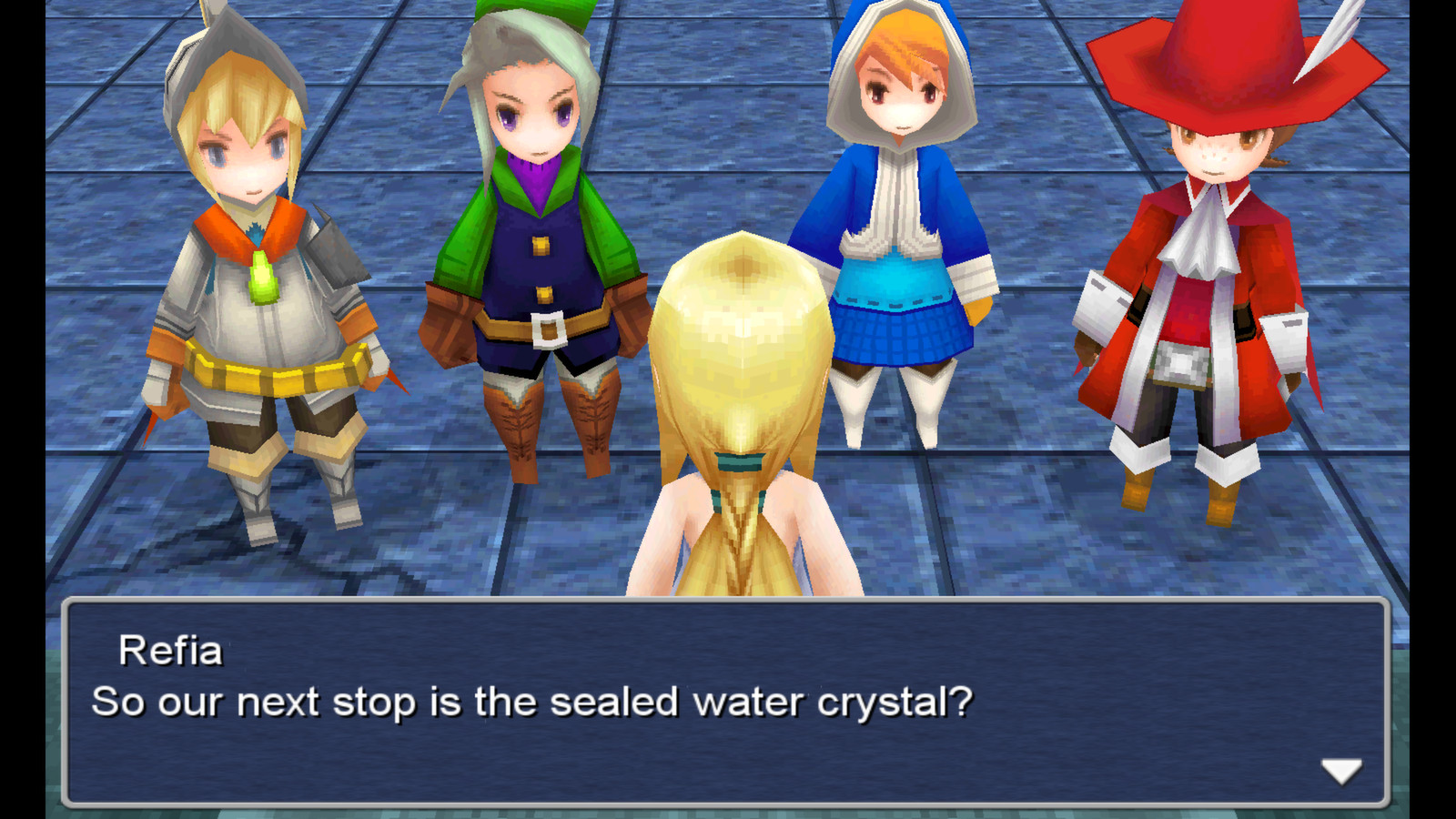
Final Fantasy Dimensions II was released five years after the first game, and despite being developed by the same team it has a completely different look and feel to the original. Evident right away is that it has a much higher budget than the first game, with an animated intro and an original song, as well as a revamped visual style a bit reminiscent of Square Enix's late-00's fare on the DS with higher-resolution sprites, some gorgeous 2D backdrops, character portraits and much flashier spell effects. Combat is also overhauled to be more reminiscent of Final Fantasy X - a straight turn-based system with turn order management as a focus of its strategy. The game is also much more stripped-down in terms of design, having you click on destinations marked on a map containing story events and/or strings of battles to complete, with your HP and MP restored to full after each battle string. Rather than the classic Final Fantasy based system you also get something more akin to Final Fantasy IX, equipping "signet stones" that grant abilities which you can then learn permanently by earning enough points through battles. Signet Stones can also be powered up by using certain items, boosting all of the abilities they contain. As one deals and receives damage they also charge up a meter which can be used to summon creatures for various effects like dealing damage or buffing the party, with more powerful effects requiring more filled pips. Equipment is similarly simplified too, with each character just getting one weapon, armor and accessory slot apiece. When originally launched the game was a free-to-play title with episodic design, microtransactions and an "energy" mechanic that ensured you would have to wait several minutes of real time in between combat challenges, but the subsequent release of a pay-up-front version seems to have completely removed all this. Even with the change though it's not a particularly great game - far from awful, but it's all a bit shallow and insubstantial unless you're really invested in the storyline, and doesn't even attempt to recapture the look and feel of a 16-bit FF like its predecessor did. Dimensions II might be worth a purchase to die-hard Final Fantasy fanatics if you can get it on sale for a couple bucks, but otherwise I'd say it's one you can safely skip.
RPG reviews from actual RPG fans, not fanboys or paid shills in the pockets of industry giants!
Saturday, June 1, 2024
Final Fantasy Dimensions II
Final Fantasy Dimensions
Initially released as an episodic title similar to Final Fantasy IV: The After Years (and sharing many of the same developers), Final Fantasy Dimensions is a 16-bit styled Final Fantasy in just about every respect - familiar monsters, job classes and abilities appear, there are numerous familiar character names and story beats, and the combat system feels remarkably similar to Final Fantasy IV and V with its five-character teams, active time battles and customizable character classes. The story also plays with an idea only briefly touched upon in Final Fantasy III - there being a parallel team of Warriors of Darkness that serve as a counterbalance to the Warriors of Light, splitting the narrative between two separate parties that eventually coalesce into a larger plot. There are also (quite frequent) random battles and a lot of dungeons to get through, so while the game does last a good 50 hours, it does get pretty monotonous to play. The game controls adequately for touch-screen based platforms, although talking to wandering NPCs can be a bit irritating, and if you're on a smaller device it's easy to fat-finger and hit the wrong command at a bad moment. All in all though, Dimensions is a decent 2D Final Fantasy that obviously draws inspiration and numerous elements from the series' roots, but has enough fresh ideas to become a distinct and memorable title its own right. If you're one of those fans who has lamented the lack of turn based Final Fantasy games in recent years, Dimensions is one you may want to give a try.
Friday, March 15, 2024
Final Fantasy VII Remake Intergrade "INTERmission"
Released as downloadable content for Final Fantasy VII Remake (but frustratingly not available on the PS4 version), INTERmission is a new chapter of the story starring a relatively minor character from the original version of FF7; namely, Yuffie. Mostly set around the Sector 7 slums, it has Yuffie ally with a new character named Sonon as they attempt to steal Shinra's "ultimate materia"; a story that unfolds in about 3-5 hours of playtime. Of course, like the main game there's also plenty of side content to undertake beforehand, with the majority of it going to a new minigame. Loosely based on the real-time strategy minigame Fort Condor from the original FF7, it plays out as more of a MOBA style minigame this time, having you summon units to defend your three towers and destroy the enemy's (or at least deal more damage) on a three-minute time limit. It's simple, but fun and surprisingly deep - you'll need to change up your team loadout and tactics quite a bit if you want to conquer every opponent in it.
Sonon is only available as an AI-controlled ally (though you can give him commands), but thankfully Yuffie has more than enough versatility to make up for it. She can fight both in close-range by slashing with her shuriken, or toss it away and have it spin in place (damaging anything it touches) and fight from afar by using magical bursts, giving her quite a bit of versatility. Her innate abilities are also quite varied, letting her effectively exploit any elemental weakness without requiring Materia or MP-consuming spells. Her HP is relatively low, but she is extremely speedy and mobile, so avoiding damage isn't as problematic as you'd think. Intergrade also introduces a mechanic that would become more refined in Rebirth, namely Synergy - she can Nonon can both spend an ATB bar to unleash powerful attacks, or even both spend a Limit bar at the same time to inflict massive damage.
INTERmission is what you'd expect - an interquel side-story in the form of paid DLC, with a few mechanics (and a major character) that would of course have more prominence in the next game in the series. While not strictly essential to enjoy the experience it is quite fun, and it doesn't wear out its welcome; you're provided with some fun minigames and a decent enough side-story containing about 4-6 hours of content to enjoy. Worth a pickup or a bundled buy for sure.
Developer: Square Enix
Publisher: Square Enix
Released: 2021
Platforms: PlayStation 5, PC
Final Fantasy VII Rebirth
The second part of the Final Fantasy VII remake trilogy finally gets the party out of Midgar and continues the remixed plot right where the last game's left off, working in many new open world elements, character interactions and minigames along the way. But does it prove a worthy continuation of Remake, or does Rebirth just give more weight to the criticism that it's an overbloated and unnecessary reimagining of a classic?
There was much buzz about the Final Fantasy VII remake, in no small part because Square had been not-so-subtly teasing it since the Playstation 3 era, remaking the intro from scratch as part of a trailer. It finally debuted in 2020, and while well-received overall, also attracted a fair amount of criticism for changing up the story in some rather bizarre ways (something upper management insisted upon against director Tetsuya Nomura's wishes), and for feeling more than a bit padded. I can't personally disagree - the dungeons did feel overly long at times and the sidequests just weren't too interesting for the most part. Still, it had enough new twists to hold my interest and it didn't stretch out into a 60+ hour slog just for the sake of it, so I had fun playing it and it didn't wear out its welcome.
Rebirth continues right where the last game picked up, but seems to take some criticisms of the original to heart. One thing you notice right away is that the game world is much more open; in fact, once the intro (the familiar Nibelheim flashback) plays out it dumps a whole bunch of quests on you all at once, prompting you to venture around the grasslands near Kalm in order to analyze rare enemies, acquire a piece of armor from some thieves, activate broadcast towers and, of course, battle Chadley's simulated critters to unlock summons and other goodies. Various NPCs also give quests of their own, so within the first few hours you've already got 40 or so side-tasks available. And there's only more to come once you reach other areas; basically, almost every time you'd hit a stretch of empty world map in the original you're now given a bunch of optional objectives to complete. While I did enjoy this at first, after the fourth or fifth time of being presented with another 30-35 hours of filler missions and minigames I got so bored that I just started rushing straight to story mission markers to get the game over with already.
Some new mechanics quickly show themselves too. Right away you're given the Item Transmuter and introduced to the game's crafting system (because every game nowadays needs one of those). Basically you find various items on the field (or in shops) that are useless on their own, but can be crafted into useful things like Potions, Phoenix Downs and Ethers, as well as more powerful versions of each that affect the entire party. As you craft new things and complete sidequests you'll gradually upgrade the Transmuter, earning new recipes that can prove quite handy in other ways - creating new accessories that can't be bought in stores or upgrading armlets, with upgraded versions having slightly better stats than the standard ones.
Party Level also crops up right away, and it's tied to each character now having a skill tree, earning more points by - you guessed it - completing sidequests and purchasing skill books. These do have a number of useful purposes, with a prominent one being that you can now launch elemental attacks without requiring MP; just spending an AP bar. Others include new synergy moves (more on those in a second) and just straight stat buffs, giving a character more HP, damage or making their unique skills more effective.
Synergy is another new addition, and it comes in two forms - Skills and Abilities. Skills serve as new attacks and are activated by holding down R1 to block and then pressing one of the four face buttons, which causes your current character and a second character in the active party to perform a flashy team-up move. They tend to do quite a bit of damage and also quickly build up AP, so they're very handy in the more hectic battles where enemies love to hound you constantly. Performing them also builds up bars, which can then be spent to activate Synergy Abilities - powerful cinematic attacks that also grant temporary buffs like unlimited MP or extended stagger time. In both cases, it's a good idea to mix them up - using the same ones repeatedly will also cause them to take longer and longer to recharge.
Rebirth of course follows the central part of Final Fantasy VII's story where much of the playable cast joins up, so they've added several new playable character and given each their own mechanics. Yuffie returns from the Intergrade DLC chapter of Remake and plays largely the same as she did there, able to attack from melee range as well as throw out her shuriken and bombard the enemy with ranged attacks while it remains separated from her (doing damage itself as it spins in place and damages nearby enemies). Red XIII is made fully playable, able to block attacks to fill his Vengeance meter and enter Vengeance Mode once it's at least partly filled, boosting his damage and dodge speed and getting a secondary attack in Siphon Fang, a move which absorbs HP. Cait Sith is perhaps the strangest character of all, effectively being three characters in one - the Cat can fight solo, but much of his effectiveness stems from his summoned Moogle, which can fight on its own or pair up with the Cat in "Mounted Mode" to greatly expand their collective moveset. Their special moves (and Limit Breaks) are also dependent on their Luck stat, so bolstering that with some Luck Plus materia will let you get more mileage out of them. Vincent and Cid appear in the game, but are not playable; presumably they'll follow in Red's footsteps and become full-fledged characters in the third and final entry.
An integral part of Final Fantasy VII's gameplay was of course its minigames, and Rebirth certainly doesn't skimp on bringing that back. In fact, there's enough minigames here to rival one of the Yakuza games. From crunches to combat challenges to smashing boxes to herding moogles to a MOBA-like minigame based on Fort Condor (also seen in Intergrade), and that's all before you hit the Gold Saucer, which has plenty more of its own. 3D brawling, shooting targets, and even a Rocket League style minigame with Red playing a high-speed version of Soccer. For the first time since Final Fantasy IX, we also get a game-spanning substory in the form of Queen's Blood - a collectible card minigame. It has a similar element of controlling space on the board, but comes down more to strategic placement of your own cards ratings rather than trying to dominate or destroy your opponent's; basically, you place cards down to mark adjacent spaces as your own for future moves, and once both players pass a turn, whoever has the highest score in each of the three lanes gets points for that lane, with whoever has the highest score in total winning the game. There are a wide variety of different cards and tactics to employ, as well as some rare cards with powerful effects to overcome and use yourself, so there's certainly no shortage of tactics despite being a simple game at a glance; you'll have to get pretty creative if you want to conquer every opponent and collect every card. Thankfully you don't lose your own cards when you lose a round either, which spare a lot of the tedious reloading saves that came with FFVIII and IX's card games.
One thing I did find a little jarring about Rebirth (and Remake to a degree) is that it plays up the humor element quite a lot compared to the 1997 original. Nomura isn't in the director's chair this time, but his influence is still felt, with hammy voiceover, jokey dialog and no shortage of exaggerated silly moments. One that particularly stands out in my mind is the famous Midgardsormr death scene - a chilling scene we only saw the aftermath of in the original, but here it's an onscreen event - one that's so abupt and over-the-top that it actually made me laugh out loud. The original FF7 did have its moments of levity, but certainly not to this degree; honestly the Remake series almost feels like a parody of Final Fantasy VII at times rather than an earnest attempt to recapture the original's heavy mood.
Rebirth feels like a logical extension of Remake in almost every respect - addressing some prominent shortcomings of its predecessors, adding a much wider world to explore and keeping the core combat intact while adding in numerous new mechanics and playable characters. The addition of more (and more varied) sidequests, combat mechanics and minigames helps it quite a bit too, staving off the monotony of constant combat and dungeon-crawling that its predecessor frequently fell into. That said, the fact that they still have to fall back on lame padding quests to fill time in a game that encompasses a much larger part of OG FF7's plot is pretty dopey, and some of the combat challenges and minigames are exercises in sheer frustration more than anything else. There's confusing decisions made with them at times too - you get a choice for an easy mode if you fail the Moogle minigame more than twice but for the actual near-impossible ones (like the situps minigame) you're on your own? I also absolutely despise when games lock a single trophy behind completing dozens of side objectives you otherwise wouldn't glance twice at, which - surprise - this one does. That's bad enough, but making you play the entire game twice (hard mode doesn't unlock until you've finished the game once on a lower difficulty) also just smacks of deliberately wasting your time; so no, it's not a game I ever intend to platinum. But even with those faults, a lot of dopey humor, more than a bit of padding in the story and some downright obnoxious objectives I enjoyed Rebirth overall. It's not as tightly designed and written as Final Fantasy XVI and definitely nowhere near as grondbreaking and brilliantly paced as original FF7, but it does justice to its legacy; it's just a shame that for every moment of inspired storytelling and character building there's about 5 hours of tedious filler quests sandwiching it. I don't regret the time I spent with Rebirth, but I'm not exactly chomping at the bit to play Part 3 if it's just going to be more of this.
Developer: Square Enix
Publisher: Square Enix
Released: 2024
Platforms: PlayStation 5
Wednesday, January 3, 2024
Dissidia Final Fantasy NT
Dissidia Duodecim 012 Final Fantasy
Dissidia 012 is of course the sequel to Dissidia Final Fantasy, which was released a little over a year after the original game. As one would expect it adds a few new mechanics into the mix and adds some fan-favorite characters that weren't represented in the original like Kain, Tifa, Gilgamesh and Laguna, as well as Lightning from the recently-released Final Fantasy XIII. The story mode is also greatly expanded this time - it takes place on a 3D world map rather than the simple grid of the original, complete with random encounters and NPCs to interact with, and allowing the player to control a party of up to three characters at a time. In addition to serving as a prequel, this mode also retells the entire story of the first game in its new style, as well as adding a new following chapter, so there's quite a bit more to experience on the single-player front this time. Combat remains largely similar to the first game, though with some new mechanics added into the mix. Assist Mode allows a player to call in a second character to aid them in battle, helping to attack or defend against incoming attacks. Assists can also be "Broken" while a character is in EX Mode, preventing the other player from calling in their own assist for a short time. Similarly, a character's EX Mode can be countered with an EX Break - calling in an assist character to force them out of that mode. Finally, there's EX Revenge, allowing a player to sacrifice their EX meter to stop an opponent's attack and slow them down temporarily, allowing them to get an attack in instead. A game with a lot of flair, quite a bit of content to experience and plenty of popular characters and little nods to series canon to enjoy make it an enjoyable arena combat experience on the PSP.
Developer: Square EnixPublisher: Square Enix
Released: 2011
Platforms: Playstation Portable
Dissidia Final Fantasy
While the Final Fantasy franchise has ventured out into numerous other genres over the years, its first foray into fighting games (as guest characters in Dream Factory's Ehrgeiz) was viewed as lackluster by many; it was a pretty mediocre fighter in the first place, but the characters were also mostly just reskins of existing characters and had no presence in the storyline (not even unique endings), so it wasn't a particularly interesting new angle to see them from. Dissidia was initially intended as a fighting-based offshoot of the Kingdom Hearts franchise, though it was later changed to focus exclusively on Final Fantasy characters, its cast eventually expanding to incorporate characters from every game in the franchise to that point. Rather than being a one-on-one fighter focused on execution and combos though, it was more of a blend of an RPG and an arena combat game similar to Virtual On. Players maneuver around large, open arenas, interacting with objects in the environment to move faster or trigger traps that hinder their opponents, and of course go on the offensive themselves with a plenty of flashy attacks and weapons. In addition to a health bar one also has a stat called "Brave" which determines how much damage their attacks deal; using a circle button attack steals Brave from the opponent, while a square-button attack deals damage to the opponent's health, emptying their Brave in the process if it lands, though it will quickly refill. If one is completely drained of Brave by an attack they will be at a significant disadvantage - not only can they not harm their opponent until they get some Brave back, but their opponent will get a substantial boost in Brave themselves. In addition, an EX Gauge gradually fills as the player takes or deals damage or collects items about the field, and once filled they will be able to transform and become significantly stronger. While in EX state they can to unleash a powerful "EX Attack" by landing a blow and then correctly pressing a number of quick-time inputs, while their opponent can reduce the damage they take by performing correct inputs of their own. The RPG element comes in between battles, with characters gaining stats, levels and randomized equipment to utilize in future bouts. These can also be used in two-player competitive matches, or if one wishes, they can instead play the "Arcade Mode" which strips out all the RPG elements to balance characters out as much as possible. While not a particularly deep game and the story mode layout is a little drab, Dissidia does have plenty of visual flair (especially for the PSP platform) and the story mode has plenty of service for long-time franchise fans, with a lot of familiar characters, plot points, items and music to experience. It's also the first time many of the characters depicted have been presented in 3D with full voicework, so that's also a nice touch for fans of the pre-10 Final Fantasies.
Developer: Square Enix
Publisher: Square Enix
Released: 2009
Platforms: Playstation Portable
Saturday, June 24, 2023
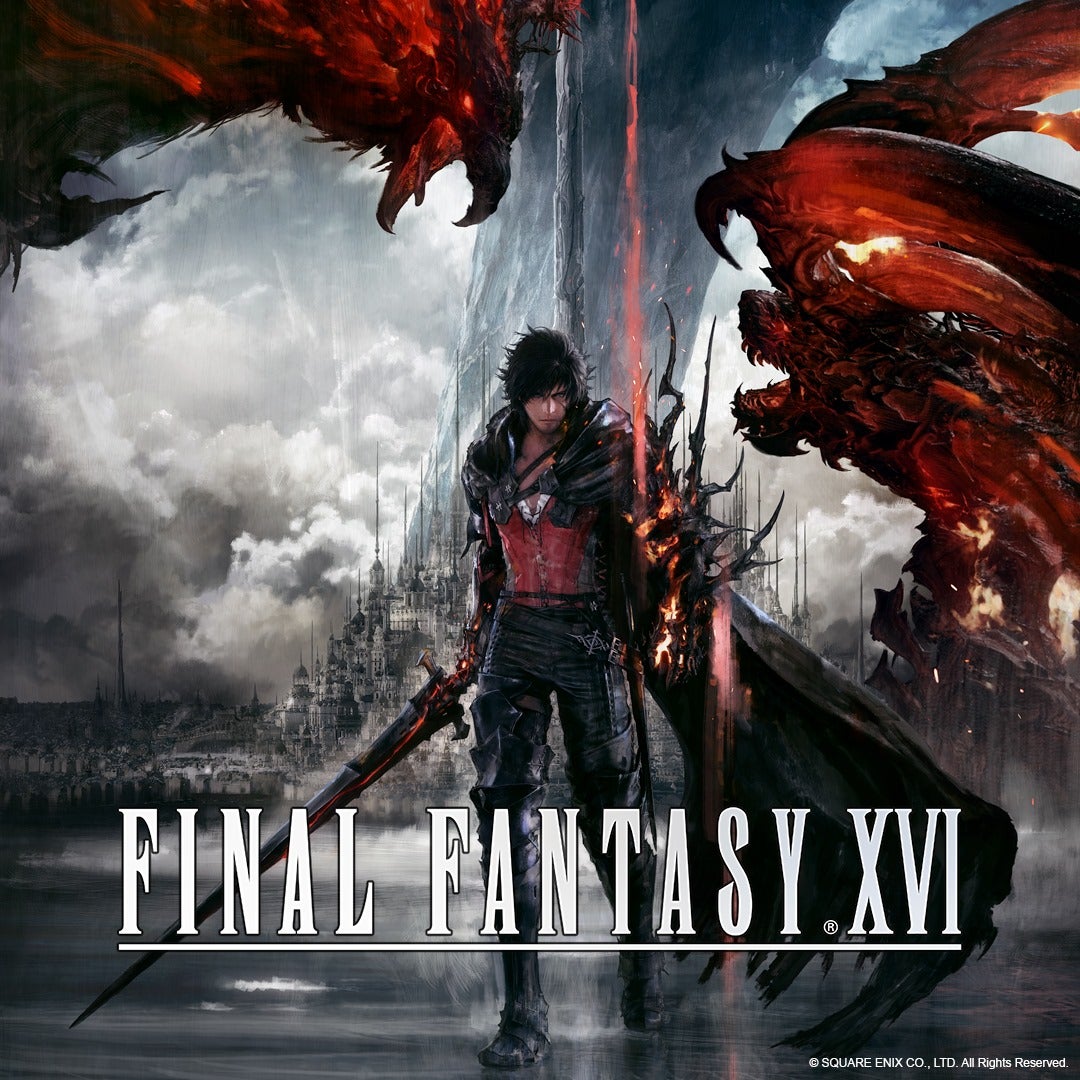
Final Fantasy XVI
Publisher: Square Enix
Released: 2023
Platforms: Playstation 5
Saturday, March 25, 2023
Final Fantasy III (3D Remake)
Publisher: Square Enix
Platform: Nintendo DS, iOS, Android, PC
Released: 2006, 2012, 2013, 2014
Monday, February 13, 2023
Final Fantasy: All the Bravest
A mobile take on Final Fantasy, or so it claims; if you're expecting anything resembling a captivating narrative or an interesting world to explore or clever character building and combat mechanics to play around with, you're going to be severely disappointed. So what do you get? An exceedingly simple monster mash where you form a party of up to 30 (!) characters, have them spam their single move over and over to defeat enemies, and if they fall in battle, you get to either wait 3 minutes of real time for them to return or pay up real money (of course) to replace them. And if you shell out even more money, you can get a random handful of proper named characters from the Final Fantasy series like Kain, Cecil, Cloud, Tifa, Rinoa and Zidane to join your ranks; otherwise you just get to use generic Fighters, Mages, Monks, et al from the early titles. Not that it matters because the named guys function exactly the same as the generic characters, just with maybe a slightly flashier animation or inflicting a bit more damage. Yes, somehow the gameplay is even more shallow than Final Fantasy XIII's legendarily braindead design, and the fact they've added a gambling/pay-to-win angle to it just adds an extra layer of scumminess. The only thing even lending it a faint resemblance to Final Fantasy is some sprites ripped straight from the old games, a handful of music tracks and the Active Time Battle combat, but with no depth to its gameplay and no story to tell whatsoever, there's just no reason for any franchise fan, new or old, to care. So who will All the Bravest curry favor with? Nobody really, except possibly very young kids; like the vast majority of mobile games it's predatory junk engineered to secure that all-important demographic of grade schoolers whose parents only buy them games that resemble something popular and are safe in content, simple to play, easy to win at and (most importantly) have a dirt cheap entry price. Well, I say that even young kids deserve better than disposable slop like this. Shame on Square Enix for lending their brand to this garbage, and especially for trying to use it as a crutch to make their other terrible games of the early '10s look better by comparison. If you want something that effectively pays homage to the series' formative days, play Dissidia, World of Final Fantasy or Final Fantasy Dimensions instead; sure those games have their flaws, but they're far more worthy of your time and respectful to their source material than some bottom-shelf cash grab mobile game will ever be.
Developer: Bitgroove
Publisher: Square Enix
Released: 2013
Platforms: Android, iOS
Saturday, April 2, 2022
Lightning Returns: Final Fantasy XIII
The conclusion to the Final Fantasy XIII trilogy, and at first I had some hope for it, as it seemed to at last break away from the infamous railroaded gameplay of its predecessors and try something new. Alas, I found myself severely disappointed yet again. Lightning Returns at least has a clever concept, having the player operate on a thirteen-day time limit and complete missions to extend it, power up their character, and try to make their way to the final boss and defeat him before the sand in the hourglass finally runs out. However, they've chosen to implement this idea in probably the most flat, unrewarding way possible - by making every single quest feel like busywork. Moreso as the bad writing of its predecessors is now a central focus of the gameplay too, having the player bond with NPCs and endure some of the most grating, over-worded, badly-acted dialog I've seen outside of a thirteen-year-old's whiny webcomic, let alone in a multi-million dollar RPG project. Combat is slightly changed up but no better than it was in the previous two games, mostly just coming down to swapping between three equipped costumes (functionally almost identical to the previous games' Paradigms) and spamming a small handful of attacks until everything is dead. Yes, one does get the chance to block enemy attacks and stun enemies by striking at their weaknesses in order to reduce damage and get a better rank, but it's just not enough to make the action any more compelling; particularly when the game still can't craft a decent reason for you to care about slogging through any of the cynical by-the-numbers questlines, bad characterizations, insufferable dialog or droning action associated with either. I may not be the biggest Final Fantasy fan out there, but the XIII trilogy will unquestionably stand in my mind as its biggest failure. By that already appalling standard, Lightning Returns stands out as the nadir of an atrocious trilogy, one of the lowest points for any legendary franchise and one of the worst gaming experiences I've ever had. Yes, it's really that bad.

Publisher: Square Enix
Released: 2013
Platforms: XBox 360, Playstation 3, PC, iOS, Android
Friday, April 1, 2022
Final Fantasy XV: Pocket Edition
As the name implies, Final Fantasy XV: Pocket Edition is a scaled-down version of the original game. This is most evident in that it is designed to be a much more linear experience - no longer an open-world game, but a series of short dungeons with the occasional reprieve at a town or rest stop to purchase items and talk with NPCs. Fittingly, elements like the Ascension (skill tree) are scaled down to match this, and side-quests are considerably smaller in scope, typically just having you complete small optional goals along the way rather than travel a great distance across the game world to do so (with an objective pointer always present under your character). Combat operates much like the original game, though the action gets paused to use items and you get a substantial amount of time to input QTEs for parries and counters, making things considerably less hectic. Some new quests and dialog are added, however, and impressively, they even got all of the original voice cast to return for them. Fortunately, while it was a game built for phones with touch screens, the controls work fine on a console with a controller (though one small annoyance with the Switch version is that you cannot use the D-pad to navigate menus - only the sticks). Basically, the game delivers what its title promises - nothing more, nothing less. So if you don't have one of the big consoles (or a beefy PC), or just want to experience the story of Final Fantasy XV again without nearly as much of a time investment, this one might be worth your while. However, may want to wait for a sale or a price drop, as $30 is a rather steep investment for what you get.

Developer: Square Enix/XPEC Entertainment/SummerTimeStudio
Publisher: Square Enix
Released: 2018
Platforms: Android, iOS, PC, Playstation 4, XBox One, Switch
Final Fantasy XIII-2
Final Fantasy XIII-2 was released two years after the much-hated original game, and sadly, it's still a pretty abysmal experience. Though at the very least I can say that it addresses a few fan complaints and overall does a better job of what the original set out to accomplish (whether that was worth doing in the first place, however, is a topic I've already made my stance quite clear on). The game's action is considerably improved, with cleaner shots and dynamic setpieces during battles that lend it more of an action movie-like feel. Cutscenes are also spiced-up slightly by incorporating QTE events, allowing you to score damage on your opponents before the fight properly begins or deal extra damage during big attacks by mashing buttons or tilting control sticks instead of just sitting idle. There was also an attempt made to have the game feel less like a strictly linear and braindead experience, giving the player many more wide-open areas to explore, hidden objects to find, enemies randomly spawning on the map (though one can still avoid combat if they move far enough away before the onscreen gauge falls into the red) and the ability to actually traverse obstacles with a jump button instead of an automated event; small touches in the grand scheme, but they do make gameplay at least a little more engaging. However, the rest of XIII-2's design still leaves much to be desired. The constant banter from onscreen NPCs clutters up the screen and becomes an earsore to listen to after a while, and the "multiple choice" dialog prompts are just baffling in their existence. Basically you get to pick one of four options at set points in the story, getting different dialog from each one, but that's it; you can't also pick the other answers for more information a la a CRPG. Sorry, but I'm not playing through your game four different times just to see all the possible dialog, especially when it's no less banal than the first game's and none of your choices have any actual impact on the narrative anyhow. XIII-2 is a better game than the first, but not by nearly enough; with only small tweaks made to a fundamentally fatally flawed experience, it is the perfect example of polishing a turd.

Developer: Square Enix
Publisher: Square Enix
Released: 2012
Platforms: XBox 360, Playstation 3, PC, iOS, Android
Final Fantasy XIII
Final Fantasy XIII is a heavily maligned game among the series' fanbase, who criticize it for its restrictively linear layout, poorly-structured story, grating writing, scene staging (or lack thereof) on level with a bad Michael Bay movie, and greatly simplified gameplay. But in an age where hyperbole and groupthink reign, is it really all that bad? After having played it myself, my answer has to be yes. Not only is it exactly as unpleasant a game experience as it's cracked up to be, it might just take the cake for the most dumbed-down entry to a beloved RPG franchise of all time; even moreso than Dragon Age 2, Digital Devil Saga or the oft-maligned-but-honestly-not-that-bad Final Fantasy Mystic Quest. I never once believed I'd pine for Final Fantasy X's constricted design over anything, but XIII takes its suffocating linearity to a new extreme, simply having the player walk down a narrow corridor, encountering enemies every few steps, for nearly 75% of the adventure; it's only some thirty hours in before the world finally opens up and allows for some free exploration. Combat in the game is downright braindead as one now only controls a single character (the other two being AI-controlled), picks a pre-made "paradigm" (commands which they laughably try to sell as a substitute for job classes) and then chooses "Auto Battle" to carry out a series of pre-selected attacks or spells, only having to use a potion here and there to stop their party from dying. It actually resembles Panzer Dragoon Saga's combat in some respects, trying to be both cinematic and strategic, but unlike PDS it's so dumbed down and repetitious that it succeeds at being neither. The game's main selling point was in its animated cutscenes, but even those aren't satisfying to watch, mostly relying on non-interactive action full of ugly, close-in shakycam fights that are repetitious at best and almost incomprehensible at worst. Even boss battles are bland, with slow camera pans, clumsy physics (models gently pushing one another out of the way happening too many times to count) and attack animations that just get tiresome after you've seen them a thousand times, no matter how many shiny particle and aurora effects they sprinkle on them. But moreover, you just don't care who's winning or losing because the narrative gives you no reason to get invested in its characters or events. The writing is sloppier than a Kindergartener's fan fiction (a character literally dies in one scene, only to pop up again later with absolutely no explanation). Every scene casually drops loads of dull-as-dirt exposition packed with unexplained terminology (relegated to the much-hated Plot Codex, which you have to stop and read frequently throughout the adventure to catch up on), and the incredibly shallow protagonists and trite slapstick humor and angst throughout only proves that flowery writing is no substitute for giving your characters personalities. The character designs and overblown constant bling effects don't look 'cool' either, despite what fanboys will tell you - they look as good as computers and a complete bankruptcy of animation can make something look. Final Fantasy XIII tries to be more movie than game, but without a well-planned story, a memorable cast, writing that ever captivates or even feels competent, action that's any fun to watch or any art direction beyond "looking pretty", it fundamentally fails on every level. It's blatantly obvious that this is software's algorithmically generated idea of what a "cool" game looks like - completely superficial, with no genuine passion or substance to be found beneath that shiny coat of paint. It doesn't appeal to me as a long time RPG fan, and frankly I can't fathom it appealing to people who like Final Fantasy, or RPGs, or stories, or characters, or even video games - it's made just for those who like to push buttons and see sparkly effects flash across the screen, no matter how vapid and empty the rest of the experience is. This might just be the first role-playing game made, quite literally, for toddlers.

Developer: Square Enix
Platforms: XBox 360, Playstation 3, PC, iOS, Android
Final Fantasy Type-0
Many Final Fantasy fans, casual and die-hard alike, make no secret of their disdain for all things related to its thirteenth entry. But there is something of a ray of hope in Type-0; a spinoff game set in the same universe, though in a different time period and with a much more grounded storyline. To that end you control "Class Zero", a team of fourteen characters with their own sets of abilities (reminiscent of the archetypal Final Fantasy job classes) and take them, in squads of three, through various missions. Gameplay is much more involved than the others in the Fabula Nova Crystallis series, playing more like a proper action game with unique abilities and mechanics to each character (though rather clumsy controls and collision detection), and the occasional light real time strategy battle adds some diversity. The player is free to explore the world between missions (including a world map!) and interact with characters within Akademia to fill out various subplots, get more lore on the setting and utilize a plethora of optional challenges and online features to keep the game relatively fresh. Type-0 is by no means amazing, but when you go from two godawful games to a mediocre game, you've still seen quite a bit of improvement.

Publisher: Square Enix
Released: 2011, 2015
Platforms: Playstation Portable, XBox One, Playstation 4, PC
Final Fantasy Tactics A2: Grimoire of the Rift
Final Fantasy Tactics Advance was a somewhat divisive game among the fanbase, but it garnered a lot of positive reviews regardless and was a strong seller besides (over 2 million copies worldwide), so of course a sequel was greenlit right away. However, it ultimately didn't see a release until five years passed and a new handheld system became the market leader, leading to the awkwardly-abbreviated title. While mostly the same game at its core, some criticisms of the original are addressed - missions have more variety now, and the much-maligned Judge system is also overhauled so that you don't have characters jailed when you break a law, instead just losing rewards and privileges (pre-selected bonuses) and being unable to revive fallen party members for that fight. The game also utilizes the DS touch screen for more convenient menuing, and has higher-resolution visuals that allow for some flashier effects (like summons). The story is decent enough for what it is, though the meta element of the first FFTA is largely absent and it once again lacks the heavy mood of the original game, just feeling like a by-the-numbers Final Fantasy plot sanitized just enough to keep it kid-friendly. If you enjoyed the original FFTA you'll probably like this one too, but if you're still pining for another grimdark fantasy tale more akin to the original Final Fantasy Tactics, well, you're probably better off picking up the Tactics Ogre remake on PSP instead.

Developer: Square Enix
Publisher: Square Enix
Released: 2008
Platforms: Nintendo DS
Tuesday, October 6, 2020
Final Fantasy Tactics Advance
The first official sequel to Final Fantasy Tactics was helmed by a very different team from the first (Yasumi Matsuno returned, though as the project's producer rather than writer/director), and was controversially made for a younger audience, with more cartoonish visuals and the grim tone of the original mostly absent. But does Tactics Advance prove to be a worthwhile return to Ivalice, or is this just a misstep for a sequel to a Playstation 1 classic?
Final Fantasy Tactics was a big hit on the Playstation 1, taking the innovative class system of Final Fantasy and combining it with the complex and challenging turn-based strategy gameplay of Tactics Ogre, as well as a grim storyline on the backdrop of a country torn apart by war and famine. It is still a favorite of many to this day, myself included; in fact, I consider it to be the single best game to ever bear the Final Fantasy moniker.
Being a popular game and a successful spinoff for an already huge series, demand for a followup was high. Another entry was announced five years later, though you can imagine the surprise at the announcement that it was being made for the Game Boy Advance, especially after Square's famous split from Nintendo years prior. Not only that, but it was a sharp departure in tone from the original, set in an alternate Ivalice with several other races and a distinctly lighter, almost cartoony feel. In fact, like most Final Fantasy sequels, the only direct link to the original were its similar concepts and themes. Notable also is the fact that the game does lay a lot of the Ivalice Alliance series' groundwork - numerous elements featured here would later be integrated into the mainline Ivalice with Final Fantasy XII, and Montblanc, first introduced in this game, would become the series' most prominent recurring character.
While a stark contrast in tone from the first game, Tactics Advance opens with a similar framing device to the original - the events of the game telling a story chronicled in a book - though it quickly goes more meta with the concept. The game's three main characters are drawn into the story and end up in a fantasy world where they find their deepest desires coming true, though as the story unfolds, the implications of this steadily become more and more sinister. A relatively archetypal concept, but it manages to put a clever twist on the idea while working in a few self-referential nods, so I ended up enjoying it regardless.
The gameplay remains mostly similar to the original game's, though with a somewhat simplified UI and mechanics. Like the first, the main story unfolds through a series of battles throughout the game, though there is much emphasis put in the game's mission-based layout here. Besides the story quest, one can undertake numerous side-quests for various rewards (usually bonus items), generally placing restrictions on what units the player can utilize or requiring certain items to be undertaken first. There are a total of 300 missions in the game, so it's certainly not lacking for content or longevity, and completing all of them will even earn the player an alternate ending. Interestingly, as new locations are revealed by undertaking missions, the player can freely place them in empty slots on the map, effectively customizing Ivalice's layout. Certain locations placed in certain slots can also unlock hidden items via "treasure hunts", though I'm unaware if the game itself provides any clues to this fact.
Final Fantasy's famous job system returns here too, with a grand total of 34 classes for the player to use. However, there are now five playable races as well - Humans, Bangaa, Moogles, Viera and Nu Mou, and several jobs are exclusive to a particular race. Nu Mous, for example, focus on magic and are the only ones who can utilize powerful classes like Alchemist, Sage and Morpher, while Bangaas are almost exclusively geared toward physical fighting. Humans, as in most RPGs, are the versatile jack-of-all trades, able to do a little of everything but lacking many highly specialized classes or abilities.
The skill system is a slight departure from the first game's, however, and bears some resemblance to Final Fantasy IX's. Many pieces of equipment have skills associated with them, and earning AP through actions in battle will distribute points among them; once the player has acquired a set amount of AP toward an ability, it is "mastered" and permanently added to their repertoire, allowing them to continue using it even if they change classes (though with some restrictions - obviously, one can't use a gun-based skill with a class that primarily uses swords, for example). Mastering abilities is also required to unlock new classes; one cannot change class to Paladin unless they've mastered at least two abilities for the Soldier class, while the Alchemist can only be unlocked after mastering three White Mage skills and five Black Mage skills.
Another controversial gameplay change comes in the form of the Judge system. Almost every battle in the game is governed by a Judge, who imposes bonuses and penalties on certain actions depending on the date. For example, White Magic spells may be listed as "forbidden" while attacking with bows or swords could be encouraged. Forbidden actions will be punished with a yellow card (imposing a penalty after the battle) or a red card (causing them to be imprisoned until freed by the player, usually at hefty cost, or a game over if the main character is red-carded). As the game goes on, more and more laws are in play at once, encouraging the player to vary their team composition and strategies to prevent being locked down. On the other hand, most enemies are bound by the same rules, so it can be to your advantage to take certain missions when certain laws are in effect to stop them from using their best moves. Performing an encouraged action will earn the player "Judge Points"; collecting enough of these will let the player do a Combo with all adjacent units, or summon a Totema, both of which can do hefty damage to enemies. Sadly, even though the Judge is an active unit on the field at all times, one cannot target and defeat them to remove them from the fight. However, the player can randomly earn "Law Cards" through battles that allow them to add or negate laws for a single fight, and there are a few lawless areas called "Jagd" where Judges will not appear, leaving the player to use whatever strategies they wish; however, any units that are KO'd at the end of the battle die permanently, so they come with significant risk as well.
Tactics Advance was one of many games to jump on the Game Boy Advance's multiplayer bandwagon too. As one expects, they can pit their teams against one another in combat and win a few extra prizes, but players can also trade units and items, and even earn a few exclusive items and undertake missions not available when playing solo. Nothing you'd sorely miss if you skipped it, but if you're really into the game, it can provide a few interesting new twists.
Final Fantasy Tactics Advance is an odd beast, carrying on the distinct gameplay style of its predecessor but bearing little resemblance to it in terms of storytelling or tone. If you're looking for a direct follow-up to the grim themes and high difficulty of the original Tactics, well, this isn't it. However, if you judge it on its own merits, you'll find a decent turn based strategy experience that tells a good tale in its own right, with some interesting and creative elements strewn throughout. It's worth checking out whether you're a newcomer or a long-time Final Fantasy fan, but either way, you'll get the most mileage from it if you keep an open mind.
Developer: Square Enix Product Development Division 4
Publisher: Square Enix, Nintendo
Platform: Game Boy Advance, Wii U
Released: 2003, 2016
Recommended Version: The Wii U version is an emulated port of the original GBA game.
Monday, April 13, 2020
Final Fantasy VII Remake (Part 1)
Final Fantasy VII continues to be a fan-favorite to this day, and rightfully so - it showed off what CD technology could really do for a game, offering a cinematic experience and storyline on par with a big-budget anime series, and was arguably the JRPG single-handedly most responsible for bringing the genre mainstream success and popularity. People had long wanted to see more of the game's world, with Square having its characters cameo in numerous unrelated games, following up the original Final Fantasy VII with a number of spinoffs and adaptations (most of them bad) and teasing a remake of the opening video at the beginning of the Playstation 3's lifespan that never came to anything. But, after years and years of being teased and delayed and teased again, they at last released a remake in 2020.
Part of one, at least. Following in the footsteps of the Xenosaga trilogy for the Playstation 2, Square Enix made the controversial decision to split the storyline of the original Final Fantasy VII into three parts, each a full-length game in its own right. On one hand, that's probably not what people expected or wanted, but on the other, this is probably the only RPG ever made with enough prestige and fan following to pull that off. Unlike some other games that have attempted this format, though coughDOTHACK, I'm glad to say that they've made every effort to have it be worth the price, expanding the game's world and storyline to take full advantage of the episodic format. If you're expecting a 1:1 retread of the original game, that's definitely not what you'll get here; not only is the gameplay and overall design completely reworked, but there are many new subplots, expanded story elements and game mechanics and a much denser world to explore. It almost feels like a totally different game, and in most respects, it is.
The same level of care and attention that went into the original definitely returns here, too. Thus far, it's the only Playstation 4 game I've encountered that requires more than one disc - one simply to install data and the other to actually play the game, taking up nearly 86 gigabytes of hard drive space in total once fully installed. According to Square Enix, this is because there are no recycled assets in it whatsoever. I believe them too, as no two areas or even elements within them look alike. It also somehow manages to do wonders for what was already a game that wowed people with its visuals and sheer scale, as Midgar is nothing short of breathtaking when you see it from a character's eye level. Recognizable locations are painstakingly recreated, but the size and scale of the setting truly dawns on you with the new perspective too, making you feel like you're really within an enormous self-contained city rife with corruption, decay and monsters. Even a lot of the subtle little details, like the flaked-off paint on Cloud's weapon or equipped materia showing up on character models and even in cutscenes, tell a story in their own way, and show that the developers really did their best to make this game a captivating and immersive experience. The game certainly doesn't lose anything visually when the action heats up, either; monsters actually show visible damage during battles (especially noticeable on bosses), and even when things get very chaotic, with huge amounts of particle effects, enemies leaping about and environmental elements getting destroyed around you, it never lags or slows down and rarely visibly loads textures. Transitions between combat and wandering and even into cutscenes are nearly seamless, so it effectively avoids the stop-and-go feel of most older RPGs and keeps you consistently engaged. Even the more over-the-top setpieces (some highly reminiscent of Advent Children) are a surprisingly good fit here, lending some comic relief to the game without feeling overdone or distracting.
Design-wise, the game definitely feels more akin to the style of Final Fantasy XV than the traditional JRPG fare of the original. While not a fully open-world game like XV was, you are afforded frequent opportunities to wander about and explore locales, take in the staggering amount of detail they have on display, catch idle conversations between NPCs, and undertake a number of side-quests. There are more than a few mundane kill-the-monster quests strewn throughout, though almost all of them at least take you to a new area or introduce you to a new type of monster, helping to keep them fresh regardless. Most questlines also provide helpful rewards or at least an interesting story nugget, so they almost never feel fall into the trap of "content for the sake of content" that so many modern RPGs do and are all well worth doing.
In terms of overall gameplay, Final Fantasy VII Remake is a definite departure from the original. In fact, it's more reminiscent of the style of Final Fantasy XV and Crisis Core than Final Fantasy VII's, taking place almost entirely in real-time while retaining an emphasis on RPG elements. Essentially, you control one character at a time, with the rest being AI-controlled (though you can switch the active character with the directional pad whenever you wish in a fight). Each character has a basic attack, block and dodge, as well as a unique action skill to complement their different playstyles. Cloud, for example, can switch between Operator Mode and Punisher Mode, the former being relatively well balanced while Punisher moves much more slowly, but deals heavier damage and automatically counters whenever he successfully blocks an enemy attack. Barret attacks with a rapid-fire ranged attack and can fire a powerful charged shot that slowly recharges over time (though in a pinch, you can also mash Triangle to recharge it more quickly). Tifa isn't a particularly hard-hitting character, but moves and attacks vert quickly and can perform a skill called Unbridled Strength to bolster her damage and enable more powerful skills for use. Learning to use all of these abilities effectively is definitely an essential step on the road to victory, as is utilizing the ability to stun enemies by persistently landing repeated blows to make them vulnerable (with many special moves filling the stun bar much quicker than standard attacks).
The game still utilizes the ATB Meter, albeit in a different form. Managing it is a key element of the game's strategy too, as all of your skills, spells and even using items draw from it. Each character's ATB bar slowly fills over time, though landing hits on enemies will fill it far more quickly, making it beneficial to stay on the offensive as much as possible (and, by extension, avoid damage with blocks and dodges while doing so). Once a character has at least one full pip on the bar, you can press X to pause the action and select one of their skills, spells or items to use. Skills, like abilities, differ from character to character; some come in the form of physical attacks that deal extra damage or stun, while others are more supportive. For example, Barret can buff his own defense and make it harder for enemies to knock him down, while Aerith can drain her own ATB to fill her allies' meters. Juggling between managing turns and actively attacking can be a bit much to manage if you're not used to action-RPGs of this type, though thankfully the game does include a mode that allows characters to attack and defend automatically, letting you simply focus on menu management while that plays out (not unlike the combat system in the Xenoblade games). Enemies can stuff your spells and skills with a good hit and cause you to waste meter, though, which can certainly be frustrating. Especially in larger battles, with a lot of enemies slinging spells and ranged attacks, the action can get very chaotic and make it difficult to squeeze a special in. One surprisingly effective tactic I found, though, was to swap to another character right before using a crucial skill; enemies by preference will target the character the player is actively controlling, so doing that often caused them to back off and give them a chance to heal or perform a special move.
The materia system from the original returns too, and surprisingly remains its most familiar element, letting you customize characters with new skills, spells and some new abilities like "Deadly Dodge", letting the player perform an area-of-effect attack after successfully dodging. These power up as you earn AP through battles, gaining more powerful effects as they go such as stronger spells or more range or damage for some attacks. A new element comes in the weapon modification system; essentially, each character now gets multiple weapons that serve as "side-grades" rather than straight upgrades from one another, emphasized by each giving different but relatively equal stat bonuses and special abilities whilst equipped. As a character levels up, they will earn SP to spend on upgrading their weapons, generally in the form of added stat bonuses, extra materia slots, or bonuses to their stats that activate upon certain conditions (like getting more effect from spells while their HP level is above 75%). Once all slots on a particular weapon are purchased, a "sub-core" is unlocked that allows more more skills and upgrades to be purchased, effectively rewarding the player for focusing their gameplay style in a particular direction rather than going for a jack-of-all trades approach.
So, was Final Fantasy VII's remake worth the long wait? Hard to say. It's a fresh new spin on a classic in every sense, taking the same basic story and premise and fleshing it out in a way that only modern technology could allow it to. The eye for detail in its setting and the virtually seamless nature of its design really makes you feel like you've stepped into a new world, and it's easy to lose hours just taking in the scope and intricacy of it all between battles and story beats. Combat and mechanics are familiar enough to be comfortable, yet fresh enough to keep the player engaged, and it proves to be a surprising challenge even for those who think they've mastered action-centered RPGs of this type. On the other hand it does have the inescapable feel of padding, taking what was roughly 6 hours of gameplay in the original and stretching it out to thirty or so, with plenty of overly long dungeons and battles that seemingly just exist to fill time rather than provide anything compelling to do. Maybe the later entries will justify remaking this classic as a huge long form open world game, but that remains to be seen.
Tuesday, April 7, 2020
Crisis Core: Final Fantasy VII
Final Fantasy VII was doubtlessly Square's breakout game, making them into a mainstream success and practically synonymous with Japanese RPGs in the west for many years. So naturally, they sought to cash in on this popularity in any way they could. Cloud and friends would cameo in numerous other games (Ehrgeiz, Final Fantasy Tactics, Kingdom Hearts, et cetera) and, several years after the fact, some sequels and spinoffs would begin to appear on various platforms. The first was Before Crisis, a mobile phone game first released in 2004; this one has never been officially localized, though a complete fan remake was created in the RPG Maker 2003 engine. Dirge of Cerberus followed two years after and was very negatively received by many fans, with gameplay essentially being a poor knockoff of Devil May Cry and the story feeling like a cheap cash-in sequel with little substance and an overuse of corny anime tropes. Advent Children - a CGI movie - was released in 2006 as well, adding little to the story and overall feeling like little more than cheap fan service with a dash of Michael Bay-esque OTT action.
Thankfully, they seem to have finally gotten the message with Crisis Core, as the game both tries to be faithful to the tone of Final Fantasy VII's original entry, expands on its story in fitting fashion, and provide an action-driven style of gameplay that feels well-crafted and less derivative than Dirge of Cerberus. Even some of its gameplay elements feel more faithful to the original, utilizing equippable Materia to allow for a variety of special moves and a constantly spinning slot reel mechanic (slightly reminiscent of Cait Sith's limit break) to keep combat dynamic.
In terms of plot, Crisis Core is a prequel story starring Zack Fair - a character who is mostly just alluded to in the original game, and only seen at length in one relatively obscure scene. This is used to good effect throughout, though, giving the player a chance to see firsthand several events that are only hinted at throughout Final Fantasy VII (such as the war with Wutai) and get a bit more of a human perspective from characters like Sephiroth. I was personally glad they went this route, as it afforded them a way to expand on the series' lore and give more attention to characters and events that are only alluded to in the first game, and showing more of a character that played a large role despite his minimal screen time. Simultaneously, this allows it to avoid the same pitfall the sequels fell into - trying to re-engage the audience with cheap nostalgia and little else.
In keeping with the company's penchant for high production values, Crisis Core certainly doesn't skimp on its presentation. The game is downright beautiful to look at, with clear, high-quality FMVs (despite the low resolution) carrying the story at points, and well-rendered spell effects, environments and combat animations throughout. Character models are surprisingly expressive, and the monsters are large, imaginative and vicious-looking as per series norms. The music and voiceover sound remarkably crisp and clear too, even as they come out of the PSP's tiny speakers. It's easily one of the most impressive games on the platform from an aesthetic viewpoint, if not the best.
Gameplay-wise, Crisis Core is a relatively simple action experience. The main storyline is broken up into a series of short missions - roughly 45 minutes to an hour apiece - which is in line with the portable format of the game. Numerous optional missions can also be undertaken between story-relevant ones - usually toughened up battles from the story that offer rewards if they are successfully completed. Combat takes place largely in real-time, with you selecting an action via the L and R triggers and then carrying it out via the X button - either a normal attack or one of six equippable materia that grant spells or special moves like a spinning slash, as well as an ever-present items menu for when you need a quick boost. You also have a dodge button (mapped to Square) and a block button (mapped to Triangle) at all times. However, I rarely used the guard since you have to wait for an attack or dodge animation to completely finish before a block will activate, whereas you can cancel into a dodge at almost any point. Between battles, you're afforded some opportunity to explore, interact with objects and change up your equipment if needed; you're afforded up to four accessory slots to do just that, and items are frequently earned as bonuses between missions or as hidden items during them. Another very prominent mechanic is the bizarrely-named DMW ("Digital Mind Wave"), which is essentially spells, limit breaks, level-ups and a gambling element all rolled into one. This affords you the opportunity you to adapt new tactics on the fly, perform your most powerful attacks and earn bonuses that either last a short while or for the duration of the combat phase. It also requires that you dispatch foes with a degree of efficiency as it consumes 10 SP every time it spins, and will do so constantly as long as the player has SP to spend.
Essentially, it works like this: three slot reels spin, each with a number from 1 to 7 and a character portrait; at first there are only two visible (Sephiroth and Angeal), though more portraits are unlocked as you meet key characters during the story. The player can earn beneficial status effects from getting at least one 7 in any reel or matching three of the same number - temporary invincibility, immunity to physical/magic attacks (either for a short period or the entire battle) or reducing MP or AP costs to 0 (ditto). Getting two matching pictures on the left and right reels begins a "modulating phase", stopping the action temporarily and moving the reels to center-screen for another spin. At this point, if all three reels have matching portraits, you get a bonus to your HP, MP, AP and SP and do one of several limit break animations (depending on the character they landed on). The numbers spin during this phase too, which can potentially power up one of your equipped materia - rolling two of the same number from 1 to 6 will cause a materia in that slot to gain a level, while rolling three of the same will give it two levels instead. If you roll three 7s during this phase, Zack himself will gain a level, permanently boosting his own stats. A triple-7 is not completely random, however - Zack does have a hidden experience counter and must hit a certain threshold before the reels even have a chance to land on it. As the game progresses more modifiers are added to the modulating phase, allowing you to perform summon attacks or earn bonuses like free items or casting a number of beneficial status effects all at once. It certainly keeps the combat dynamic, but having no real control over what effects you'll get or when you get them may be a turnoff to some, especially during some of the tougher missions.
Soldier Points have another important effect in the game too; namely, tying into the Materia Fusion system. This operates a bit like the magic crafting system from Final Fantasy 15, having the player combine two materia together to get a new one with the effects of both. Fusing a Fire and a Dark materia together, for example, will create Dark Fire, which deals damage and inflicts Poison and Silence status at the same time. Some materia also grant stat bonuses when equipped, like a bonus to Vitality, Attack or Luck, and these can be carried over to other materia that they are fused to, creating a cumulative effect if they have the same stat bonus. Later in the game, one can even mix in items to get more stat bonuses, though only up to a certain point - trying to raise materia stat bonuses above a certain threshold (generally around 40) can only be done by fusing similar materia to them.
Crisis Core is definitely the standout title among the numerous Final Fantasy VII spinoffs. While I wouldn't call it a masterpiece, one can definitely tell that the team behind it had passion for the series and wanted to do right by its fans. (In fact, they famously wanted to include more interactions between Zack and Cloud, though they had to drop the majority of those planned scenes owing to the UMD format's relatively low storage space). Its gameplay is relatively simple, yet fun, the story does justice to Final Fantasy VII and rarely feels superfluous, and the materia crafting system definitely provides some extra play value for the die-hard stat-grinders in the audience (though the random element to gaining levels certainly makes it more protracted than it needs to be). For a portable spinoff game to a beloved classic, Crisis Core didn't blow me away, but it certainly didn't let me down.
Developer: Square Enix
Publisher: Square Enix
Platform: Playstation Portable, PS4, PS5 PC, Switch, XBox One, XBox Series
Released: 2007, 2008, 2022
Recommended version: The HD ports on various platforms are definitely the ones to play nowadays, though you should try to get the PC, XBox Series or PS5 version if you can; I encountered quite a bit of lag and hitching on the PS4 release. The PC version also has a fan mod available to restore the original voice acting from the PSP version if that's your preference.