RPGreats now has a Discord! Come on in to talk about game music, games in general, submit reviews or just hang out!
Showing posts with label Rating: ⭐✩. Show all posts

Monday, May 11, 2026

Dragon Scroll: Yomigaerishi Maryuu

 A pretty obscure Zelda-like for the Famicom, even if it was developed by a high profile company like Konami.  Dragon Scroll puts a bit more emphasis on RPG elements than Zelda though, with experience points and levels being a prominent mechanic.  Levels upgrading your maximum health, magic points and allowing the use of new weapons, while found equipment upgrades your other abilities; the silver ring lets you move faster than your glacial walking pace, while the gold ring reduces all damage taken.  Other items are required to progress the plot, such as a magic key to open doors or a branch that creates a bridge over an impassable lake.  Basically, there's a lot of good adventure-RPG hallmarks there.  So, why wasn't this game as well-regarded as many other adventures on the platform?  I think it mostly comes down to the puzzles; they're not the fun, intuitive Zelda style of puzzles, but rather tedious guesswork a la Milon's Secret Castle.  Standing in a certain spot, or shooting a certain nondescript statue (multiple times), or walking a specific path through a room being required to progress.  There are NPCs to talk to, but the game also just pops up clues after defeating arbitrary enemies, which makes it easy to accidentally skip them by pressing the button at the wrong moment.  Combat also tends to be more tedious than fun, with enemies sponging up damage and landing cheap shots on you as you enter rooms or pass through narrow halls, and health and magic refills only being available by finding specific chests in dungeons (or dying).  The game does at least have a fair bit of longevity (and a password system to save progress), as well as Konami's usual excellent visual and musical chops, but overall it's a fairly average open world adventure RPG that doesn't stand out much from others on the system.


Developer: Konami
Publisher: Konami
Released: 1987
Platform: Famicom

Tuesday, January 20, 2026

Return to Krondor

After five years and a very underwhelming offshoot game, the Riftwar series returned to the world of gaming, albeit with a different studio taking the helm.  Two, actually.  One is 7th Level, a company mostly known for subpar adventure titles and licensed interactive software; and the other is Pyrotechnix, who have exactly one other game to their name - a long defunct online-only tank combat game.  That doesn't bode well right off the bat, but you can definitely see the former's influence as the game now has fixed camera angles and *sigh* tank controls in addition to point-and-click movement.  There's also underwhelming voiceover and no subtitles, so get used to hearing a lot of school play caliber acting.  Combat is essentially the same grid and turn-based system, though now much slower, and progression is extremely linear with very little opportunity to explore and do side missions.  Rather unintuitively you can't just walk between areas anymore either - you have to bring up the map via the "Krondor" menu and then click to go to a new area, which isn't great.  Even less great is that room exits aren't always apparent from the fixed camera angles you're given, so you often have to press the bracket keys to rotate to a new angle in order to progress.  There's random encounters in various rooms and passages though, and unlike the original game (and the offshoot), there's now a traditional Experience system, awarded for winning combat and completing both story and side quests.  Opening locked chests is no longer a simple skill check or a roll of the dice, but now a full-blown minigame where one basically must cut away parts of the chest and disassemble the locks and traps in it using various tools.  A clever idea, though it mostly seems to come down to luck and savescumming since there's no discernible logic to using any tool on any parts, or at least, none that I could find.  There's an alchemy system too, though in practice it mostly just clutters up your inventory with useless items until you find one of the rare spots where the game allows rest and crafting.  A considerably better game than the previous attempt, but still a far cry from the quality and depth of the first Krondor.  There's a reason you never hear anyone talk about this game, and that's because Baldur's Gate came out one month after and was a superior experience in basically every way...


Developer: 7th Level, Pyrotechnix
Publisher: Sierra Studios
Released: 1998
Platforms: PC

Tuesday, November 18, 2025

The Outer Worlds 2

The Outer Worlds was a clever and genuinely funny satire of the dark side of capitalism on the backdrop of a campy old space serial; it had its flaws for sure, but I still found it a compelling journey and an interesting character study.  By contrast, the sequel is just constant grating Used Car Salesman dialog trying way too hard to outdo what came before.  Brandon Adler and Leonard Boyarsky's idea of "improvement" is to just make every character their personal sock puppets, constantly belting out "Look how smart we are!  Pay attention to our writing style and rapier wit!" while forgetting they have nothing to say that hasn't already been said better and funnier in the previous game. The gameplay has at least improved a little, adding in Fallout style perks upon level-up and encouraging more focused builds, though it's often frustrating to try and complete quests when you need a specific skill at a particular level and simply don't have any way around it, other than to quit out and go do more filler quests until you do.  "Flaws", an interesting if undercooked concept in the first game, now seem actively engineered to screw you over by turning you into an ineffective master-of-none character; none that I encountered ever seemed to offer a benefit worth the drawback.  Gunplay is just Borderlands Lite with its moddable weapons and overly spongey enemies that lack any real variety, and your comrades simply don't have much of anything in the way of customization; well, they do have upgrades you can find and perks to assign every five levels, but they have almost no tangible impact on making the combat feel any more deep or rewarding.  Outer Worlds 2 is your typical self-proclaimed intellectual with no real personality and nary a novel idea in its head, but that doesn't stop it from running its mouth and laughing at its own stupid jokes for a solid sixty hours; which is about forty more than I could bear.

They wanted to sell this at $80 when frankly it'd still suck even at $0.  Talk about a lack of self-awareness from such an "anti-capitalist" game... 

Developer: Obsidian Entertainment
Publisher: XBox Game Studios
Released: 2025
Platform: PlayStation 5, PC, XBox Series, PC

Monday, August 4, 2025

Cyberpunk 2077

A controversial launch marred it, a big-time turnaround with numerous subsequent patches aided by a successful anime tie-in redeemed it, and now Cyberpunk 2077 is regarded as another modern classic from CD Projekt Red.  But is there anything here for me as someone jaded by open world design that focuses more on volume than quality, or is it done in once again by its own hubris?

Cyberpunk 2077 was a public relations disaster when it launched, for a variety of reasons.  Whether completely unnecessary health hazards to epileptic people, alleged exploitation of CDPR employees (later offset by a suspiciously large number of positive employee reviews appearing to offset negative ones), or a conveniently timed data breach that may or may not have been staged for publicity, the game was a pretty big font of negativity when it launched and continued to be so for some time after.  Of course, it had its defenders too; mostly people who decided it was the best game of all time years before they ever played a single second of it and continued to do so in spite of its horrifically buggy design and poor performance.

I passed it for several years for all those reasons, as well as just not enjoying the Witcher games at all.  Mostly because rather than showing you tangible evidence of themes and ideas and letting you draw your own conclusions, they instead sit you down every five minutes to smugly tell you all about how intelligent and important and poignant and progressive and visionary they're being, all while showing disappointingly little in the way of innovative design, compelling writing or interesting gameplay.  I mean, unless you count "follow quest marker and push confirm button until it says you've finished it" design, permanently botchable quests, no hard saves and guessing at which dialog options will lead you to a bad ending 40+ hours later as compelling; I certainly don't.  It's the equivalent of a pretentious film student roping you into watching his 2-hour magnum opus and then spending the next six hours explaining all the symbolism in extreme detail to make sure you get it.  Not because they have any anything poignant to say, but because they desperately want you to admire and worship them; preferably through their wallet.

Cyberpunk (the heavily-patched version) at least has more to offer in terms of gameplay than Witcher does.  Built as a gigantic open world game in a sprawling city, it feels like a logical mashup of elements from Grand Theft Auto, Deus Ex, Borderlands and Watch_Dogs.  You drive around, you get into fights with hostile NPCs, evade the cops, and complete various side missions, getting different dialog and rewards depending on your approach.  Going in guns blazing, using stealth to disable enemies and hacking to create distractions or destroy targets (NPCs and mundane objects like air conditioners, lights and even oil barrels can be "hacked" with destructive results, which makes little sense to me).  There's also semi-randomized loot in the form of armors and weapons with various random attributes and stat bonuses, and you get core stat upgrades and perks depending on your playstyle.  You can install implants to improve your character as well, either finding them about the world or ripping them off dead gangers and psychos; so long as you have the cash to install them, of course.

Of course, balancing all these elements out is never an easy job in a sprawling open-ended game like this, and Cyberpunk... doesn't really do a great job.  I mostly stuck to melee weapons as they consistently drop enemies in two or three hits, whereas even an average thug can absorb half a magazine of assault rifle ammo or more without even flinching.  Combat doesn't feel good in general either, with some very floaty movement, weightless action that lacks any visceral impact and strange hit detection at times - I've visibly leapt backwards from a boss enemy, saw their weapon fly right past me and still taken damage, while I've swung at them multiple times while they're a foot away and dead center on screen and never seem to land a hit when it counts.  Some of the earliest powers you get also afford you health regeneration at a pretty substantial rate, and you get free regenerating grenades and emergency health packs, so as long as you don't take too much damage at once you're pretty difficult to actually kill.

Dialog in the game is also considerably more streamlined than most.  Outside of scripted cutscenes you're not locked into a separate dialog screen, instead just getting options for what to say next depending on the character you're currently facing.  There's usually little choice in these - you can generally just ask a second or third option for a bit more information before you're forced to pick the first one in order to progress to the next part of the dialog and ultimately accept or decline a mission; Ultima-level deep conversations laden with puzzle solving these are not.  They're also punctuated with a lot of V's smarmy dialog and characters bouncing constant comic book one-liners off you, which is cute for a bit but quickly gets grating when they have to cram heaps of it into every single exchange.  Hell, they never manage to turn it off even during the serious moments.

Presentation wise I can't say I like the game much even when it is performing well.  The dialog is all well-acted and some of the radio tracks are honestly pretty catchy, but it's just not a pleasant game to look at.  The whole world is dingy, grimy and utilizes a pretty garish color palette and overbearing harsh lighting.  I suppose it fits the cyberpunk aesthetic in that regard, but it does get a little annoying when there's bright neon/sun glare in your eyes every 2 seconds and all your targets just blend into the constant environmental haze and clashing colors.  The only thing that does stand out are the weapons, which are painted in bright yellows, purples and blues; they look more like Super Soakers and Nerf toys than anything that can do harm.  It all controls decently enough with a controller, though if you're playing the Switch 2 version you can also utilize gimmicky Wii-style motion controls with detached joycons. I mostly just stuck to the Pro Controller; normally I'm not a fan of twin stick aiming but in conjunction with axis aiming it's good enough here.

Cyberpunk 2077 is relatively competent at everything it does, but nothing it does is very unique, deep or fun.  It just feels like a mish-mash of every popular open world game and futuristic action-RPG made in the last 25 years, cynically engineered for maximum marketability and play time with little thought spared for giving it any identity of its own.  Not to mention stretches where CDPR takes control away from you for several minutes at at time so they can play long, plotless cutscenes full of head-banging music and terrible self-aggrandizing narration about how badass and cool their world and characters are; how unconfident do you have to be to straight-up tell your audience what to think instead of letting the material speak for itself?  The gameplay kept me amused for a few hours, but with the repetitive setup, bare-bones core story and combat, uninteresting characters and dialog that's more tedious than compelling, I got bored of it well before the end.  It's the most competent CDPR project yet in terms of design; unfortunately being competent and being captivating are two very different things, and CDPR still has yet to get a grasp on how to do the latter well.


Developer: CD Projekt Red
Publisher: CD Projekt
Released: 2020, 2022, 2025
Platform: PlayStation 4, PC, XBox One, PlayStation 5, XBox Series, Switch 2, macOS
Recommended Version: Definitely avoid the early releases on PS4 and XBox One and go for one of the newer versions instead, or the PC port if you have a powerful enough machine.  The Switch 2 version is surprisingly solid though, with a smooth framerate and overall good performance.

Saturday, August 2, 2025

The Adventures of Elliot: the Millennium Tales (Demo)

Produced by prominent Square Enix producer Tomoya Asano, The Adventures of Elliot: the Millenium Tales is a Zelda/Ys clone made by Claytechworks, who also developed Bravely Default 2.  Utilizing Asano's trademark (and still gaudy and distracting) HD-2D style, the game takes place largely from a top-down perspective, having the player battle enemies, avoid obstacles, do a bit of platforming, uncover hidden secrets and of course take on the occasional boss fight.  It plays competently and solidly enough, but isn't very unique save for a few elements; some good, some bad.  ZL and ZR are map and inventory, respectively, which isn't very intuitive to me as a long-time Zelda player.  One can also parry attacks via a well-timed press of the R button, which can occasionally stun enemies or reflect attacks; I didn't find this very intuitive or useful, though, and just found it more economical to dodge them.  You can find objects called Magicite that can be equipped to boost your stats or abilities, such as letting your arrows hit multiple times per shot.  You also have a fairy sidekick who can be maneuvered around to pick up items or, more usefully, to teleport to her current position by pressing the L button, letting you skip over gaps.  She also affords you a dash power, which seems pretty useless since the environments aren't very wide open and hitting anything brings you to a dead stop.  (She also cuts in constantly with obvious tips and other banter, which is all fully voiced and pretty grating.).  If you die at any point you can either choose to continue right from where you are for a small money cost, or reset to the last checkpoint.   Continuing is dirt cheap and even lets you pick up mid-fight during boss battles, so I see little reason to pick the latter.  The game is overall competently made and plays decently but from the demo I see little reason to recommend it over a good Ys or Zelda title.  Maybe the full version will have a some more unique elements to offer, but from what I've seen here, I'd say wait for a substantial discount.  Or just buy Echoes of Wisdom if you haven't already, which looks and plays great on the Switch 2.

Developer: Claytechworks
Publisher: Square Enix
Released: 2025
Platform: Switch 2

Oh it crashed twice when I played it too.  One literally five seconds after starting the game (though after redownloading the demo, it seemed to work) and the other when I collected a chest and then pressed the R button.

Wednesday, July 16, 2025

Neverwinter Nights 2 Enhanced Edition

Neverwinter Nights is a series I'm not overly familiar with; I never played the original at all, and even though I did try out 2, I never got very far in since it's running on janky, dated code that makes it unpleasant to play on modern Windows.  I was hoping the Enhanced Edition would improve upon this, but they don't seem to have put a great deal of quality of life improvements into this remaster.  It runs at higher resolutions and without weird animation bugs but it still has bizarrely long load times, weird collision detection and a somewhat clunky UI (get prompted to save before I load?  seriously?).  I also had a controller plugged in that would vibrate during the bigger hits and couldn't find any way to disable it in the options.  Not to mention several options just seem to not work; I disabled switching characters when I click on them and it still happened.

As for the game itself, it's based on Third Edition Dungeons & Dragons, which is pretty jarring for someone who isn't overly familiar with the tabletop game and previously only played the Baldur's Gate titles.  You can freely swap between classes after gaining levels (with some exceptions) and now gain upgrades in the form of Feats and stat upgrades to tweak your character more and more into a niche playstyle.  Alchemy, crafting weapons and armor, and thief skills are now also available to any class, and there are so many sub-races that I just started getting choice paralysis before very long because there's so many damn options and no way to know which ones will actually benefit you or not (at least not without playing the game to death and memorizing every one of its maps).  Like Icewind Dale most of these seem to be pretty moot since the primary focus is just on endless dungeon crawling and combat, so there's little benefit to picking anything not geared specifically toward killing things more efficiently.  Crafting armor and weapons and alchemy also seems pretty pointless when you can just buy most anything you need for a pittance; I get that it's there for completeness owing to the more open-ended, roleplaying focus of the table top game, but if it's not going to be the slightest bit practical in a video game adaption, why include it?  The story also just feels very generic overall and the voice acting is honestly pretty crappy for a 2006 game, so... yeah.  I got bored of it real quick and just found myself replaying Baldur's Gate 3 again, rather than retreading a 'classic' that's aged like an isotope of hydrogen-5.


Developer: Aspyr Media, Obsidian Entertainment
Publisher: Aspyr Entertainment
Released: 2006, 2025
Platform: PC, Switch, PlayStation 4, PlayStation 5, XBox One, XBox Series

Friday, December 6, 2024

Fantasian: Neo Dimension

A game met with much anticipation as it's been hinted to be their final game project, Fantasian sees Hironobu Sakaguchi return to write and produce and Nobuo Uematsu to compose the soundtrack.  But does it serve as a high note to go out on for two legendary names of the industry, or does this final fantasy just not bring the magic?

Mistwalker of course was founded by Hironobu Sakaguchi after his departure from Square Enix in 2003, and while they did produce a few decently-received games for the XBox 360 and Wii, they hadn't really done a high-profile release since 2011, mostly relegating their output to lower-stakes mobile releases.  Fantasian seemed to mark a return to form as a narrative-driven cinematic RPG reminiscent of the old Final Fantasy games, and despite being exclusive to Apple Arcade managed to amass a decent following - enough for Square Enix themselves to codevelop a port with Arzest and give it a wider release on consoles, in effect bringing Sakaguchi and Uematsu's careers full-circle.

Fantasian was also a unique turn for Mistwalker in many respects.  The game was developed in Unity, and rather than simply using CGI backgrounds they actually built dioramas and digitized photos of them for the game, giving them a more realistic yet slightly surreal touch compared to the Playstation-era Final Fantasies.  That said all the characters in the game are still CGI models, so there is a definite and slightly awkward contrast there.  The Neo Dimension port adds voiceover in both English and Japanese, and it's well done in spite of the often-clunky dialog.  The game also invokes Lost Odyssey's Memories with its amnesiac protagonist and frequent flashback scenes told in a sparse, very wordy style with scrolling text effects and voiceover, which are easily the best part of the storytelling.

In terms of design it's a fairly streamlined turn-based RPG experience, with turn-based combat, a small handful of abilities per character, and items to inflict one-off elemental damage or restore HP or MP.  A bit like Chrono Trigger is the fact that most abilities have given ranges - a radius around the cursor or a straight line - and will hit any enemies in their path.  Spells can be angled into curved shots to hit multiple enemies - a useful tactic in many battles, and particularly battles with dozens of enemies.  Exploration is also fairly standard fare, having you wander through the labyrinthine environments in search of hidden treasures, which are often locked behind chests that require specific types of single-use keys.  The sudden camera shifts, paired with the fact you keep moving in the same direction after one unless you completely take your thumb off the stick and then move again, can get a bit jarring, but there is a convenient minimap in the menu to prevent it from becoming disorienting.

Yes, dozens.  There are frequent battles where you'll fight many enemies at once.  Sometimes these are boss battles, but more often they tie into another mechanic called the Dimengion Machine.  Essentially, what this does is store up to 30 (later 40 or 50) enemies you'd normally fight in random encounters, which you can then fight in one big marathon at any time you choose; typically about 10 will be on the field at time, with enemies replacing defeated ones until you've cleared them all.  They do go surprisingly quickly with line and area-clearing skills, though, and one can even tag small crystals that appear on the field with their attacks to get temporary buffs or bonus turns.

The game is fairly basic (and very linear) for its first half, but jarringly adds many new mechanics in the second.  Suddenly you have skill points to unlock character-specific ability trees, not unlike Final Fantasy XII's license boards or Dragon Quest XI's skill panels, equipment crafting, a tension meter as a new combat mechanic that operates somewhat like a Limit Break, and the ability to swap characters mid-battle a la Final Fantasy X.  My guess is that the first half of the game (initially released standalone on Apple Arcade) was criticized for its basic design, so they added many new mechanics to the second half in an attempt to punch it up.  It would have been nice to see them be integrated a bit more smoothly into the Neo Dimension port, but they opted to keep it as originally presented.  But worse than that is that the pacing takes a nosedive, with enemies barely giving a pittance of XP and the player having to slog through fights with 40+ enemies on a frequent basis owing to the absurd encounter rate.

Fantasian, for both good and ill, resembles an early '90s era Final Fantasy game more than any other Mistwalker effort I've played - it's got a familiar but enjoyable (to a point) gameplay loop, an archetypal story with a lot of goofy dialog and contrived plot points, a visual style that blends 2D and 3D elements reminiscent of the early PS1 era, and relatively brisk pacing with enough mechanical intricacies to keep you interested for the entirety of its ~40 hour runtime.  It doesn't hold a candle to the best of the Final Fantasy games, but it is much better than Mistwalker's previous overproduced and poorly-paced fare and frequently invokes the crisp, satisfying design that made the Final Fantasy franchise a classic to begin with; something so many other lame copycats have tried and repeatedly failed to do.  I should probably mention as well that I always felt Sakaguchi role in making FF such a legendary series was heavily overstated; yes he pitched the first game, wrote the scenarios of many of its classic entries and even directed the first five, but he was never its sole creative force; he'd always worked alongside several other writers and designers to flesh out their ideas and have them meld together in a satisfying way.  VI, VII and IX - easily the most popular Final Fantasies where he served creatively - were all especially large collaborative projects, and while he was their scenario writer and producer, other big names at Square like Masato Kato, Yoshinori Kitase, Takashi Tokita, Hirohiko Ito, Tetsuya Takahashi, Tetsuya Nomura and of course Nobuo Uematsu also played major roles in giving them their identities.  Sakaguchi can certainly make a project come together, but without all those other big talents there to help putty up the cracks, the shortcomings in his writing and design become all the more prominent; they've only become more obvious with the rise of so many other other fantastic players in the field since his heyday too. Fantasian has some hints of old Final Fantasy's ingenuity, but they're sandwiched between a lot of baffling design decisions and some really bad character dialog and plot points.  As a possible capstone to two legendary gaming careers, it's better than Sakaguchi's last couple efforts, but still leaves much to be desired.


Developer: Mistwalker, Console ports by Square Enix/Arzest
Publisher: Mistwalker, Console ports by Square Enix
Released: 2021, 2024
Platforms: iOS, macOS, tvOS, Switch, PlayStation 4, PlayStation 5, PC, XBox Series
Recommended Version:  Neo Fantasian, in addition to the upgraded presentation, adds many balance tweaks, a difficulty select and the option to utilize the battle themes from numerous Final Fantasy titles.

Saturday, September 7, 2024

Visions of Mana

The latest entry in the Mana series and its first new mainline title in nearly two decades, Visions of Mana blends open world exploration and action-based combat with many monster designs, artistic elements and gameplay traits that invoke its predecessors.  But does this vision prove a worthy new entry to a fairly overlooked Square Enix franchise, or does it just lose sight of itself?

The Mana franchise was always a low-key favorite among Square fans, though sales for the series remained relatively low after Secret of Mana and it never saw much priority from Square Enix as a result.  However, after the mobile spinoff Rise of Mana and the remakes of Secret and Trials proved to be successful, series producer Masaru Oyamada decided it was finally time to reinvigorate the series with an entirely new entry.  

Of course, making something that appeals to long-time fans while having an identity of its own is no easy task, but Visions certainly tries its best.  A lot of monster designs are taken straight from earlier games in the franchise, and the game features a class system somewhat similar to the one seen in Trials, with each characters' appearance, equipment and movesets changing depending on what elemental they have equipped.  Visions retains the franchise's very colorful graphics, imaginative environments and expressive character designs as one would expect, and Hiroki Kikuta, Tsuyoshi Sekito and Ryo Yamazaki return to compose the soundtrack.  

The game isn't a total retread of older elements, though.  While still focused on action and exploration, Visions opts for a semi-open world style of design.  While not completely free-roaming and it still retains a linear structure, there are quite large areas to explore between each major objective.  This means there are quite a few collectibles to find, optional objectives to complete for extra rewards and hidden areas off the beaten path, some with enemies that are many levels above your party and can easily wipe you out if you're not careful.  Chests and other useful points of interest are marked on the map, though it still takes a bit of searching to find them owing to them often being hidden by terrain or placed just out of reach until you unlock a later ability.  Save points double as fast travel points which you can zip to at any time out of combat, which cuts down on quite a bit of tedious walking from point to point as you explore.  You'll also have to return later on once you unlock new elementals to reach certain areas if you want full completion, as you often won't be able to reach certain items or open certain challenges your first time through.

Combat in Visions is fairly simple but serviceable, with a light attack, a slower but stronger attack and a dodge button, with skills accessible either via hotkeys or by pressing left or right on the D-pad to pause the action and bring up a "ring menu" of every skill/item available to your character.  You can add new moves to your repertoire or upgrade your stats by purchasing class upgrades or equipping seeds.  You also get something akin to a limit break in the form of a Class Strike - by dealing out and taking damage or smashing blue puts you fill up the blue meter at the bottom, and once it's filled to 100%, you can press L2 to unleash a powerful attack accompanied by a flashy animation for hefty damage.  Completing battles efficiently (in a short period, without getting hit or using a Class Strike) earns small experience bonuses after the fight, which can be handy.  One annoying thing is that the player cannot manually control the camera during battles and has to wait for it to slowly recenter onto a locked-on enemy, which can be annoying with faster enemies that tend to zip around the combat zone.  Said combat zone also tends to be just a bit too small and running from battle entails pressing up against it for about two seconds; on more than a few occasions I tried to dodge away from attacks and ended up accidentally fleeing a fight.  Bosses have multiple targets, with one usually designated as a weak point - striking there will deal extra damage and, after enough hits are landed, will stun them for a short time.

As an RPG Visions of Mana of course has no shortage of cutscenes, though they are surprisingly well-animated and staged, showcasing a lot of the series' glitzy presentation. Dialog in the game is surprisingly plentiful and pretty cheesy, but the voice acting is well directed.  Een though it's an easy story to follow, they still see fit to give you a glossary, a brief summary of each major plot scene and profiles for every major character in the main menu.  On a technical level the game runs well; I did encounter some occasional bits of hitching and frame-dropping but it doesn't hinder the experience much.

All told, Visions of Mana is a passable but not particularly interesting game.  While everything here functions, nothing about it is particularly deep or innovative; but then again, Mana never really was.  It's certainly got enough pretty graphics and music to retain its familiar following and if you're somehow still not bored of open world design and doodad-gathering there's plenty of that, but if you're not a devout series fan, this one probably won't do much to change your mind.


Developer: Ouka Studios
Publisher: Square Enix
Released: 2024
Platforms: PlayStation 4, PlayStation 5, PC, XBox Series
Recommended Version: I have only personally played the PS5 version but all of them seem to be more or less identical.

Thursday, August 29, 2024

Etrian Odyssey II: Heroes of Lagaard

 The sequel to Etrian Odyssey, and while Kazuya Niino had no involvement (opting instead to work on the first entry of the competing series 7th Dragon), it follows the same basic format - building a party, traversing a grid-based dungeon and constructing your own maps on the touch screen.  In addition to all the classes from the first game returning, three new ones are introduced - the Gunner serves as a strong ranged attacker, the War Magus as something of a "Red Mage" with healing, fighting and support abilities, and the Beast as a party-protecting animal companion.  Skill sets were tweaked seemingly as an attempt to address the awkward balance of the first game, but they severely overcorrected in this regard - the underpowered classes from the first Etrian Odyssey are now ridiculously strong while all the returning ones are nerfed, becoming average at best.  Case in point, the Ronin and Dark Hunter are now absurdly powerful damage dealers, while the lowly Hexer becomes the single most broken class in the entire series.  Inversely, the Landsknecht, Survivalist, Protector, and Medic have their skills and damage potential severely nerfed while the Troubadour and Alchemist are now almost entirely useless.  It puts the player in a strange place - the party they used in the first game is now almost entirely obsolete while all the classes they probably ignored now get the spotlight.  Some other questionable tweaks are made too; gathering skills are nerfed, topping off at level 5 and only allowing one use per skill per day, and when gathering you have a chance to randomly be attacked by a powerful monster, making it a risky enterprise.  FOEs no longer give experience, which eliminates your primary means of quick re-leveling from the first game.  The Boost mechanic, rather than adding five extra levels to whatever skill you use that turn, is now more of a "limit break" that varies by class - usually a powerful attack or a temporary party buff.  Another interesting, if underutilized addition, is that you can import your guild from the previous game, which changes a few story events and allows you to import the Town Medal or Town Crown if you earned it there (albeit with a major nerf to its stats so it's only really useful in the early game).  Etrian Odyssey II is a pretty standard sequel, though its lackluster balancing and minimal story earn it the unenviable reputation of being the black sheep of the series.  If you got it on the HD collection you'll probably give it a playthrough regardless, but it's definitely eclipsed by every later game in the series, especially its remake (considered one of the franchise's best!).

Developer: Atlus, Lancarse
Publisher: Atlus
Released: 2008, 2023
Platforms: Nintendo DS, Switch, PC

Tuesday, July 23, 2024

Aidyn Chronicles: the First Mage

Aidyn Chronicles was one of the last games released for the Nintendo 64 and one of the few among its very small library of RPGs.  It came out only a month after Paper Mario, though, which probably did it no favors whatsoever.  Neither did its presentation, honestly - Aidyn Chronicles is quite possibly the ugliest game on the platform, and if you're familiar with the N64's library, you know that's no small feat.  For its part, the gameplay is at least relatively ambitious - an open world RPG with a day-night cycle and with an array of skills reminiscent of computer RPGs like lockpicking, stealth, disarming traps, reading books, identifying items and even armor crafting and alchemy.  Experience points act as a spendable currency to power up your skills, and at certain thresholds of total points earned your experience level increases (which mostly determines what enemies will appear as you wander around).  Combat operates like a more advanced version of Quest 64 with the same movement-range mechanic, though you do get party members and more options to utilize.  Oh, and there's permadeath, too, so if someone dies they're gone for good.  There's quite a bit going on mechanically with Aidyn Chronicles, but it's just not a lot of fun to play - the world is rather large but pretty bland, combat is frequent and rarely has much variety, and the overall story is pretty generic, with a lot of drawn-out dialog scenes and not much in the way of memorable characterization.  Aidyn Chronicles might be worth a look as a relatively unique take on role playing games for the platform (and in some ways, a much more developed Quest 64), but there's not much reason to spend a lot of time with it; especially since Morrowind - a much better open world skill-driven RPG in virtually every respect - came out the following year.


Developer: H2O Entertainment
Publisher: THQ
Released: 2001
Platforms: Nintendo 64

Saturday, June 1, 2024

Final Fantasy Dimensions II

Final Fantasy Dimensions II was released five years after the first game, and despite being developed by the same team it has a completely different look and feel to the original.  Evident right away is that it has a much higher budget than the first game, with an animated intro and an original song, as well as a revamped visual style a bit reminiscent of Square Enix's late-00's fare on the DS with higher-resolution sprites, some gorgeous 2D backdrops, character portraits and much flashier spell effects.  Combat is also overhauled to be more reminiscent of Final Fantasy X - a straight turn-based system with turn order management as a focus of its strategy.  The game is also much more stripped-down in terms of design, having you click on destinations marked on a map containing story events and/or strings of battles to complete, with your HP and MP restored to full after each battle string.  Rather than the classic Final Fantasy based system you also get something more akin to Final Fantasy IX, equipping "signet stones" that grant abilities which you can then learn permanently by earning enough points through battles.  Signet Stones can also be powered up by using certain items, boosting all of the abilities they contain.  As one deals and receives damage they also charge up a meter which can be used to summon creatures for various effects like dealing damage or buffing the party, with more powerful effects requiring more filled pips.  Equipment is similarly simplified too, with each character just getting one weapon, armor and accessory slot apiece.  When originally launched the game was a free-to-play title with episodic design, microtransactions and an "energy" mechanic that ensured you would have to wait several minutes of real time in between combat challenges, but the subsequent release of a pay-up-front version seems to have completely removed all this.  Even with the change though it's not a particularly great game - far from awful, but it's all a bit shallow and insubstantial unless you're really invested in the storyline, and doesn't even attempt to recapture the look and feel of a 16-bit FF like its predecessor did.  Dimensions II might be worth a purchase to die-hard Final Fantasy fanatics if you can get it on sale for a couple bucks, but otherwise I'd say it's one you can safely skip.


Developer: Matrix Software
Publisher: Square Enix
Released: 2015, 2017
Platforms: iOS, Android

Thursday, February 15, 2024

Persona 3 Reload

The fourth version of Persona 3 to be released brings some new features into the fold while controversially omitting several from prior releases and replacing almost its entire voice cast.  But is there enough new here to appease long time fans and newcomers alike, or is this undefinitive-by-choice release one for newcomers only?


Remakes seem to be the flavor of the month in gaming - taking old games that already did well, keeping the familiar elements intact and reworking the rest to modern standards.  In fact, they seem to be more common than original games these days, with companies like Capcom, Sony, Naughty Dog, Square Enix and even Nintendo commissioning them now; sometimes less than a decade after the original game was released. They inevitably draw complaints from fans for not staying "faithful enough" to the originals for any number of reasons (almost invariably longtime fans trying to hold onto whatever imaginary 'cred' they believe they have and vindictively nitpicking every last minute difference they can find to prove how much of a "real fan" they are), though I really don't get that mentality; I mean, if the original game is so 'perfect', why did they even buy a remake in the first place?  And if the remake is really that awful, why did they play through it multiple times just to pick it apart?

That said, the announcement of Persona 3 Reload drew criticism right away from many fans, myself included.  The game has already had three distinct versions - there was the PS2 original, which was followed by an enhanced version called FES which made various design tweaks, added a new social link and an extra story chapter (The Answer) that expanded on the original game's ending. A few years after came Persona 3 Portable - a PSP port which brought several more tweaks and added an alternate story mode with a female protagonist and many new Social Links.  It sadly lacked the Answer chapter and most of the FMVs owing to space constraints on the UMD medium, but it's downright impressive how much content they managed to fit in there regardless.  So with Reload they had a perfect opportunity to collate all the content from FES and Portable into one game, add in some new graphics and voiceover, and create a new, definitive release of Persona 3 at long last.

You can probably guess from all that leadup that it didn't happen.  In fact, from the moment it was announced they made no secret that it was going to be a remake of the base game's content only, excluding the Answer and the Female Protagonist route from Portable, with one or both likely to be sold later as DLC or an "enhanced version" a year or two down the road (and wouldn't you know it, fans have since discovered that the Answer will likely be released as paid DLC at some point in the future).  Seems a bit silly and/or money-grubbing to do something like that, especially in a time period where the industry's reputation is on shaky footing with mass layoffs and various scummy business practices.  One of which is that numerous other Sega-released RPGs have started selling you basic features as "premium content" and charging exorbitant prices for it (witness having to buy the $90 Digital Deluxe Edition of Infinite Wealth just to access New Game Plus).

All that said, I do endeavor to judge games on their merits here on RPGreats, rather than what I think they should be; I don't always succeed, but I try.  So, putting all the stigma aside, does the fourth edition of Persona 3 have enough to set it apart?  Well, the presentation definitely gets a nice upgrade, adding much more voiceover (with even the social link characters having voiced scenes now) and adding more glitz to the UI, with animated character portraits, some flashier stylized menus and Persona 5 style splash screens for winning via an All-Out Attack.  Cutscenes and FMVs are all redone and brought up to modern standards to show off the game's higher budget, and they even re-recorded the vocals on all the game's music tracks make the lyrics more distinct and less phonetic.  The major voice roles in the game have all controversially been recast, and while I can tell they're trying for the most part, they just don't match up to the originals.  Half the time they barely sound awake, and the auto-advance is really not well-implemented - there's barely any pause between the lines so the characters just sound like they're rambling in every cutscene.  Really guys, give the lines a second or two to breathe; it won't kill you.

In terms of design P3R is is at least not a retread of the earliest versions of its line.  Several new mechanics (some ironically grandfathered in from Portable) make an appearance here, including the option to have full control over your party members rather than giving broad orders, and there are five difficulty selections to allow both newcomers and die-hards to enjoy the game.  New mechanics include "Twilight Fragments" used to unlock certain chests in Tartarus; some are strewn about Tatsumi while others must be found in special, randomly placed floors of Tartarus or earned as rewards for building Social Links from Elizabeth.  Monad Doors also return from Portable, allowing the player to challenge tougher battles against previously defeated bosses for extra rewards.  Similar to Persona 5 Royal's Baton Pass, one can also Shift - effectively passing their bonus turn to an ally - after getting a One More, letting you conserve MP or switch up tactics.  Tartarus in general is also more tightly designed and the combat faster paced, cutting down considerably on the tedium from earlier versions.

Some of Persona 3's core mechanics are reworked too.  Shuffle Time is no longer a minigame and is more consistent (you'll always get one if you finish a battle with an All-Out Attack) and the rewards change up significantly.  A substantial new addition here is Arcana bursts - cards with new, temporary buffs that gradually unlock as you defeat story bosses.  Each character now has something akin to a super move or a limit break in the form of "Theurgy" - each character has a meter that is charged in differing ways (dealing damage, healing allies etc.) and can be unleashed once full to powerful effect.  The game also does away with the pointless tiredness mechanics and party splitting in dungeons, and events that formerly relied on them (like getting medicine from the school nurse) can be done at one's leisure.

All in all, Reload is a decent, if not particularly necessary, remake.  It's worth a pickup if you've never experienced P3 before and the new enhancements are quite welcome, but at $70 for what's essentially another rerelease of a nearly 20-year-old game at this point it feels overpriced.  Not to mention that the Answer will probably be paid DLC and you'll still have to buy Portable too if you want to experience that version's extra content (which, conveniently enough, was made available digitally on all the major platforms a year before P3R launched), Unless they decide to release it as paid DLC in the future too; either way, you'll be paying well over $100 to get the entire P3 experience. To me this all just smacks of Atlus trying to set another really horrible precedent for all future rereleases and remakes in this genre, and considering games are likely going up in price to $80 a pop soon, it's just more of the industry becoming increasingly anti-consumer.  I would love to give a version of Persona 3 a 3.5 or even a 4-star rating, especially as it's one of the games that revived my interest in JRPGs in the mid-2000s; you'd think Atlus would want to give it the best possible treatment too considering how instrumental the game was in making them the powerhouse name they are today.  But alas, Atlus only cares about turning a quick buck for daddy Sega, no matter how low they have to stoop to do it, and this is just another quick-and-dirty cash grab for them.  Wait till it's on steep discount, or better yet, save yourself $80+ and just play Portable instead; if you're going to be stuck with a non-definitive release regardless, you may as well get the one that has the most (and most interesting) content.


Developer: Atlus 
Publisher: Sega
Released: 2024
Platforms: PlayStation 4, PlayStation 5, XBox One, XBox Series, PC
Recommended Version: All versions are pretty much the same.  The PC version already has a fan mod to reimplement the female protagonist from Portable too, so if that's your jam it may be worth picking up that version.

Wednesday, January 3, 2024

Dissidia Final Fantasy NT

The third game in the Dissidia franchise overall and its first entry in HD, and like the previous two it's an arena combat game with a plethora of Final Fantasy characters and elements to utilize.  NT revamps the gameplay into a three-on-three free-to-play online combat experience; 'free-to-play' of course meaning "you can get a small handful of features at no cost but if you want to use most of the characters and weapon sets, you gotta pay up".  Thankfully there is a season pass available that grants you most of the game's content for around $30 (substantially less if you happen to buy while it's on sale) and a Deluxe Edition that includes all the characters, though there are also an awful lot of extra weapon packs and costumes available, making it easy to feel like you're being nickel-and-dimed. The core gameplay remains solid enough, based around juggling Brave and dealing HP damage and trying to be the first team to score three knockouts.  New additions include equippable Materia to cast spells, which have supportive effects like poisoning enemies or recovering some HP over time.  Summons replace the Assists from Duodecim; your team builds a meter by either landing blows, taking damage, charging via the touchpad or destroying Summoning Cores, and once the gauge is full you can pull off a summon, which can provide powerful buff effects on your team or deal heavy damage to the enemy.  Another game mode called 'Core Battle' is added to complement the multiplayer focus - somewhat similar to 'Capture the Flag', one must drive the enemy's teammates away from their core and destroy it before the same happens to theirs.  It's a pretty fun game if you have some friends to play with (and against), but the minimal single player experience and battles always involving teams of three may be a deal breaker to some longtime fans of Dissidia.

(Also dare I say Square Enix should get some tips on animating faces from Team Ninja?)


Developer: Team Ninja
Publisher: Square Enix
Released: 2015, 2018, 2019
Platforms: Arcade, Playstation 4, PC

Friday, December 29, 2023

Etrian Mystery Dungeon

Another crossover for the Etrian series, this time with Mystery Dungeon's roguelike gameplay, though it may not be the best fit for a crossover - roguelikes are generally built as single-character romps, so having a full party accompanying you throughout feels a touch unwieldy.  Particularly as enemies will almost always target your weakest characters by preference (like your squishy mages and healers) and will power up on scoring a successful kill, proving a much greater threat to the rest of your party.  Your fighters and mages will generally attack of their own accord unless you choose to take all their turns manually, though that does significantly slow down the action, and of course having multiple characters around makes it much easier to trigger traps as you move about (though other characters will at least avoid them automatically once they're uncovered).  You do at least have the ability to swap between party members and assign skills to hotkeys with combinations of buttons, though it takes some adapting.  The formula does work fairly well once you adapt to it, though in all honestly I'd rather just play an Etrian or a proper roguelike instead of a strange hybrid of the two.  A sentiment seemingly echoed by many who played it, as it didn't sell well enough for Etrian Mystery Dungeon 2 to be brought outside of Japan.

Developer: Spike Chunsoft
Publisher: Atlus
Released: 2015
Platforms: Nintendo 3DS

Tuesday, December 12, 2023

Magician

Magician is a fairly obscure NES RPG by Eurocom and published by Taxan with some unique design elements and a notorious difficulty level among those who have heard of it.  But is there some merit to be found in this mostly forgotten game, or should it just be left buried in favor of other, better known 8-bit titles?


Magician is a mostly forgotten RPG these days, and even among fans of retro console games it's not really one that comes up much in conversation. Not for a lack of trying, though, as it's one of the more unique RPGs on the platform. Taking place in a sidescrolling view, the game also utilizes a stage-based format, with nine levels in total. However, there is no way to backtrack to a previous level, so if you miss a key item from an earlier stage it can potentially mean restarting the entire game. Numerous things can also kill you instantly, from falling in a pit to triggering a trap to starving to death; that's right you have to manage your character's food and water meters, and both deplete at a surprisingly rapid rate, effectively putting your progress on a strict time limit. Shops to replenish food and water supplies are also very few and far between, and though you can occasionally find more supplies as part of treasure hordes, that likewise means being constantly wary of traps and enemies that can deplete significant amounts of your health, shields and magic. While you can save your progress at any time and there four slots to save to, you only get fifteen saves per playthrough, so one must ration them carefully throughout the game.

Magician features a relatively novel spell-crafting system - you create spells by combining different syllables in the pause menu, then click the spellbook to memorize them.   Unlike Dungeon Magic, however, not all combinations are viable.  In fact, the vast majority result in an "unknown spell" that will have completely unpredictable effects; usually instant death to your character with a surprising number of different animations exclusively for this purpose (although on rare occasions you may also get a full heal or other beneficial effect).  The manual only tells you how to access a basic attack spell, while the rest must be discovered in-game by finding or purchasing scrolls at hefty cost (though the manual does also provide spaces to write discovered spells down, saving you money on later playthroughs).  Spells can also be adjusted to four levels of power, which annoyingly plays into some puzzles; the swamp stage is one notorious example, requiring you to constantly adjust the power of your Jump spell to leap to the next platform, with a level too low or too high usually sending you plummeting to an instant death.  (Just casting the Fly spell to avoid this isn't an option either, as you'll be struck by lightning the moment you leave the ground for - yep - another instant death.)  

Combat is Magician is pretty bland and monotonous.  There are four elements in the game (Physical, Venom, Fire and Power) and four varieties of shields to cast which completely block those elements, depleting themselves as they do.  Thus, battles typically boil down to casting shields to block the enemy's attacks, then spamming one attack spell repeatedly until you knock your way through the enemy's shields and eat away all of their life; preferably before they do the same to you.  Thankfully it's not nearly as prevalent as it is in many other NES RPGs - all encounters in the game are fixed events - but it's still something you end up becoming annoyed by rather than looking forward to.

All in all, Magician is a fairly clunky game with some annoying trial-and-error puzzles, irritating difficulty compounded by limited saves, and underwhelming combat that mostly consists of raising shields and spamming one attack until your enemy falls.  However, it is very well presented, with detailed backdrops, smooth character animations and some stellar music by Neil Baldwin.  In fact, I dare say it ranks among the best soundtracks on the NES, lending the game a heavy, foreboding atmosphere throughout and showing off some impressive technical tricks, like simulating wind sounds for the forest stage theme.  So while the game itself isn't really anything special, the soundtrack is well worth a listen for fans of chiptune music.  The source code has been released by the developer too, which may be of interest to those interested in making their own NES games (or possibly improving on this one's clunkier aspects).


Developer: Eurocom
Publisher: Taxan
Released: 1991
Platforms: NES
Recommended Version: N/A

Thursday, October 5, 2023

Starfield

Starfield is a game that definitely had a lot of hype behind it; both as Bethesda's first new IP in 25 years, as well as a game Todd Howard has purportedly wanted to make for most of his life, inspired by early groundbreaking space-oriented games like Sundog: Frozen Legacy and Elite.  Starfield definitely shows off its influences too, letting the player take on various randomized missions that have them delivering cargo (including contraband that can get them arrested), battling space pirates and purchasing and upgrading new ships.  Gameplay still retains a heavy on-foot exploration element, having the player raid various outposts overtaken by pirates and hostile aliens in search of useful loot and equipment upgrades.  Of course there is a main storyline too, having the player uncover the mystery of strange artifacts scattered throughout the galaxy.  Somehow though, it just never quite grabbed me; standards for the role playing game genre have hit an all time high in 2023, but Bethesda's seem to have regressed to where they were almost three decades ago, focusing on sheer content volume over making any of it unique, deep or memorable.  Starfield very much feels like a retread of Fallout 4's school of design, blending elements together from a half-dozen other popular games to try and cash in - a little Elite here, a little No Man's Sky there, a handful of Starflight, a touch of Fallout 4's gun customization and base raiding, a sprinkling of spaceship customization like... er, Kingdom Hearts? ...and Bethesda's usual dry characters, lore and plotting as the glue holding it all together, without giving any element of it a unique spin or adding any serious depth for fear of driving off that very lucrative casual audience.  They also manage to suck all the joy and sense of wonder out of seeing new sights, which is a pretty grievous flaw in any game about exploring the final frontier.  Much like Arena and Daggerfall you're required to do story missions and read various books and logs to activate fast-travel waypoints if you ever want to see much of anything beyond empty hills and valleys, and there aren't even any land vehicles to make on-foot wandering faster; yeah, they still can't seem to make that oft-requested feature a reality, despite the existence of fan mods that add them in games like Fallout 4 (but then again, why put in the work yourself when fans will do it for free, right?).  Heck, you can't even low-fly over the surface in your ship as you could in even the earliest release of No Man's Sky, so the whole game just boils down to activating a waypoint, going there, raiding generic bases, fighting a spaceship or two once in a while, rinse and repeat until you win or get bored, whichever comes first. I suppose if you want something to get lost in and shoot stuff and collect loot for a bit it reaches the plateau of being passable, but just being "passable" isn't good enough to warrant a $70 purchase when there's hundreds of amazing action-adventure games available for a fraction of that price, or even for free.  For those who enjoy character-based, story driven, mechanically innovative RPGs or more nuanced takes on space combat/exploration, Starfield has very little that several older games haven't already done better.  The experience only feels all the more blasΓ© considering it came out in late 2023, a year that had already brought us incredible titles from other big names like Sea of Stars, Baldur's Gate III and Legend of Zelda: Tears of the Kingdom.  I did have some hope that Starfield would prove to be the start of a renaissance for spacefaring RPGs and allow Bethesda to finally break free of the same tired, shallow design tropes they've been retreading over and over again since 2006, but alas, it's just another safe, inoffensive* content mine that modders and casual gamers and maybe a dedicated roleplayer or two will have a good time exploring for a while, but those in search of an enduring, emotionally investing journey will forget about pretty quickly.

* Unless you're one of those towering intellects who equates having token bi/gay characters, nonwhites and pronoun choices with the decline of western society, of course.

Developer: Bethesda Game Studios
Publisher: Bethesda Softworks
Released: 2023
Platforms: PC, XBox Series

Saturday, May 6, 2023

Suikoden IV

The fourth Suikoden game and the first to not be helmed by Yoshitaka Murayama.  It's also a pretty big departure for the series in other ways - rather than continuing the ongoing storyline from the first three games, it's a prequel set 150 years before the first title, resulting in a story largely disconnected from its predecessors.  The gameplay is somewhat reverted to the series classic style, with individual control over each character (though only a maximum of four this time as opposed to the series usual 6).  War battles are now turn-based and mostly take place on the open sea, utilizing an elemental wheel to determine attack effectiveness and having you form attack parties to raid ships in close combat.  The game was criticized for these elements, its overall lackluster length (reportedly as short as 15 hours once you know where to go), as well as for its absurd encounter rate that made traveling about the map extremely tedious.  That said, it's not without is merits - it does have a well written, complex deuteragonist in Snowe Vingerhut, whose journey is easily the most intriguing part of the game.  The game's overall presentation is quite strong, with some well-animated characters and surprisingly good voiceover for the time; oddly it also looks significantly better than its followup game, Suikoden V, with more detailed character models and environments that game's.  All in all a pretty mediocre Suikoden, but one with a few strong elements that make it worth at least checking out for series fans.

Developer: Konami
Publisher: Konami
Released: 2002
Platforms: Playstation 2, Playstation 3

Saturday, March 25, 2023

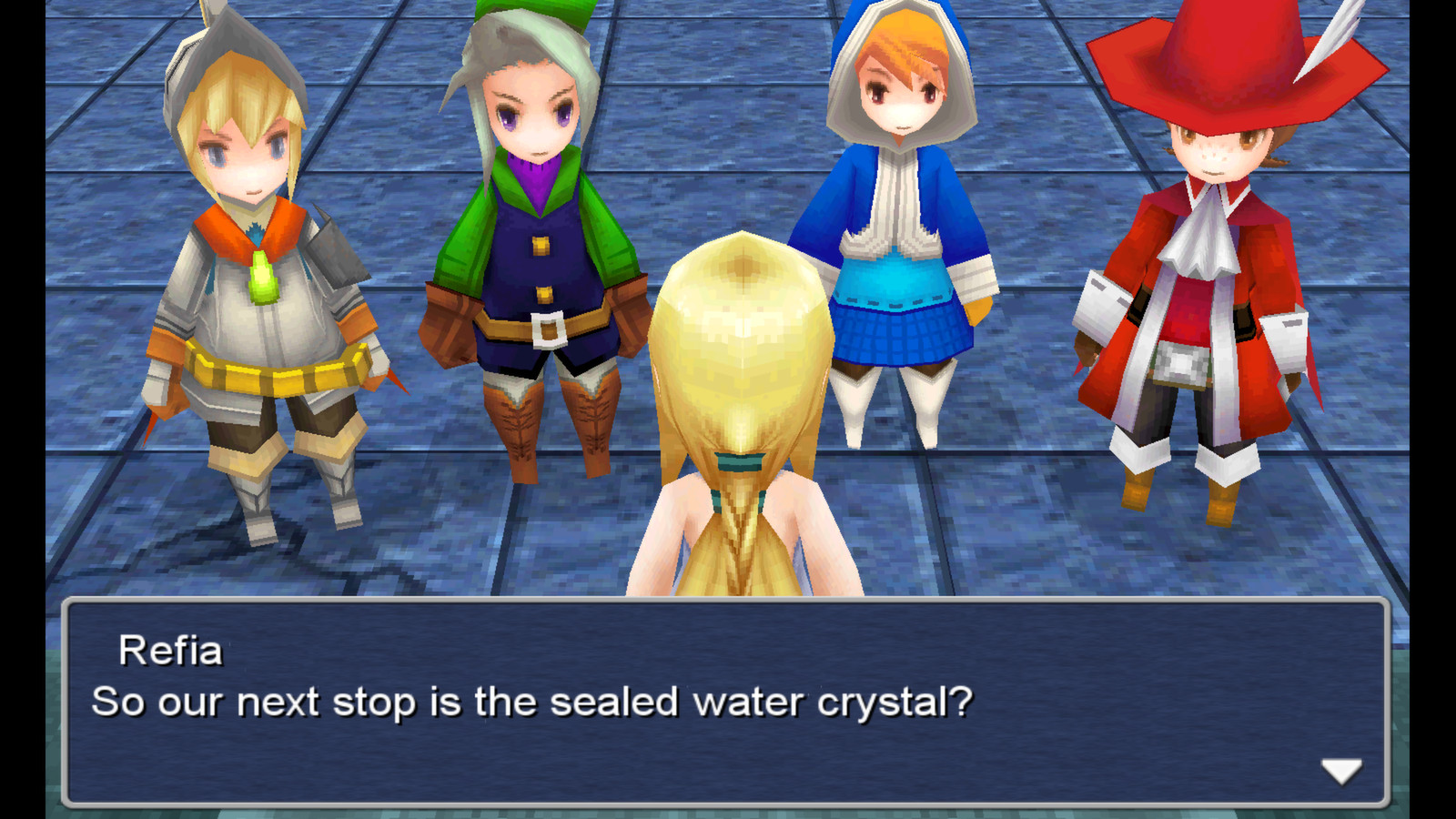
Final Fantasy III (3D Remake)

Final Fantasy III's 3D remake was notable for being the first time the game was released on something other than the Famicom - throughout the slew of remakes and enhanced ports the series got on the Playstation and the GBA and even the Wonderswan, Final Fantasy III was conspicuously absent.  Of course, having played the original Famicom release emulated I picked it up as soon as I could, but what I found was a pretty stark departure from that version.  The opening sequence of events is changed slightly, the protagonists are given prefab names and designs (by Akihiko Yoshida, who also designed characters in the Ivalice games) and the gameplay was pretty heavily reworked.  Everything feels considerably slower and battles are scaled down quite a bit, generally having no more than 4 enemies (whereas the Famicom version had double that at times).  The job system is also reworked to be more "balanced", with lackluster results - rather than the specialized jobs of original FF3, most are now more-or-less hybrid classes, adding more spell slots and abilities rather than having you focus on their individual strengths.  Worse is that there's more grinding involved now; class levels were a thing in the original FF3 and did affect stats, but to such a small degree that it was hardly worth the effort of grinding them out.  Here, it's basically mandatory, and you get to do it all again each time you find a crystal and unlock more jobs to use.  Even dopier is the fact that they've significantly nerfed the two endgame classes - Ninja and Sage - giving them low stats to offset their ability to use any equipment or spell respectively.  Onion Knights (the default class in the original) become a hidden class that comes late in the game, and like their original counterparts they are pathetically weak until you get their class to level 92, at which point their stat gains skyrocket; and gain spellcasting abilities too, which they completely lacked in the original.  There is at least an attempt to spice up some of the more lacking elements of the original game by adding in an optional boss and tweaking the final battle to be more involved, but they're only marginal improvements on a rather dragging and overall slow experience.  Final Fantasy III's 3D remake doesn't add a lot of substance and actively subtracts from the original in many other ways.  It may have provided a passable experience to some fans who were eager to check out the long-neglected third entry in the franchise back in the mid 2000s, but with the subsequent release of the Pixel Remaster (which is far more faithful to the original game), there's no reason to come back to this one.


Developer: Matrix Software, Square Enix
Publisher: Square Enix
Platform: Nintendo DS, iOS, Android, PC
Released: 2006, 2012, 2013, 2014

Saturday, August 27, 2022

The Bouncer

A game that had a considerable amount of hype behind it, in no small part because it would have been Square's first (published) game on the Playstation 2, but it ended up being quickly cast aside after its release.  I've hyperbolically described a fair number of modern games as having the barest minimum of gameplay in between long droughts of visual filler, but the Bouncer might just be the first game I've seen that literally follows that design philosophy.  Playing like a 3D beat-em-up (and similarly to other DreamFactory developed games Tobal and Ehrgeiz), you battle 2-6 enemies in bouts that typically last under a minute and then more of the story unfolds in long sequences of FMVs, with only about three or four run-through-a-maze action segments providing any changeup between those two elements.  Rinse and repeat for approximately two hours (about a third of that if you skip all the cutscenes), and you've completed a playthrough.  Yes, the game is really that short; so you can imagine how many die-hard Square fans lined up, plunked down $50 to play an epic next-gen action-adventure game on their expensive new Playstation 2 console, and were left severely disappointed when they finished the whole game in the same afternoon they first booted it up.  They tried to add at least some depth with the built-in experience system, where landing the finishing blow on enemies earns your character points that allow you to unlock new moves and power up your attributes, as well as a couple of extra game modes (including a four-player versus battle) where you could put your powered-up characters to a greater test, but it all just feels like fluff in the end; especially when the core gameplay is so stock that arcade games stretching all the way back to the mid-'80s already did everything it does better.  Hell, even the Playstation 2 itself would get some much better RPGs that blended in beat-em-up elements like Kingdom Hearts, Yakuza and Odin Sphere, all with much more engaging and strategic gameplay to boot.  So while the Bouncer might at first appear to be a long-lost Square gem to gamers who weren't around in the early 2000's, it's actually been forgotten for good reason - it's so insubstantial and over with so quickly that it leaves no lasting impact.

Developer: DreamFactory
Publisher: Squaresoft
Platform: Playstation 2
Released: 2001

Sunday, August 7, 2022

Wizards & Warriors

Not to be confused with the similarly-named trilogy of NES action-platformer games, Wizards & Warriors on PC is a game by David W. Bradley, who made his name working on Wizardry 5, 6 and 7.  During 8's protracted development, however, he had a falling out with Sir-Tech and left the company, enjoying a brief stint with Origin Systems (and releasing Cybermage: Darklight Awakening) before founding his own company, Heuristic Park.  Wizards & Warriors is seemingly his attempt to carry on in the tradition of the Wizardry series - a traditional dungeon crawling experience with multiple races, the four basic RPG job classes (Cleric, Wizard, Thief and Fighter) that can eventually upgrade into powerful 'prestige classes', and plenty of randomized loot and respawning monsters to fight, but gameplay-wise it's changed up a fair bit from its inspiration.  In fact, it actually plays a bit closer to Might and Magic 6-8 than any of the classic Wizardries, operating in real-time and with a first-person, full-3D viewpoint, though everything you do is still governed by dice rolls.  It's a very awkwardly balanced experience, too - enemy spawns seem to be highly random, often appearing only one or two at a time or dropping huge groups on you with no forewarning whatsoever, there's huge and sudden leaps in difficulty even within a single dungeon, leveling takes ages as quests and monsters give a piddly amount of experience each, stat gains from levels are randomized (which can put you at a serious disadvantage later on), and ranged weapons and "diplomacy skills" have no practical use that I could find.  Seemingly taking some cues from Daggerfall, you can also undertake semi-randomized quests at pubs and guilds and purchase horses to ride for slightly more movement speed, though the latter is largely a waste of money - you don't go much faster than you do on foot, and you can easily outrun nearly every monster in the game without a horse anyway.  Basically, Wizards & Warriors is a game that might have garnered a bit of a following had it come out in the early '90s, but by the year 2000 its rigid design sensibilities and general lack of polish made it look seriously dated compared to the likes of competing franchises like Baldur's Gate, Might and Magic, Deus Ex and Diablo.  Wizardry 8's release, despite being over a year after W&W's, only further doomed it to obscurity, as it married classic dungeon crawling and new elements together in a well-crafted, fan pleasing conclusion to the series.  Heuristic Park would take one more crack at an old-style dungeon crawl with 2005's Dungeon Lords, but it being released in a very rough, unfinished state led to their downfall and the closure of David W. Bradley's career as a game developer.


Developer: Heuristic Park
Publisher: Activision
Platform: PC
Released: 2000