RPGreats now has a Discord! Come on in to talk about game music, games in general, submit reviews or just hang out!
Showing posts with label Series: Baldur's Gate. Show all posts

Friday, November 15, 2024

Baldur's Gate: Siege of Dragonspear

A bit of an oddity for sure, Siege of Dragonspear is an interquel/expansion to Baldur's Gate Enhanced Edition, released nearly two decades after the original game was on PC and sixteen years after the story was concluded in Throne of Bhaal.  Serving to bridge the gap between the first and second games, it has the protagonist come under attack by a group of assassins under the command of a crusading warrior known as the Shining Lady who threatens the stability of the Sword Coast.  Imoen is unavailable for much of the game for plot reasons (first poisoned, then in an apprenticeship to explain her new status as a mage in 2), but much of the main cast from the first game returns, as do several new characters exclusive to this expansion.  The progression is very linear - you just hop from one area to the next in each chapter, a small contingent of Flaming Fist soldiers accompanying you, selling you items and storing your equipment, and while there are a few optional missions to undertake, the main story definitely takes precedent.  The story itself is serviceable, if not particularly memorable, but the dialog seems to be trying way too hard to be clever/funny and as a result becomes more annoying than anything.   The voice acting is decent for the most part, with many of the original cast returning (including the late David Warner as "the Hooded Man", whose scenes are easily the highlight of the whole package).  Encounters also strike a middle ground, mostly consisting of stronger variants of enemies from 1 with a few from 2 mixed in and it raises the experience cap to 500,000 - just enough to let you gain an extra level or two without completely disrupting the second game's balance, so it feels like a proper interquel in that regard.  All in all, an inoffensive but ultimately inconsequential addon.

Developer: Beamdog
Publisher: Beamdog, Skybound Games
Released: 2016
Platforms: PC, OS X, Linux, iOS, Android, Switch, PlayStation 4, XBox One

Saturday, April 15, 2023

Baldur's Gate III (Review #300!)

Can you believe I've been doing this for six and a half years now?  Neither can I.  Ah well.  For my 300th Full Review it's time to look at a revival of a classic CRPG franchise.

A beloved PC RPG classic, Baldur's Gate fell off the map for a long time as Interplay went bust, only recently coming back to prominence with some Enhanced Editions and, later on, being revived under a different company's banner; not unlike the similarly-beloved Fallout series.  But does Baldur's Gate III prove to be a worthwhile return for the franchise despite the major change, or is this just one comeback that never should have happened?
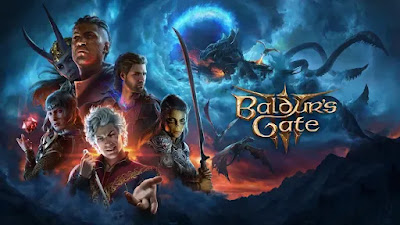
The early 2000's was definitely a tumultuous time for western RPGs; Interplay's closure meant that Fallout - regarded as a savior for the genre by many - would go dormant for nearly a decade, controversially being revived by Bethesda in 2008.  Baldur's Gate, while developed by BioWare, ran on the Infinity Engine owned by Interplay, so it too fell victim to their financial troubles.  Bioware and the newly-formed Obsidian would continue to develop original games with new engines and publishers, and a decade later the offshoot studio Beamdog (and their division Overhaul Games) would develop Enhanced Editions of several of the Infinity Engine games, reviving interest in seeing the series return.  Despite Beamdog teasing a third entry for the series, though, it would eventually come to be developed by Larian Studios - a company hot off the success of their Divinity: Original Sin games and using the engine from them.  That meant the series' gameplay changed up, going from pausable real-time combat to a turn-based style, and like Fallout 3 before it, it would discard all the work done on a canceled early version of the game (Baldur's Gate III: The Black Hound) in favor of telling an original story.

Of course, Dungeons and Dragons itself has also undergone some heavy changes since the '90s, so the gameplay itself is also changed up a lot from the earlier Baldur's Gates, being based around Fifth Edition rules rather than Second Edition.  Later revisions of the ruleset are in numerous ways geared much more toward roleplaying and storytelling than simple monster smashing (and indeed, I've criticized other D&D games based on Third Edition and later rules for focusing so heavily on combat to the exclusion of everything else, since so many other mechanics go completely to waste).  Baldur's Gate III does it right, though - you're afforded a surprising number of options to deal with almost every situation, and while it of course makes sense to stay in line with your character's pre-built stats and skillsets, you're by no means bound to them.  You can bluff, intimidate, use stealth, arcane knowledge or just brute-force your way past almost any obstacle, favorable stats or otherwise.  Indeed, you can avoid nearly all combat with successful skill rolls, or at the very least find creative ways to turn things to your favor ahead of time.  Staying in line with a given character's principles as you complete puzzles also earns you "Inspiration Points", which allow you to redo failed rolls - always a nice thing to have when you get the notorious Natural 1 on what should be an easy roll (or just want another crack at a particularly challenging obstacle).

As mentioned, the game utilizes the same engine as the Divinity: Original Sin games, so combat here bears a strong resemblance to those - gridless turn-based action with a heavy focus on field control and elemental effects.  Spells can lay down effects like acid, poison or fire that will damage enemies passing through them, while ice or grease can make anyone who passes through them slip and fall and water can be used to conduct electricity, damaging all enemies inside it.  Grease and oil can likewise be lit on fire to damage all enemies standing in it (and ignite them for further damage in subsequent turns).  One also gets a height advantage shooting down at enemies from above and a penalty for attacking enemies above them, and oftentimes you can lure enemies into a narrow corridor or run around a corner to shield yourself from ranged attacks.  Barring that, you can also create clouds of steam or smoke to obscure their view, though this can also work against you as well.  At other times you can also weaponize the environment in creative ways, like knocking over braziers full of burning coals or even collapsing bridges to cause enemies to tumble to their doom, though you lose our on any treasure they may have been carrying.  In short, it's the first tabletop RPG inspired engine that actually lends itself well to that style of improvisation and creative thinking; indeed, it's very hard to survive without employing creative tactics whenever possible, as you're always at the whim of the dice to land hits with your weapons and most spells, so every advantage you can give yourself is a worth taking.

Character creation is something I always tend to dread in western RPGs, mostly because it's very easy to hose yourself unless you're intimately familiar with both the rules of the game itself and what the game is going to throw at you in advance, which results in a lot of tedious rerolling and frustrating game sessions where you're setting yourself up to fail and not even knowing it.  You may not think it given my choice of genre to review on this site, but I detest tedious overdone stat crunching and inane micromanagement in games.  It's certainly not necessary for a good RPG experience, especially since the genre (ostensibly) began as a means of storytelling rather than a dopey math lesson. Original Sin 2 largely averted inane stat-crunching by being a well-balanced game, but also by allowing you to respec your character at almost any time by finding the nearest magic mirror if your current build was just not working out.  Baldur's Gate III does a good job avoiding it as well, offering a solid explanation of all the skills and stats each race, background and character class provides, as well as giving you a pretty well optimized starting stat loadout by default (and when you level up); of course, you're also free to customize at your leisure if you're a die-hard min-maxer. Fifth Edition also largely does away with the issue of "Dump Stats" present in earlier D&D versions, mostly tying characters' abilities to stats and proficiencies they're expected to have.  So Bards, Paladins, Warlocks and Sorcerers cast from their Charisma rather than superfluously relying on Intelligence, for example, and having knowledge of a particular field gets bonuses based on a character's background and learned skills (and the subsequent roll bonuses they grant) rather than a bare stat roll.  All of this stuff contributes in various ways to letting you focus on enjoying the gameplay and the story rather than obsessing about the number crunching going on under the hood, which earns it a lot of points in my book.  Of course, even if you still dislike your current build, you can visit a character at your camp named Withers and pay him a small fee to respec any or all of your characters.

Something else the game gets down (after so, so many failed attempts in previous western RPGs) is that the roleplaying element actually feels natural and well-done.  Rather than having a predetermined chaotic/lawful/good/evil scale that you're rigidly glued to the entire game, your choices throughout all feel valid, all have palpable consequences, and any of them can make you new friends or enemies depending on how you handle them.  Your party members all have their own personalities, backstories and motivations as well and will react accordingly to your actions, and may become offended or even leave entirely if you do too many things they dislike; though you may be able to mitigate this to a degree with successful skill rolls, peoples' patience will inevitably run out, so every choice on your long journey feels weighty and requires careful consideration.  Getting them to change the ways they're rooted in is no easy task either; it requires a long and subtle commitment and not just one dice roll at a pivotal moment.  All good stuff, though as ever, the attempt to fit character romance into a largely open-ended RPG experience feels very shoehorned and cringey, with characters trying to get in your pants mere hours after you meet them.  Considering Fallout and Star Control were already actively mocking badly-written nymphomaniac characters in the '90s and yet devs like BioWare and CDPR roared ahead with it anyway with no trace of irony, I don't think it's a problem that will be resolved anytime soon either.  The final act of the game gets pretty messy too, with far too many extraneous subplots tangled together and even trying to tie it back to the first two games with nothing indicating the story would go in that direction before that point, so it becomes a bit of an overblown mess, and I definitely don't recommend trying to go for anything resembling full completion in it.

But even with a few minor missteps and the baked-in frustration factor of having everything being built on random all-or-nothing rolls, Baldur's Gate III is a stellar experience.  The engine lends itself well to not just intense and strategic combat with a lot of subtle nuance, but to actual role-playing - creating a character, thinking how they would think, forging alliances with other characters, bluffing your way out of trouble, and seeing the consequences of your actions unfold in a surprisingly organic way without making every action feel like a trite good-or-bad pull on some overarching moral compass that determines which boolean endings you'll get.  The strong narrative, surprisingly good voiceover and never once having to rely on a dopey plot codex to get you caught up on what's occurring also speak well to its quality.  It's a game about playing a role first and foremost, and for that reason it's one I'll eagerly be playing it for a good, long while.  Hell, it easily ranks among the finest western RPGs I've ever played.


Developer: Larian Studios
Publisher: Larian Studios
Released: 2020 (PC early access), 2023 (Full release)
Platforms: PC, macOS, Playstation 5, XBox Series
Recommended Version: Only available on Steam Early Access as of this writing.

Monday, December 2, 2019

Baldur's Gate II: Shadows of Amn

The second game in BioWare's Baldur's Gate series, which made several tweaks to the original's design and, after an expansion was released, concluded its running story. But does Baldur's Gate prove to be a worthwhile adventure for D&D fans, or is this simply a lackluster sequel to a game that hasn't aged particularly well?


The original Baldur's Gate was a game renowned among PC gamers and D&D fans in general for its interesting storyline and strict adhesion to second edition rules, making it a classic to both camps.  It was not without its faults, however - the overall slow progression and some downright cheap encounters with enemies that could spam various debilitating effects (charm, stone, web, etc), paired with an extremely long duration for all of them, made combat downright frustrating at times and frequently all but forced the player to cheat in order to get by.

Baldur's Gate 2 continues this trend, adding some new effects to the mix like confusion and level drain (and my personal least favorite, psionic attacks from mind flayers that leave the player stunned for an extremely long time and vulnerable to their instant-death brain eating attack).  However, the game does show some improvement in this regard too, shortening the duration of many of the nastier statuses and taking care to give the player tools to counter most of them (like a Level 4 Lesser Restoration spell to counter level drain which did not exist in the tabletop game).  Many pieces of equipment also grant resistance or immunity to particular effects, and several class kits do as well, so there are tools to counter a lot of the nastiness one encounters.  Still, some fights are extremely cheap and all but require the player to use some underhanded tactics to succeed, so the big overarching issue from the first game is mitigated to a degree, but by no means eliminated.

Class kits are a new addition to Baldur's Gate II, adding much to the game's flavor and replayability.  Essentially, each of the generic D&D classes now has one of several variants the player can choose from, granting them some new abilities in exchange for others. For example, the Cavalier kit for the Paladin is completely immune to fear, charm and poison, gets innate fire and acid resistance and can cast Remove Fear once a day to aid the party, but cannot use any missile weapons.  Some offer a relatively reasonable balance of advantages and drawbacks (like the Kensai kit for the Fighter, which can deal out massive damage but cannot use any armor or ranged weapons) while others are virtually straight upgrades (nearly all of the Thief, Cleric and Bard kits).  One even has the option to retroactively apply them to characters imported from the previous game, which is a nice touch (though it comes with the drawback of averaging out their HP if the player employed savescumming to maximize their HP gains).  It can also allow for some amazingly powerful Dual Class combinations, like the Kensai dialing to a Mage and getting several spells to offset his weak defense, or a Cleric that gets the high weapon proficiencies and special abilities of a Berserker.

Some other significant improvements quickly show themselves too.  There is a much greater focus on party member interaction now, with each character one encounters being tied to their own questline and having several unique dialogs with the player and one another.  This can be interesting at times (like Viconia's character arc which, played properly, can convince her to change her alignment), and at other times it can be deterimental; some characters outright hate one another and will fight to the death if kept in the same party for too long.  One even has romance options with many of the female characters (though only one male character if playing as a female character yourself, disappointingly).  It ultimately doesn't have a huge effect on the overall gameplay most of the time, but it is nice to have the option and for characters to have alternate endings depending on the player's choices.  The antagonists in BG2 are significantly more nuanced too, proving to be effectively well-written and with a legitimate strong element of tragedy to them instead of the rather cartoonish ones of the first game.

The gameplay is much more focused as well. The world map is no longer nearly as expansive, with more interesting areas than just "woods with slightly different enemy sets" and fewer random encounters with generic goons on the way to a destination.  Sorely lacking from the original game, the player is now properly rewarded for completing quests with a large sum of experience for each character, not just a lump sum spread across the entire party.  Another nice bonus is that the player is afforded a unique questline depending upon their chosen class - thieves get to run a thieves guild, bards can run a playhouse, fighters get a castle (and must keep their peasants safe and taxes reasonable, lest they revolt), to name a few.  The rewards for these tend to be pretty useful and worth undertaking, as well as satisfying from a storytelling perspective, and it's another nice element of depth and replay value for the game.

Like many D&D games, Baldur's Gate doesn't offer a lot in terms of player alignment roleplaying choices.  There are only a small handful of times when being "evil" causes a storyline to change significantly (mostly in the form of your allies leaving the party), and there is very little benefit to choosing an evil character.  A few quests may yield useful alternate rewards, but for the most part, you're just doing more harm than good to your own experience by playing an "evil" character, as letting your reputation drop too low will cause you to constantly be attacked by bounty hunters and result in much higher prices in shops.

Baldur's Gate II is a logical extension of the first in every way, proving to be a much better experience on a storytelling and design front but every bit as frustrating as its predecessor managed to be in a lot of ways.  Combat still requires you to exploit loopholes to win at times, the roleplaying element of the game is stronger but still not amazing, and a general lack of balance and polish leads to a game with some very uneven difficulty and a lot of save-scumming being required to succeed, as well as some pretty game-breaking exploits for the player to abuse once they're aware of them.  Still, the game's stronger elements shine through to make it an entertaining experience, and in my book, still BioWare's best game.


Developer: BioWare, Black Isle Studios, BeamDog
Publisher: Interplay, Atari
Platform: PC, iOS, OSX, Android, Linux, Switch
Released: 2000, 2012, 2013, 2014, 2019
Recommended version: The 2013+ update (dubbed "Enhanced Edition") makes some quality of life improvements like widescreen resolution support and a much-improved AI, as well as programmable party AI and some enhancements like new characters (most of whom can be romanced), quests and kits to play as, which only adds more depth and replayability to a game already swimming in it.  It also includes an alternate story mode (The Black Pits II), the original expansion and bonus disc content packed in, making it a definitive release.

Sunday, February 25, 2018

Baldur's Gate

To many PC gamers of the late '90s, Baldur's Gate was one of the games that put BioWare on the map and helped push Dungeons and Dragons games into a new generation of the gaming consciousness.  But does BioWare's breakout game stand the test of time, or is this one adventure that's best left as a historical curiosity and little else?


Dungeons and Dragons is certainly nothing new when it comes to the world of video games - having been around longer than the medium itself, there have been numerous D&D inspired games from the very beginning.  Games like Ultima, Wizardry, Dragon Quest, Final Fantasy and Might and Magic all drew heavy influence from the game, and it of course inspired a franchise of games in itself.  Probably the most prominent of these for most of the 1980s was the "Gold Box series" by Strategic Simulations, which effectively carried over the rules of the tabletop game while also engrossing the player in a long-running narrative that spanned four games and even a toolkit that allowed players to build their own adventures in the engine.  Others soon followed, including the Dragonlance series, the Eye of the Beholder games, and even the first graphical MMORPG ever made, Neverwinter Nights, released in 1993.

BioWare acquired the license in the mid-90s and threw their own hat into the ring with Baldur's Gate in 1998.  Baldur's Gate, unlike many of its predecessors, aimed to provide a true "role-playing" experience by giving the player freedom of choice and multiple ways to complete almost every objective put before them.  This, aided with a dense narrative, developed characters with a complement of voiced dialog (with no shortage of big names like Jim Cummings, Jennifer Hale and Grey Delisle) and a very large number of sidequests, made for a game that provided quite a lot more content and variation than most RPGs before it.

Baldur's Gate was also quite an impressive game on a presentation front.  Like many games of the era, it took full advantage of the CD format to provide not only a lot of gameplay content, but a strong graphical and audio presentation.  Music is in typical quality for the format, lending a strong orchestral feel to the combat and some nice atmosphere for the towns.  Visuals in the game, unlike many RPGs of the era, were also not tile-based, instead utilizing prerendered backdrops and fully animated 3D models for the characters, giving it a more fluid feel overall.  Key scenes are also conveyed through computer-generated FMVs which, while laughably dated by modern standards, were quite a sight to behold in the late '90s.

In terms of gameplay, Baldur's Gate is somewhat more of a mixed bag, however.  Advanced Dungeons and Dragons rules are painstakingly recreated in the Infinity Engine, for both good and ill.  This, paired with the game's low level cap (89,000 experience in the base version, 161,000 with the expansion installed) proves to be a point of frustration on several fronts.  Many classes that truly shine at higher levels, such as Mages, prove to be nearly useless for a large portion of the game, getting to cast only a small handful of spells and then becoming dead weight until the party rests again.  Even the latter proves problematic, though, as one has to make the ever-infamous THAC0 rolls to hit anything, which start at a very high base and grow lower (requiring lower rolls) as their level decreases - thus, many of the early game fights become a frustrating affair of standing toe-to-toe with each enemy you run across and hoping you hit them before they hit you too many times and kill you.  Experience is divided evenly amongst the entirety of the party, which, when paired with the overall low experience gains most enemies give, ends up making leveling an extremely slow and arduous process.  Some spells like Hold, Confuse, Horror and Charm also last an obnoxiously long time, usually persisting until long after the fight ends and forcing the player to wait long periods before getting to quicksave.  In the worst possible cases, allies can even run off randomly into another encounter while under the influence of Fear or Confusion and get slaughtered, forcing the player to reload and lose several more minutes of progress than they normally would.

Worse, the game also falls into the trap of making fights atrociously difficult in its late stages, which can boil some encounters down to either pure luck or basically having to "cheat" to succeed.  Two prominent examples in my mind come during an ambush where the player must defend some officials from hasted, high-leveled doppelgangers who resist all spells and beeline straight for their quarry, with an instant game over occurring if they die; I spent well over three hours here alone simply trying every spell, wand and strategy at my disposal to get them to survive long enough to give me a fighting chance, only eventually winning out by pure luck.  The final battle is just as much of a pain, with the villain flanked by numerous high-level mages who cast spells well beyond what the party can, flooding the screen with webs, confusion, fireballs, Malisons, and all sorts of other ridiculous effects that the player has basically no means to resist, all whilst the main baddie (a very high-level, magic-resistant fighter) is running around landing highly damaging attacks with every swing and the room is littered with booby-traps that only unleash more pain on the party.  The only recourse I found here was to stealthily pick off the guy's mages from a distance with fireballs and Flaming Oils before the fight even began, then have one Hasted character serve as a diversion while the rest pelted him to death with Magic Missiles and flaming arrows.  It felt completely unfair and is probably not at all what the developers intended, but it was either that or get slaughtered in an endless barrage of status spells and fireballs, so I saw little recourse in the matter.

In the end, Baldur's Gate is a Dungeons and Dragons game with a particularly insidious GM at the helm, throwing everything nasty they can think of at the player and all but forcing them to abuse quicksaves and various bugs and exploits in order to succeed.  Even then, though, they'll still have to reload many times as their main character gets unavoidably killed by a cheap shot and brings the game to an immediate end on an extremely frequent basis.  Some may applaud it for that - I did at first too - but games like Shadowrun, Oblivion, Skyrim and Fallout: New Vegas would later serve as proof positive that western RPGs could do just as well without rigid and arbitrary dice rolls dictating every facet of the game experience, or nearly as many instances of a single one meaning the difference between life and death.  So while I do applaud the game's narrative and eye for detail, I don't find it a particularly fun title to revisit today.  Its sequel fares somewhat better, having cut down the effect time of many spells and the higher level of the setting lending less "save-scummy" feel to the proceedings, as well as adding many more gameplay options, but I see little reason to come back to OG Baldur's Gate 1 these days.


Developer: BioWare, Black Isle Studios, Overhaul Games
Publisher: Interplay, Atari
Platform: PC, iOS, OSX, Android, Linux
Released: 1998, 2012, 2013, 2014
Recommended version: The 2012-and-on rerelease "Enhanced Edition" updates the game into the Baldur's Gate 2 engine, allowing for a much greater number of class choices, reduced spell durations on many effects (most prominently Charm and Sleep) and a much less cumbersome interface.  This also for higher resolutions, adds in some new characters and a new, alternate story mode called "the Black Pits", which mostly just amounts to increasingly difficult combat challenges and little else.  There's also a new expansion called "Siege of Dragonspear" that bridges the story between 1 and 2.  These new additions are of somewhat uneven quality, but the updated engine alone makes it a considerably smoother experience than the original release, as well as one more befitting modern standards (the original game could only run in 640x480 or 800x600 fullscreen mode).  All in all, a much better experience today; add an extra half-star for that version.