RPGreats now has a Discord! Come on in to talk about game music, games in general, submit reviews or just hang out!
Showing posts with label Developer: Game Arts. Show all posts

Monday, May 23, 2022

Grandia: Parallel Trippers

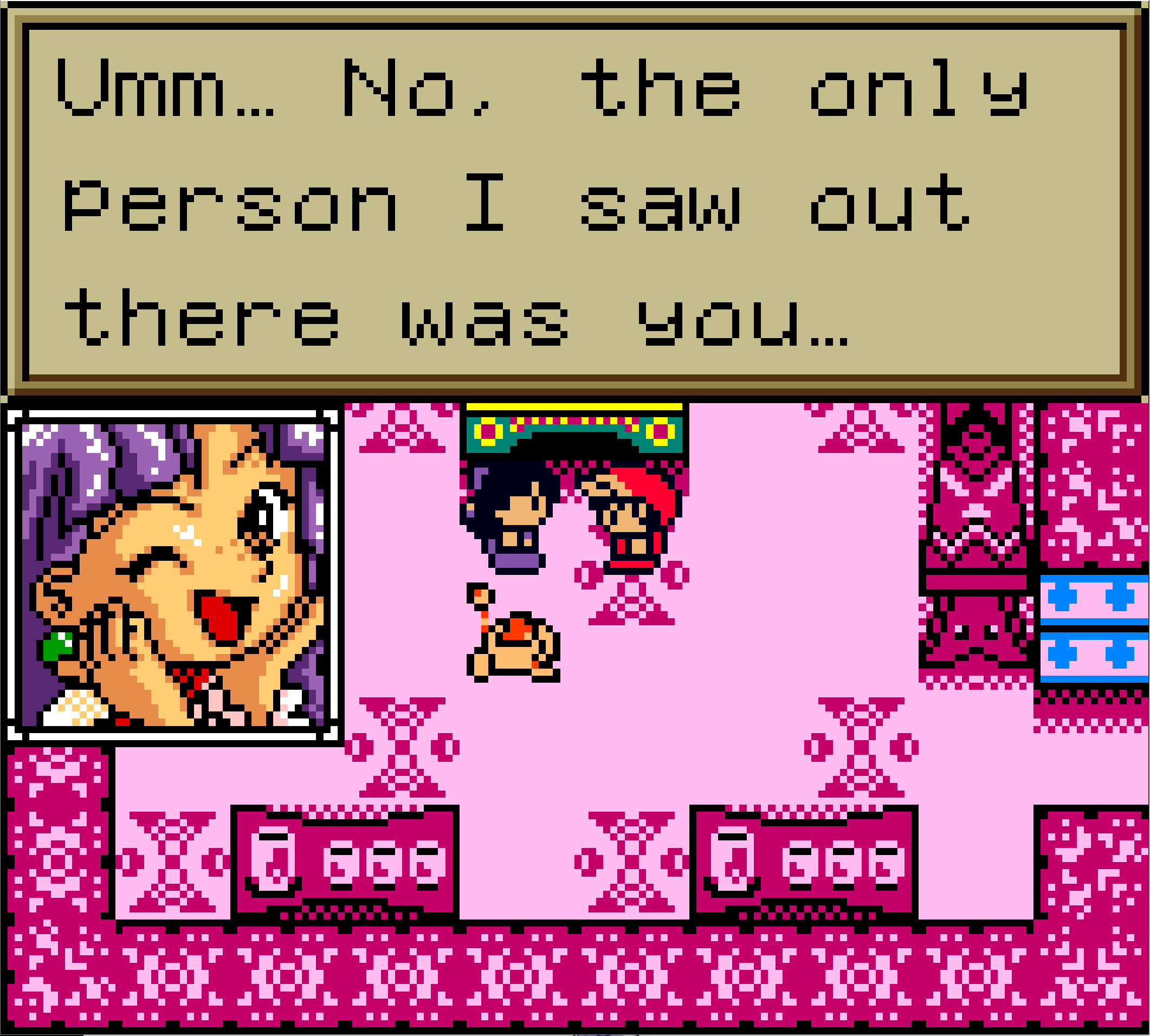
Game Arts' breakout game is doubtlessly Lunar, but not nearly as many people talk about Grandia.  And it's a shame, as I actually think it's a fantastic series, with the first game in particular even surpassing Lunar in its sense of adventure, wonderful characters and overall fun design, and I'm glad it's available on modern platforms alongside its sequel in the Grandia HD Collection.  As with many late '90s games, though, it had a spinoff on a portable platform; this time as a Japan-exclusive on the Game Boy Color.  The plot stars a character called Yuuhi who, along with his friend and rival, are pulled into the world of Grandia, and he must ally with the familiar protagonists of that game to reunite with his classmates and return home.  It incorporates some of the actiony elements of Grandia's dungeons, having you jump pits, avoid hazards and solve puzzles to progress, and even has quite a few familiar musical beats from the original game.  Combat is changed up to be  a turn-based experience, though still incorporating Grandia's Initiative-Point based combat to a degree - after selecting an action you can choose where to place a character on the timeline, and having several characters act in succession can combine their moves together into new, damaging combinations for extra damage and effects (like hitting all enemies on the field or inflicting a different type of elemental damage).  Actions themselves are tied to a collectible card element; you find new cards by winning battles or as treasures in the field, and you can then equip them on characters to use them in battle, or combine two cards together to potentially get a new type of card, or two similar cards to combine them into a more powerful version.  It all feels a bit like it's hopping on the bandwagon of Pokemon, Digimon and similar collect-em-all games of the time, but it's at least a well-executed and entertaining experience.  Grandia fans will definitely get the most out of it, though.


Developer: Game Arts
Publisher: Hudson Soft
Released: 2000
Platform: Game Boy Color

Saturday, May 1, 2021

Faria: A World of Mystery and Danger!

Game Arts is a beloved company to many old-school gamers, responsible for the Lunar and Grandia franchises, as well as for some other cult favorites like Silpheed on the Sega CD and Alisia Dragoon on the Sega Genesis.  One of their earlier outings on home consoles, however, was not so well received.  Faria has all the makings of a good 8-bit RPG - well-detailed visuals, charming characters and a creative fantasy world - but the gameplay unfortunately does not stack up.  Combat in the game, rather than a turn-based format, is done in real-time, with you trying to defeat enemies in an overhead battlefield before they deplete your HP.  Unfortunately, some spotty hit detection makes it difficult to take hits without being hit yourself, and you die very easily, especially early on, when you can go straight from an encounter with some weak bug enemies to getting your face punched in by a hulking red monster many times your current level.  Running from combat only docks you further, causing you to lose experience, gold, or even equipment you've picked up (which really sucks when you drop a piece of gear you just spent hours grinding for).  Pair that with uninteresting dungeon designs and a extraordinarily high encounter rate, and you have a game that just isn't fun to play.  You'd expect a lot better from the studio that brought us the legendary Lunar games just a few years later, but Faria is an RPG that sadly ranks among the system's worst.


Developer: Game Arts
Publisher: Hi-Score, Nexoft
Released: 1991
Platform: NES

Tuesday, March 24, 2020

Lunar 2: Eternal Blue Complete

Lunar's first remake for the fifth generation of consoles was a hit with fans of classic 2D RPGs, so it was inevitable that its highly-acclaimed sequel would soon get a remake of its own.  But does this remake do justice to the Sega CD cult classic, or is it simply a flawed counterpart?


Despite being released late in the system's life and garnering overall low sales as a result, Lunar 2 on the Sega CD quickly became a cult classic for the platform and is still widely hailed as one of its best games.  Its gripping story and high quality animated cutscenes were a sight to behold, as was a great CD soundtrack and even surprisingly competent voice-over for the era.  But it was marred with criticism as well, mostly for its publishers (the ever-controversial Working Designs) making bizarre and unnecessary alterations to both the gameplay and the script.  Like most of their games, it's translation was far from faithful to the original Japanese script, changing many plot points and adding in numerous juvenile jokes.  There are also an abundance of references to the movie "This is Spinal Tap" - even the company's motto at the time was "our games go to 11".  Many gameplay changes were implemented as well, ostensibly to add challenge but in practice making the game considerably more grindy and less fun.  The difficulty has been dramatically ramped up through higher MP costs for many spells, buying items and healing at shrines cost much more money, enemy stats were all cranked up, and most infamously of all, it forces the player to pay large sums of valuable Magic Experience (dependent on Hiro's current level) just to save the game - something that didn't exist at all in the original Japanese version. 

Thankfully, they seem to have finally taken that criticism to heart by the time Lunar 2's remake was announced.  Eternal Blue Complete was left largely untouched gameplay-wise, only making some minor tweaks to address bugs and other inconveniences (like disallowing items in fights the player is scripted to lose so that they don't go to waste). The translation is also a bit more subdued than their earlier efforts, though still laden with jokes, silly accents and pop culture gags (one that particularly stands out to me is a Who Wants to be a Millionaire reference, which dates the game quite a bit).  As usual, they also went all-in with the packaging, shipping the game in a foil-stamped box and including extras like a map, a bonus CD with a "Making of" commentary, a hard-cover manual and a set of miniature standees depicting all of the main cast.  They were very obviously passionate about their works and tried to invoke the mood you'd get buying an old big-box PC game with all the extras - you weren't just playing a game, you were adventuring into another world.  The downside, of course, is that complete copies of the game are now somewhat sparse and can go for over $100 online.

Eternal Blue Complete's gameplay is largely modeled on its predecessor's, retaining many of the improvements it brought. Random encounters are still a thing of the past, now allowing the player to see them on the dungeon map and evade them with the ability to dash. Combat retains a slight tactical bent, with each character having a finite movement range per turn and some attacks having areas of effect, giving the ability to hit large groups of enemies at once and lessen the damage from some moves by spreading out the party. The Magic Experience system from the original is done away with completely in favor of earning spells through levels, with some attaining more powerful upgraded versions after the player's level reaches a certain threshold.  Ruby (Hiro's dragon companion) also aids in battle, though in a slightly different manner than Nall from the previous game - if an enemy is reduced to very low HP but not quite dead, she will often fly down and deal a finishing blow at the end of the round.

A new addition to the game is the Crest system.  Crests are items that grant small stat bonuses/penalties and occasionally spells when equipped.  This allows for a degree of character customization, and some even allow any character to cast elemental attacks, letting you exploit weaknesses more easily than in 1.  Seemingly taking a cue from the Final Fantasy series, many items also have extra effects when used in battle; particularly staves, which often cast mid-ranged elemental spells for no MP cost.  One of the more interesting ones is the Thieves' Staff, which grants a chance to steal items from enemies; you won't get anything too rare from most enemies, but having a few extra Angel Tears or Star Lights around is never a bad thing, particularly late in the game.

Lunar 2: Eternal Blue Complete, simply put, is a great update to a classic, taking the same great story as the first and updating it to a new generation in style.  Higher-quality cutscenes with top-notch animation, remastered music that sounds fantastic, the same great reworked engine and design philosophy as the first Lunar remake, and a number of gameplay improvements over the first.  Working Designs resisting the urge to make the game more difficult certainly helps it too; the game is polished to near-perfection as is, providing just the right amount of challenge without ever feeling overbearing and rarely requiring the player to stop and grind for experience and resources.  It may not be the most visually impressive PS1 RPG or quite as memorable as the remake of 1, but it's an elegant, enjoyable and charming update of a Sega CD cult classic.


Developer: Game Arts, Studio Alex, Japan Art Media
Publisher: Kadokawa Shoten, Working Designs
Platform: Sega Saturn, Playstation 1, Playstation Network
Released: 1998, 2000, 2015
Recommended version: Thus far, the only version of the game in English is the Working Designs release on the Playstation.  The Japan-only Sega Saturn version is the "non-complete" release and lacks some extra content that was added to the Playstation versions.  The Playstation Network release is an emulation of the Japanese version and is currently only available in that region.

The original Sega CD release is a cult classic in its own right, although Working Designs did include a few of their questionable changes, including having to pay Magic Experience to save your game and making the battles considerably more difficult.  I would recommend finding the fan patch that "unworks" that version.

Tuesday, May 14, 2019

Lunar: Silver Star Story Complete

A remake of a cult classic Sega CD RPG that introduced the franchise to a new console generation and gave it some substantial upgrades in the process. But did a 2D fairy tale RPG manage to hold its own in an era where 3d graphics, cyberpunk and urban fantasy were the new norm, or did it just sink into obscurity?


The Lunar games were some of the most influential JRPGs of the early 90s - niche to be sure, being released only for the Sega CD platform, but they were among the first to show western audiences what the CD format could do for the genre.  Not just providing a solid adventure with a lot of substantial content (and not just grinding to pad length), but high-quality music, voiceover and FMV to give them more of a cinematic feel.  Lunar 2 in particular is regarded as one of the best RPGs of the 16-bit era and has a cult following that continues to this day.

All that being said, I didn't play the original Sega CD games back when they were new.  While I knew of them from game magazines and catching glimpses at stores,  I wasn't really into RPGs yet at that point.  On top of that, I couldn't afford a Sega CD addon at the time, so I mostly stuck to the stock Genesis and the Super Nintendo.  However, once the Playstation era rolled around and remakes of the games were announced, I saw an opportunity to jump on board and see what I had missed in the last generation.

Luckily, what I saw did not disappoint.  Not only was it a breath of fresh air to see an RPG in that era that used good old 2D sprites instead of rough-edged, pixelated PS1 polygons, but even in the in-game cutscenes were hand-drawn and very good quality besides; maybe not Ghibli quality, but enough to rival any big-budget anime of the era.  Also unusually for the time, it featured voice acting of surprisingly good quality, giving the characters a lot of personality and adding perfectly to the humor - even in the non-voiced lines, it makes it easier to imagine the voices and timing of the jokes.

Combat retains a traditional turn-based style, though with some slight changes.  First is the fact that your hand-to-hand oriented characters can get multiple attacks per turn, and can even hit different targets with them, keeping their power level roughly on par with your more magic-oriented ones (unlike many RPGs, where mages tend to start out weak but dominate in the endgame).  Second, the game has a slight strategy RPG feel in that for said melee attacks, one must actually approach an enemy on the field and attack them - if they are out of range, then you just spend a turn getting closer and that's it (which can put you at a disadvantage when the enemies get their turns).  Defending also allows you to manually reposition your characters, which proves to be an essential tactic in some battles (particularly against bosses with large area-of-effect attacks).  Throughout the game you are constantly accompanied by Nall, who does factor into combat too - from time to time, he will revive a downed character with 1 HP and allow them to get back into the fight.  While only sporadically useful, this is still better than Nall's contribution in the Sega CD version, where he simply gave useless advice against monsters.  New to this version as well, Nall will revive any downed characters at the end of combat, thus preventing them from missing out on any experience points gained - generally a good thing (though if for some reason you want someone to miss out on gaining XP, you now have to command that individual character to run from the fight).

Something else that was unusual for the time was that Lunar's bosses do not have fixed stats - instead, their stats are all based on multiples of Alex's level, so they effectively power up as he does to provide a consistent challenge (and reduce the player's reliance on over-leveling).  Some unscrupulous players found that they could exploit this by having Alex flee from every fight and simply let the rest of the party gain experience instead, making every major battle beyond the first hours of the game into a total joke.  Probably little surprise that this mechanic was left out of the sequel in favor of more traditional fixed-stat bosses.

Being published by Working Designs had its benefit for the game too; before virtually every game with a well-known name attached had big-box Special Edition releases, Working Designs paved the way.  Silver Star Story was probably their most ambitious one yet with additions like a cloth map, soundtrack CD, hardcover manual and even variant covers for the disc box.  Those who preordered the game got a Ghaleon punching puppet (though the Alex puppet, planned for release alongside the PC version, sadly never saw the light of day), and even the player's guide for the game was unusual in that it was a high-quality hardcover release.  Naturally, this all came at a cost, retailing for significantly higher than the average Playstation game and being relatively rare and expensive nowadays.

On the other side of that coin, Working Designs is a divisive name among RPG fans, making some controversial changes to many of the games they localized for western territories.  While not quite on the same level as Silhouette Mirage 's overhauled gameplay or having to spend Magic Experience to save one' s game in Lunar 2 for Sega CD, they nevertheless make for a substantially different experience than the Japanese release.  In general, enemy HP is about 10 percent lower, their damage output is 20-40 percent higher and XP and silver rewards were lowered around 15 percent, making combat tougher and the game require substantially more grinding.  All chests containing silver had their contents halved as well, and bosses were made significantly stronger, getting higher multipliers based on Alex's level and generally taking much longer to beat.  The translation also added many jokes (including several pop culture references and some generally juvenile moments) and a couple of puzzle solutions were obscured (mistranslated or left out completely) , making them tougher to solve.  I've never personally played the original Japanese release so I don't have a first-hand frame of reference, but I didn't find any of these to detract greatly from the overall experience.  In fact, the lowbrow jokes actually felt rather at home considering that the game also famously has quite a few fan-servicey moments, including allowing the player to collect "bromides" of the female characters to provide some cheesecake, and view bath scenes of both male and female characters with mild nudity (though the female baths are much tougher to access, being placed after one of the game's most dangerous dungeons).

But regardless of whether you agree with Working Designs' changes or not, there is no denying that Lunar is a solid update of a classic.  It provides enough old-school appeal for long-time RPG players, but enough charm, story and memorable characters to appeal to newer ones as well.  The 2D artwork in the game is downright gorgeous, the music is catchy and well-composed, and even the voice acting holds up remarkably well - while obviously not on the level of modern anime and game dubs, the cast is clearly trying and having a lot of fun doing it (with the post-credits blooper reel only providing more evidence of that).  Lunar is a fun and captivating fairy tale in video game form, and its charm will last for the ages.


Developer: Game Arts, Japan Art Media, Studio Alex, SoMoGa (iOS version)
Publisher: Kadokawa Shoten, ESP, Working Designs
Platform: Sega Saturn, Playstation 1, Windows iOS
Released: 1996, 1997, 1998, 1999, 2012
Recommended version: If you can get ahold of a copy, the Playstation version is the one I recommend.  While the Saturn version apparently has cleaner spritework (little surprise as the Saturn was primarily built as a 2D system) and the Windows version has higher-quality FMVs, neither is available in English.  The iOS port is a hybrid of several versions of the game (based on the Saturn version's source code, using the graphics of the Windows port and having the script/VO of the PSP remake) and seems to be comparable in quality at a glance, though I have not played it firsthand.

(There are two remakes as well - Lunar Legend for GBA and Lunar: Silver Star Harmony for the PSP - that I will review at a later date)
Tuesday, September 25, 2018

Grandia III

Released five years after Grandia II on the Playstation 2, Grandia III moved the series to a more realistic visual style for the first time and heavily revamped its combat system.  But does it prove to be a worthwhile adventure, or was this one lost in the generation shift for good reason?


Grandia was a series ahead of its time in a lot of ways, doing away with long-standing design tropes like random encounters and making time and turn order alteration a central focus of its game mechanics, ensuring that stopping an enemy's attack before it even started was just as viable a tactic as weakening its effects with buffer spells.  It was even among the earliest examples of the genre to have voice acting of decent quality, and its unique reversal of era norms - 3D environments with 2D sprites - lent its dungeons a dynamic feel that many others of the era lacked.  Unlike other RPGs of its time, it was also not apt to overusing noninteractive FMVs to push its story, instead letting the player brave many of the hazards themselves and only using them to highlight key moments in the story where the engine simply wasn't up to the task.  Essentially, it was a JRPG that felt a bit like an action movie in many respects, which helped to add to its adventurous atmosphere and charm.

Grandia III continues in that line, taking advantage of the Playstation 2's capabilities to make Grandia III a memorable experience in more ways than one.  The visual style of the series has been given a major overhaul with a more realistic style to its environments and characters.  Cutscenes have been similarly upgraded, with the minimal animation of earlier Grandias giving way to something more on par with a CGI movie- characters interact with one another realistically and even the lip syncing is surprisingly well done.  The voice talent is once again top-notch, with well-known talent like Johnny Yong Bosch, Michelle Ruff and Stephanie Sheh contributing voicework to the game.  Basically, Grandia III is a much more cinematic game than its predecessors, which was no small leap considering its lower-budget origins.

The gameplay is retooled in more ways than one to be faster-paced as well, with the coins system from Grandia II being scrapped in favor of having skills level up when used.  The more often they are used, the higher the chance they have to gain an upgrade - either a faster casting time, extra damage or a quicker recovery after use.  Mana eggs similarly no longer need to be leveled to unlock all the spells within them, but are a much more common element in the game, seeing drops from enemies as well as being purchasable in shops.  Many of the game's best Mana Eggs can only be acquired through a new fusion system, essentially combining two weaker mana eggs together into a more powerful one that has a new set of spells to use.  Tracking down the components for a particular egg can be a journey in itself, though, which lends the game quite a bit of longevity for those searching for 100% completion.

Further adding to that is Grandia III's prominent minigame, Arrange Dice.  Essentially, the game requires the player to roll dice five times, with the number they roll matching a set of five cards on the table; rolling three or more in a row results in a payout.  The odds of a payout are inordinately high with the default card set; Game Arts was seemingly aware of this, as they made many of the best prizes available cost absolutely huge amounts of tokens to buy.  The top prize - a powerful Mana Egg - costs 999,999 medals; with a maximum bet of 1000, that takes quite a long time to get, even if you are consistently getting high payouts.

The game does show some evidence of being rushed, with the storyline largely being pushed into the background by the midpoint of the game and relatively few plot and dialog scenes after the first third or so.  This is further compounded by uneven difficulty, with several instances of enemies taking a major upward leap in power that all but requires the player to stop for a while and grind to get caught up.  However, I didn't mind that very much in Grandia III's case, and this largely comes down to the fact that it features probably the single most fun, addictive and challenging combat system I've seen in any RPG to date.  As with many other elements of the game, Grandia III's distinctive combat - encouraging the player to delay or cancel enemy turns with well-placed attacks - has gotten a drastic overhaul, being better tuned to the overall fast pace of the game and just providing for a very crisp, challenging and enthralling experience in every battle.  Another new mechanic is introduced as well - cancelling an enemy's attack at the last moment will launch them into the air, at which point another character can attack them, juggling them further into the sky with a special animation and racking up a significant amount of damage as they do so.  Some skills will only further add to the damage dealt, such as Yuki's Flash doubling the amount of hits he lands during the attack, and Ulf's midair attack will send the enemy crashing back to the ground at the end for enormous damage.  Basically, one well-placed air juggle can turn the tide of battle, taking a dangerous enemy out of the fight with one extremely damaging combo, or just racking up a ton of damage while being relatively efficient with MP and SP costs.  Not to mention that it's just plain fun to watch and the game even keeps track of your height record, subtly encouraging you to launch enemies higher and higher as your characters' stats and abilities grow.

Grandia III is a bit of a mixed bag with its high production values, but also heavy evidence of being rushed; the plot largely disappears after the first half of the game, and several instances of large difficulty leaps only leave the player wondering if there were supposed to be other dungeons or events in the interim that got dropped for time constraints.  But even in spite of these problems, the game is such an addictive one that its shortcomings were quickly forgotten, with a masterfully-crafted and addictive combat system and a surprising amount of depth in its mechanics that prevents it from ever becoming dull.  A bit sad to think that this may well be Game Arts' last original contribution to the genre, as other than a third Lunar 1 remake and a forgettable licensed Ragnarok Online tie-in, they haven't made another RPG since.


Developer: Game Arts
Publisher: Square Enix
Platform: Playstation 2, Playstation 3
Released: 2006, 2016
Recommended Version: The Playstation 3 version is a direct port of the Playstation 2 game.

Thursday, August 23, 2018

Grandia II

Grandia's second entry was a largely overlooked one, seeing a relatively low-key release on the Dreamcast and later lackluster Playstation 2 and PC ports which, for many years, were the only ways to play the game.  But is there a worthwhile game beneath the surface of obscurity, or is Grandia II one of the least spoken-of Grandia games for good reason?


Released only a year after the original game's debut on the Playstation, Grandia II was also one of the few RPGs released on the short-lived Dreamcast console.  While generally a well-regarded game in its time, it was largely overshadowed by the combined efforts of Phantasy Star Online and Skies of Arcadia.  Its second attempt at fame on the Playstation 2 was overshadowed once again by Final Fantasy X, which featured an overall similar plot and themes and had a much bigger studio name behind it, not to mention being hampered by a lackluster porting job that resulted in numerous technical issues and glitches.

Still, those who picked up Grandia II found a high quality game awaiting them.  Retaining the innovative combat system of the original, which allowed the player to delay enemy turns or even cancel them entirely with well-timed attacks (and the enemy able to do the same to them if they weren't careful), Grandia II upped its game on many fronts as well.  For a start, the game features a darker aesthetic overall, with some downright eerie enemy designs in places, and the story continues to be conveyed through FMVs that combined hand-drawn and CGI elements.  Some particularly powerful special moves utilize these as well, giving them quite a bit more visceral impact, though the in-game graphics themselves are mostly a product of their time - being on the Dreamcast, they meet an odd middle-ground, having relatively low-polygon models evocative of the Nintendo 64 but high-quality textures reminiscent of the Playstation 2 and Gamecube.  Key plot scenes and special moves are still voice acted, but now feature names like Cam Clarke, Paul Eiding and Jennifer Hale - a stark contrast to the first game's localization, which seems to have been done on a shoestring budget with the cheapest actors they could find (many of which never acted in anything else).

Grandia II is a considerably more streamlined game than its predecessor as well, with a campaign roughly half the length of the original game's.  However, this is not to say that it's short-changing the player in content - there are still plenty of challenging dungeons and bosses to face, and the layouts thereof still retain their challenging, trap-laden layouts without being as opaque and difficult to navigate as the first game's.

This is most evident in the game's magic and skill systems.  Rather than having to individually level each one up through repeated usage, battles now award the player with quantities of Skill and Magic coins, which they can freely spend to level up skills and spells of their choice.  Magic is no longer tied to individual characters either, instead being assigned to "Mana Eggs"; coins can be spent to unlock new spells on a particular egg or power up ones that already exist.  Eggs can also be freely swapped between characters, which is slightly similar to the Materia system from Final Fantasy VII, though unlike that game, each character can only equip one Mana Egg at a time.

Grandia II's story, as mentioned, is a much darker tale than its predecessor.  Rather than a simple story of finding adventure in a fantasy world and confronting evil along the way, the game explores much more complex themes of religious persecution, personal revenge and the evils of both man and monster.  Ryudo is at the center of much of this, and it gets reflected in his personality for a good portion of the game - he's honestly a pretty big jerk for a good portion of it.  Though he never goes too far and becomes unlikable as a character, it was definitely unique for its time to see a JRPG protagonist who wasn't a goody-two-shoes by most any stretch.

This new turn doesn't go off completely without a hitch, though.  Some plot elements are relatively vague in their execution, without much explanation given for why things are the way they are, and a few cheesy anime tropes kick in, lending some rather silly and implausible convenience to the final hours.  While they never go too far into cringe-worthy territory, I still felt that a bit more time spent explaining out the plot, and possibly adding a bit more to its narrative, could have helped these be avoided.

Nevertheless, Grandia II is a game that is well worth a look for any serious RPG fan.  Its combat system is as fun as ever, the world design is streamlined without feeling dumbed-down, and its story, despite a few hiccups, is a compelling one, with some strong characters and smart, well-executed themes emblematic of the era in which it came out.  Top that with some strong dialog and unforgettable characters, and you have another title which only makes me question further why Game Arts has largely retired from making RPGs when they were so good at it in their time.


Developer: Game Arts, Rocket Studio (PS2), SkyBox Labs (HD Collection)
Publisher: Game Arts, Enix, Ubisoft, GungHo Online
Platform: Dreamcast, Playstation 2, Windows, Playstation 4, Switch
Released: 2000, 2002, 2015, 2018
Recommended version: Between the two console releases, the Dreamcast version is definitely superior - the Playstation 2 version is riddled with slowdown and various graphical bugs.  However, in the years since, a PC "Anniversary Edition" release has been made, which adds some new features like Steam achievements and a harder difficulty level. I did encounter a recurring crash bug with a particular animation on one late-game boss, but nevertheless, this is the version I would recommend nowadays.  An HD port for  Playstation 4 and Nintendo Switch was also announced, though at the time of this writing it has not yet been released.

Wednesday, July 19, 2017

Grandia Xtreme

The forgotten middle child in Game Arts' Grandia franchise.  But does this title hold some merit, or is it overlooked for a reason?


Grandia was always a fairly overlooked franchise, which is a tad surprising considering the name behind it.  Game Arts achieved a lot of acclaim in the Sega CD era with their Lunar titles, which were among the earliest console RPGs to feature animated cutscenes and fully-voiced characters.  This didn't change even when their games were ported overseas, even as their publisher in the west (Working Designs) drew heat for making unnecessary alterations to the gameplay and having some rather cheesy voice acting overall.  Nevertheless, their games proved to be hits on the Sega CD and again when they were released on the Playstation, particularly among collectors who were won over by their big-box releases with lots of cute packed-in extras like cloth maps and hardcover manuals.

Grandia, on the other hand, only saw release in the late days of the original Playstation and the dwindling days of the Dreamcast from less-known-at-the-time publisher Ubisoft, which probably played no small part in harming its exposure.  However, the handful who did play them found games with charm to spare - colorful visuals, creative interactive dungeons, some great characters and, of course, a combat system that ranked among the finest ever made.  Working on a similar principle to the Active Time Battle system from Final Fantasy, it also incorporated a fresh idea by allowing certain attacks to delay incoming turns, or even cancel them entirely, which greatly added to the strategic element of the game - if one was about to be struck by a big attack, for example, they would probably be better off Defending than trying to go on the offense, as they could easily be knocked out of their attack and left vulnerable.  Inversely, big boss attacks could easily deal massive damage or even wipe out the entire party, so cancelling those out before they even occur was a major part of surviving to see the next big fight.

With this system being as well-received as it was, Grandia Xtreme sought to capitalize even further by downplaying the story element of the game in favor of putting more emphasis on the combat and dungeons.  The pace of the overall gameplay is significantly improved in this regard, as there are virtually no load times in the game - going from dungeon to combat and back takes mere moments.  Battles are generally now much larger in scale, pitting the player against numerous and frequent groups of enemies, many of which use intricate combinations of debuffs, buffers and status effects for the player to deal with.  The player gains bonus experience from meeting certain conditions in battle, such as winning without taking damage or finishing off enemies with special moves.  Dungeons are also much more complex and laden with boobytraps - everything from falling ceilings to spikes to complex mazes, switch puzzles and floating platforms now make the dungeons much trickier to traverse than their predecessors.  Save points are much fewer in number than in any other Grandia game; generally, the player is only allowed to save back at their home base, which means that a death at any point can result in a lot of lost progress.

Grandia Xtreme also achieved some notoriety for its high difficulty level, particularly compared to its predecessors.  One factor in this is the new Mana Egg combination system, where two (or more) Mana Eggs can be combined together to create a more powerful one with new spells and a higher MP total for its equipper to utilize.  This is something that the player has to carefully manage as well, as Mana Eggs are limited in number and having too many high-level, high-cost spells can severely limit their options in a fight.  More infamously, though Grandia Xtreme has a massive difficulty spike at about the mid-point of the game with no option to backtrack in order to level up, so if one gets to that point and isn't strong enough to prevail over enemy groups, their run through the game is over and they're forced to restart.  Which is never fun, particularly in RPGs, which tend to take many hours of continuous play to complete (and even less so here, where opportunities to save one's progress are extremely restricted).

On an aesthetic front, Grandia Xtreme also feels somewhat limited.  The graphics here are only slightly better than Grandia II on the Dreamcast, which is slightly understandable given the relatively short gap between that game and this one (as well as the fact that development may have abruptly changed platforms after the Dreamcast was discontinued).  Less excusable, however, is the overall quality of the voice acting.  The back of the box proudly boasts that Dean Cain, Mark Hamill and Lisa Loeb provide voiceover for the game, and to be fair, they are easily the highlights of the cast (Dean sounds a bit intoxicated in some scenes, but given how corny the script is, I really can't say I blame him if he was sauced on the job).  The rest, however, are uncredited, and probably for good reason - they make very little effort to act, with nearly all of their dialog sounding like empty line reads done under duress.  This, paired with the overly long scenes in which voice acting appears and the fact that one cannot skip or even speed them up, means you'll often find yourselves listening to some very cringe-worthy voiceover for several minutes at a time at many points throughout the adventure.  Which only serves to make the already threadbare/lackluster story even more difficult to get invested in.  A disappointing turn, especially considering Grandia II had a cast of big-name actors and was surprisingly strong on that front, especially compared to the first game in the series.

To sum it up, Grandia Xtreme is what it is - a more gameplay-driven Grandia.  If you really got into the combat system in the older games and don't mind the lack of emphasis on the characters, story or setting, it's probably something you'll enjoy.  However, those who got invested in the earlier games and Grandia III for their adventurous feel and heartwarming dialog will probably be better off sticking to those instead.


Developer: Game Arts
Publisher: Enix
Platform: Playstation 2
Released: 2002
Recommended version: N/A

Sunday, March 19, 2017

Grandia

Game Arts struck gold in the Sega CD era with their Lunar games, and their remakes in the Playstation 1 era also met with considerable acclaim from fans.  Behind both of those, however, they created a new IP in Grandia.  But is this an adventure worth undertaking, or does it remain among Game Arts' less-known franchises for a good reason?


Game Arts' RPGs, while they may never have been the top of the line for the genre, certainly attracted attention among genre fans on the merits of their strong writing and memorable characters, and even if the gameplay generally wasn't as complex or nuanced as some others in the genre, they still managed to provide a considerable length and challenge.  They also made good use of the CD technology of the platform to deliver animated cutscenes, voice acting and high-quality music, which only enhanced the game's atmosphere beyond what could be done on the limited capacity of a cartridge.

Grandia is no different in that regard, though it stood out to many due to the fact that, in an era where graphics were becoming more realistic and stories much darker in tone, Grandia retained a more simple style, telling a more light-hearted story with a vibrant and exaggerated cast of characters (each with some humorous, cartoonish animations) and colorful animation.  Even the overall premise fits this tone, telling the story of a teenager who leaves his home in search of adventure and ends up on a quest to save the world.

Grandia also utilizes a unique visual style compared to most Playstation 1 and Saturn RPGs; rather than utilizing entirely 3D visuals, or 3D character models on 2D backgrounds, the characters are instead always rendered as 2D sprites in 3D environments.  This allows for some clever dynamic environments such as flowing water or rotating weathervanes while also allowing the characters to be fluidly animated, and it's easily among the best looking RPGs on the system as a result.  The 3D environments also tie into the game's dungeons, with several instances of traps the player must avoid or obstacles they must traverse by activating icons present throughout the dungeons.  These can activate all manner of things like causing plans to open to clear a path, moving blocks to create a staircase up, and so on.  It all works well for what it tries to accomplish, but the overall poor voice acting - especially in light of the quality of Lunar's - is a definite downside.

Grandia's most famous element, however, is undeniably its combat system.  Like several of the Final Fantasy games, it's something of a mid-point between real-time and turn-based, with each character and enemy in the battle getting turns dictated by an action bar at the top of the screen; once their icon reaches the "Act" marker, they get a turn.  However, it also possess a unique dynamic - the player can launch "combo" attacks for more overall damage, or use "Criticals" that can slow down an enemy's next turn or even cancel it entirely if they land a hit just before they get an action.  This lends a surprising amount of strategy to the game, as the player has to do much more than just use their best attacks constantly - they must gauge their position on the gauge relative to their enemies, and if one is about to land a hit on them before they can act, they may be better off defending or dodging instead.  Conversely, if an enemy is about to use a strong attack, the player must judge whether they should defend or take the risk and cancel it entirely before it launches.  The fact that nearly every boss encounter in the game has multiple active "targets" to contend with, each capable of launching their own attacks, also requires some judgement for which one provides the biggest threat and which they can stand to take a hit or two from.

Tying into this is the game's unique skill system.  Each character in your party not only has a choice of several different weapon types (each with their own unique skills), but four different elements of magic.  By using skills for a particular weapon or spells for a type of magic, they level up and grant the character stat boosts - more HP, higher attack power, more defense, and so on.  As they power up, schools of magic can also combine their effects together to create new, more powerful elements.  Fire and Wind combine to create Lightning, for example, while Wind and Water create ice spells.  Several of the top-tier skills also require high levels in all of a character's available weapon proficiencies, so changing up one's strategies throughout the game is an important tactic.

In an era where dungeons were becoming shorter and more static to make way for story scenes, Grandia's definitely disappoint either.  As mentioned earlier, they have an occasional action movie feel at times with traps the player needs to avoid and various triggers they must activate to open a pathway forward.  But that aside, they are also surprisingly vast, sometimes requiring two to three hours to navigate through and collect all the treasures from.  They can also be somewhat difficult to navigate at times due to an abundance of similar-looking textures and layouts, though though the game does at least provide a compass with a pointer to direct you toward the next exit, which at least gives you something to orient yourself with.

Of course, a common problem with such long dungeons is the fact that the player can simply get burned out on them; between their long length and the frequent enemy encounters, it's often easy to get disoriented and turned around.  Grandia, however, at least makes an effort to address this.  As in the Playstation Lunar ports, there are no random encounters; all of the enemies in a dungeon are clearly visible on the map, which gives the player a chance to outmaneuver them if they don't want to fight.  Defeated enemies will also not respawn as long as the player remains in that particular dungeon, so in a worst-case scenario, the player can at least go through and eliminate all the enemies so that they can devote their full attention to a particular puzzle before them.

While it may not be one of the better-known RPGs out there, Grandia is certainly a quality one nevertheless.  Its charming cast of characters on a world-spanning adventure lend it a classic feel, but its gameplay most definitely lives up to modern standards as well, providing one of the finest combat systems the genre ever produced and some surprisingly thoughtful and challenging dungeons as well.  It can get a bit drawn-out and tedious at times, but this is still an adventure worthy of Game Arts' legacy.


Developer: Game Arts
Publisher: Game Arts, SCEA, Ubisoft
Platform: Sega Saturn, Playstation, PSN
Released: 1999, 2010
Recommended version: I'm unaware of any specific differences in the Saturn version, but the Playstation port of the game is the only one available in English, so if you're reading this review, that's probably the one you're going to end up playing.